Chocolate Babka Recipe
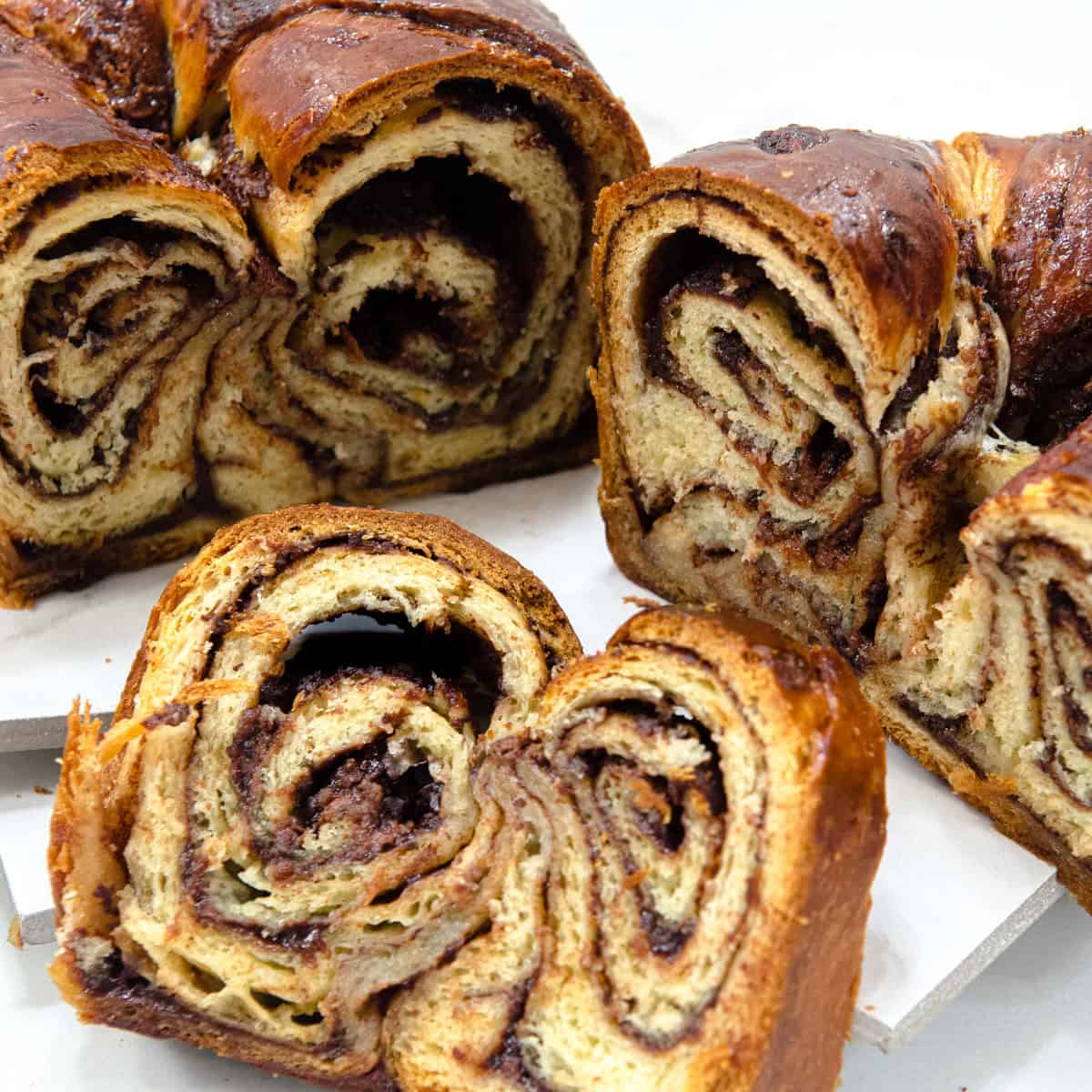
My Chocolate Babka Recipe with its nutella filling is a visually stunning sweet bread that has a couple of tips to help you shape this marvelous swirlly filled yeast dough.
Servings: 10 servings
Calories: 426kcal
Equipment
- 9 x 5" loaf pan
Ingredients
Yeast Dough
- 2 1/4 teaspoon active dry yeast
- 2 tablespoons water
- 1/3 cup milk, whole or 2%
- 1/4 cup granulated sugar (50 grams)
- 1/2 teaspoon table salt
- 1/2 cup unsalted butter (114 grams or 1 stick)
- 1 large egg
- 1 large egg yolk
- 1/2 teaspoon vanilla
- 2 1/2 cups bread flour (350 grams)
Filling and Finishing
- 1 cup + 2 tablespoons Nutella (320 grams)
- 1 large egg yolk
- 1 tablespoon cream
- 1/2 cup water
- 1/2 cup granulated sugar (100 grams)
Instructions
Yeast Dough
- Dissolve the yeast in the water. Set aside.
- Heat the milk to simmering. Remove from the heat and add the sugar, butter and salt. Stir to dissolve and cool to lukewarm.
- Transfer to a mixing bowl and add the egg, egg yolk and vanilla. Fit the mixer with a dough hook. Add half the flour and beat until smooth. Add the remaining flour and again, beat until smooth. Knead in the machine for 3 minutes, turning it half way through. It will be a very soft dough.
- Take a small piece of dough and stretch it between your fingers. If you can see through it, it's fine. If it doesn't or if it breaks, knead it for another minute or two in the machine. Test it until you can see through it. (See the photo in the Step by Step instructions). This is referred to as the windowpane test and should be used on yeast doughs to determine the strength of the gluten.
- Spray a container at least twice the size of the dough with a non-stick baking release. Remove the dough from the mixer and place in the container turning it over so the top will be greased also. Cover with a piece of plastic wrap and allow to rise until doubled - about 1 1/2 hours.
- If the room is really cool, place the container in the oven with the light on. Do not turn the oven on. The light will provide enough heat to make a proofer. Check the temperature after about an hour. Make sure it isn't over about 90°F. If it is, place a wooden spoon in the door to keep it ajar about 1/2" to moderate the temperature. This works with any yeast dough.
- Deflate, cover again and refrigerate overnight or up to 3 days.
Filling, Shaping and Finishing
- Spray a 9" x 5" loaf pan with a non-stick baking release. Set aside.
- Roll the dough into an 18" x 24" rectangle. Turn the dough so the 18" side is in front of you. If at any point the dough softens too much and is difficult to work, place it on a baking sheet (fold it to fit) and place it in the fridge or freezer to firm it up. Unfold, smooth out any wrinkles and continue.
- Reserving 2 tablespoons of nutella, spread the remainder (1 cup) over the dough to within 1/2" of all the edges. Roll up tightly to within the last inch. Lightly wet the edge of the dough and finish rolling. Pinch the seam and ends together.
- Taking one end of the roll in each hand, twist in opposite directions. Twist as hard as you can or several times to maximize the twists.
- Spread the last 2 tablespoons of nutella on half the twisted roll. Fold the plain twist on top of the nutella and press down. Twist it again as much as you can.
- Place it in the the prepared pan and press down to flatten. Cover and let rise until doubled.
- Preheat the oven to 350°F.
- While the oven is preheating, combine the egg yolk and cream. Just before putting the babka in the oven, brush it with the egg wash. Let it sit for 5 minutes and brush again to give it that really deep, shiny finish when baked.
- Bake for 45 to 55 minutes until dark brown and a tester comes out clean and the babka sounds hollow when tapped.
- While the babka is baking, combine the 1/2 cup water and 1/2 cup granulated sugar in a small saucepan. Bring to a boil and boil for 1 minute. Remove from the heat and cool.
- When the babka is baked, immediately poke holes all over the cake with a cake tester. Spoon the simple syrup evenly over the babka. Cool for about 30 minutes and then turn it out if all of the syrup has been absorebed onto a cooling rack to cool completely.
- Slice and serve. The babka will keep covered for a couple of days at room temperature. For longer storage, freeze, wrap well and keep frozen for several months. Thaw at room temperature. To freshen, wrap in foil, leaving a small opening at the top. Place in a preheated 350°F oven for about 20 minutes until warmed through.
Notes
There is always an abundance of photos to guide you in the post above. If you have questions, look at the photos or read the header of the article. Many of them will be answered there.
As always, I recommend using a scale for accuracy and consistency. Flour, in particular, is difficult to measure by volume. For my recipes, I use 140 grams per cup of unsifted all-purpose, bread or whole wheat flour and 125 grams of cake flour. Others may use different weights so use whatever they suggest.
Unless otherwise noted, salt refers to table salt.
Nutrition information provided is an estimate and will vary based on cooking methods and brands of ingredients used.
_____________________________________________________
The butter, eggs and sugar in the dough are referred to as a rich dough as opposed to lean doughs that refer to breads which contain flour, water,salt and yeast.
Refrigerating this dough allows the gluten to rest as well as firm up the dough with it's high butter content making it really easy to roll out with no spring back.
Rolling the dough up tightly and then twisting it as much as possible makes the swirly inside that is indicative of babka.
If at any point the dough becomes too soft to work, simply put it on a parchment lined baking sheet and refrigerate or freeze briefly to firm it up again.
I prefer to cover my dough when rising with a tea towel and not plastic wrap. If the item rises above the rim of the pan, the plastic wrap can inhibit any further rise if it is too tightly bound to the pan.
To make a proofer f the room is really cool, place the container in the oven with the light on. Do not turn the oven on. The light will provide enough heat to make a proofer. Check the temperature after about an hour. Make sure it isn't over about 90°F. If it is, place a wooden spoon in the door to keep it ajar about 1/2" to moderate the temperature. This works with any yeast dough.
Do not store this in the refrigerator. Refrigeration drys out breads.
Nutrition
Serving: 10servings | Calories: 426kcal | Carbohydrates: 55g | Protein: 7g | Fat: 20g | Saturated Fat: 14g | Polyunsaturated Fat: 1g | Monounsaturated Fat: 3g | Trans Fat: 0.4g | Cholesterol: 82mg | Sodium: 143mg | Potassium: 174mg | Fiber: 2g | Sugar: 30g | Vitamin A: 396IU | Vitamin C: 0.01mg | Calcium: 55mg | Iron: 2mg
