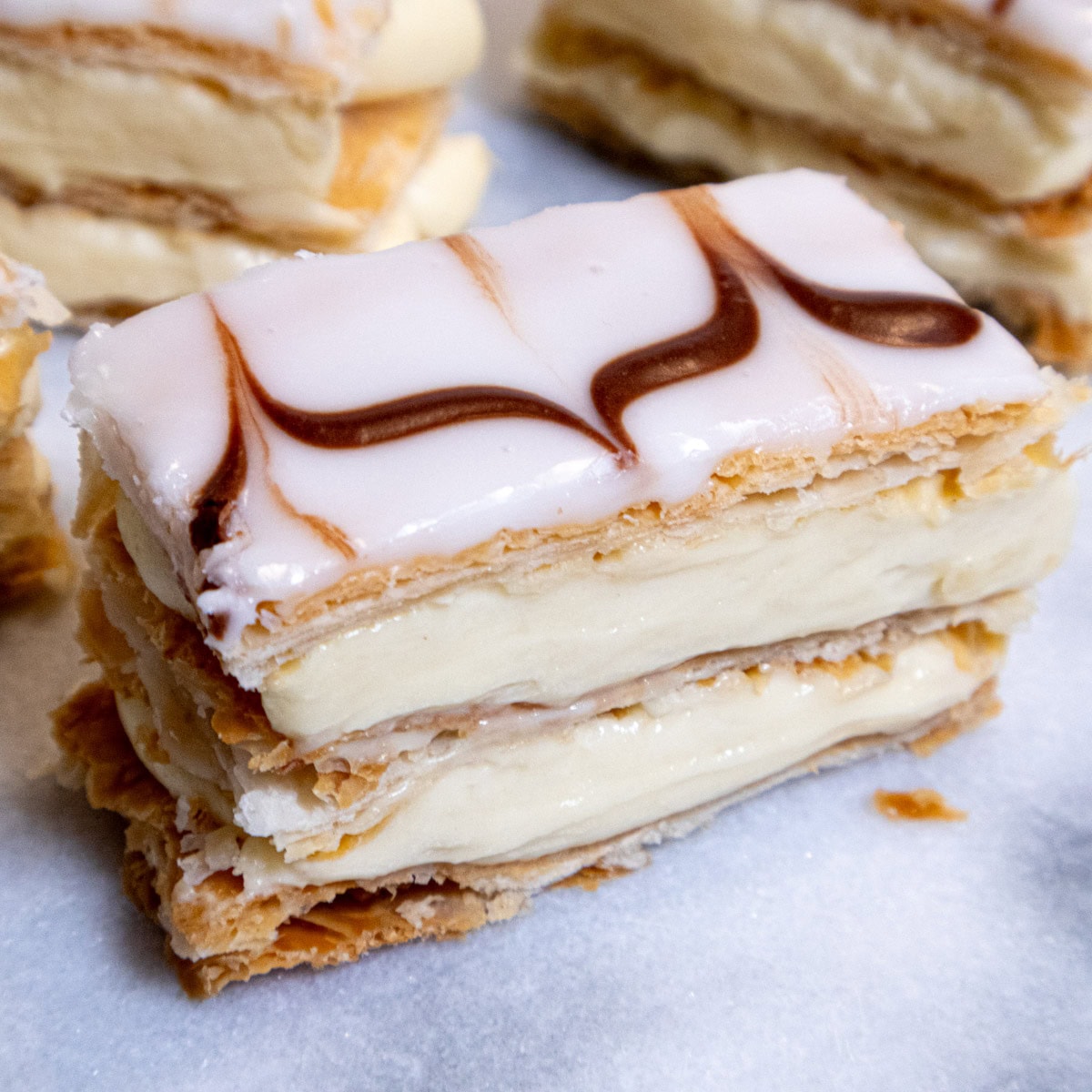
Mille-Feuille (Napoleon Pastry)
While Mille-Feuille (Napoleon Pastry) may look daunting, you absolutely can do this. To make things easier I use an all butter purchased puff pastry which makes everything go much easier and faster.
Servings: 9 servings
Calories: 207kcal
Equipment
- 2 Jelly Roll Pans (10x15) or 2 half sheet pans
Ingredients
Pastry Cream
- t teaspoon unflavored gelatin
- 1 tablespoon cold water
- 1 1/3 cups milk
- 4 large egg yolks
- 1/2 cup granulated sugar (100 grams)
- 3 tablespoons all-purpose flour
- 1 teaspoon vanilla
- 1/2 cup heavy cream
Mille-Feuille (Napoleon Pastry)
- 1 14 ounce package Dufour All-Butter Puff Pastry
Mock Fondant
- 1 cup powdered sugar (130 grams)
- 3 to 4 tablespoons milk
- 1 tablespoon corn syrup
- 1 tablespoon cocoa
Instructions
Pastry Cream
- Before you start, I encourage you to look at the photos in the post which serve as a guide to make this extraordinary pastry.
- In a very small bowl, add the gelatin to the water, stirring to combine. Set aside.
- In a small saucepan, heat the milk until very hot but not boiling.
- In a medium size bowl, whisk the egg yolks and sugar together. Whisk in the flour followed by the hot milk. Pour the mixture through a fine mesh strainer into a saucepan.
- Place over medium heat and, stirring continuously, bring it to a boil. Cook for 1 minutes, still stirring.
- Remove from the heat, tear the gelatin into pieces and add to the pastry cream along with the vanilla. There is no need to liquify them as the hot pastry cream will melt them. Stir them in after they have melted.
- Transfer to a storage container, cover the top with plastic wrap, poke a few holes in it and let it come to room temperature. Place a lid on the container. Store in the refrigerator for 3 or 4 days or freeze for several months. Thaw in the refrigerator overnight to use.
Diplomat Cream or Lightened Pastry Cream
- To make the Diplomat Cream or Lightened Pastry Cream, beat the 1/2 cup cream until stiff peaks form.
- Remove the pastry cream from the fridge and break it up with a whisk. It will be very firm and that is how it should be. Whisk until smooth. Fold in the whipped cream. This can be made ahead of time and stored in the refrigerator for a day or two before using.
Mille-Feuille (Napoleon Pastry)
- I encourage you to see the photos above to clarify these instructions as they are different from most.
- Thaw the puff pastry as directed. Dufour recommends 3 hours in the refrigerator and it's ready. I usually thaw mine overnight but that can make it softer so care needs to be taken to unwrap it, remove the paper and flatten it out.
- On a lightly floured surface, roll the pastry into a an 11x14 inch rectangle.
- Turn the jelly roll pan upside down and place the puff pastry on it. It should overhang the pan on every side. Alternatively, use two half sheet pans, placing the pastry rolled as called for in the pan. Continue as directed.
- Dock the pastry about every inch or so with the tines of a fork. This is important to prevent it from rising excessively. Freeze till rock hard. Place the pan inside of a half sheet pan to easily move it in and out of the oven.
- Place the oven rack on the lowest rung. Preheat the oven to 400°F.
- Place a piece of parchment paper on top of the frozen pastry and place another jelly roll pan on top of the paper to weight the dough down.
- Bake for 10 minutes. Remove the top pan and paper and continue baking for about 15 minutes more until golden brown and baked through.
- Remove from the oven and very carefully, turn the jelly roll pan right side up. If the pastry has not baked through, return it to the oven for about 5 more minutes until golden brown.
- Cool completely. When cool, trim the overhanging pastry so you have a flat piece of pastry. Cut it lengthwise into equal parts - about 3 inches each.
- Place one piece on a cooling rack either in a half sheet pan or over a piece of parchment paper or waxed paper.
Finishing and Assembly
- Combine the ingredients for the mock fondant starting with the powdered sugar, corn syrup and 2 tablespoons of milk. Stir with a spoon (don't use a whisk as it incorporates too many air bubbles) until very thick but pourable. Add additonal milk, a bit at a time to thin it out if necesssary.
- Reserve about 1/4 cup of the fondant. Spread the remainder evenly on top of the strip of pastry.
- Immediately, add the cocoa to the reserved fondant, thinning it with additional milk about 1/2 teaspoon at a time. It should be of piping consistency.
- Fit a pastry bag with a medium size writing tip and pipe straight lines across the fondant topped pastry strip. With a toothpick, draw a straight line DOWN the side of the pastry. Move over about 1/12 inches and draw a line straight UP the side of the pastry. Continue across the strip. This forms the traditional chevron design. Let the pastry dry for 20 to 30 minutes.
- Remove the Diplomat cream from the fridge and place it in a pastry bag fitted with a 1/2 inch plain tip.
- Pipe half the pastry cream as shown in the photo to cover each of the 2 remaining strips of pastry. Place one of the pastry cream topped strips on top of the other and place the fondant covered one on top.
- At this point, there are several options. Refrigerate for a few hours until serving. This will keep the puff pastry crisp. Refrigerate overnight or up to several days but the puff pastry will soften somewhat. The third option is to freeze the assembled pastry but covering the top with plastic wrap directly on top of the fondant. Freeze. Wrap the sides in foil and freeze for a month. Remove the foil but leave the plastic wrap on top. Thaw in the fridge overnight. Remove the plastic wrap to cut. If the fondant has been dried sufficiently, it won't be damaged at all.
- To cut: Use a serrated knife and cut through each layer of the puff pastry with a sawing motion. Do not cut straight down or the filling can squish out the sides. It is actually easiest to cut this partially frozen. I usually cut the pieces about 1 1/2" wide.
- Be aware that when the mille-feuille is cut with a fork, the filling will squish out because it's very soft and the layers of puff pastry are firm. But I can guarantee after one bit, no one will care.
Notes
There is always an abundance of photos to guide you in the post above. If you have questions, look at the photos or read the header of the article. Many of them will be answered there.
As always, I recommend using a scale for accuracy and consistency. Flour, in particular, is difficult to measure by volume. For my recipes, I use 140 grams per cup of unsifted all-purpose, bread or whole wheat flour and 125 grams of cake flour. Others may use different weights so use whatever they suggest.
_____________________________________________
For the best results, roll the pastry to the correct size. It will be thin but that is as it should be.
Keep the pastry chilled to work with it. Freeze it hard before baking.
Some recipes add pie weights to the pan weighing down the pastry. I don't find that necessary, especially with purchased all butter puff pastry.
Be sure to flip the pastry over after the initial baking to make sure the underside is baked. If not, return it to the oven for 5 to 10 minutes to bake it.
if the pastry is refrigerated for several days the pastry will loose some of its crispness but it will still be very good.
Freezing and thawing seems to retain the crispness.
The pastry cream will be very stiff after it has been chilled. That is how it should be.
While I often recommend using McCormicks Imitation Vanilla for some recipes, this is one recipe where I recommend pure vanilla. If you have Tahitian vanilla, it lends an exquistite flavor to the pastry cream.
All Butter Puff pastry is a must for this recipe. Those using other shortenings are not comparible.
The Mock fondant is a thick powdered sugar glaze that is made with milk and a bit of corn syrup, both of which ensure a shiny finish that will not turn dull as will water. It is the traditional finish to Mille-Feuille and easy to make. The chocolate chevron design is made by adding cocoa to a small amount of the mock fondant.
Nutrition
Serving: 9servings | Calories: 207kcal | Carbohydrates: 31g | Protein: 3g | Fat: 8g | Saturated Fat: 5g | Polyunsaturated Fat: 1g | Monounsaturated Fat: 2g | Cholesterol: 101mg | Sodium: 25mg | Potassium: 95mg | Fiber: 0.3g | Sugar: 28g | Vitamin A: 370IU | Vitamin C: 0.1mg | Calcium: 71mg | Iron: 0.4mg
