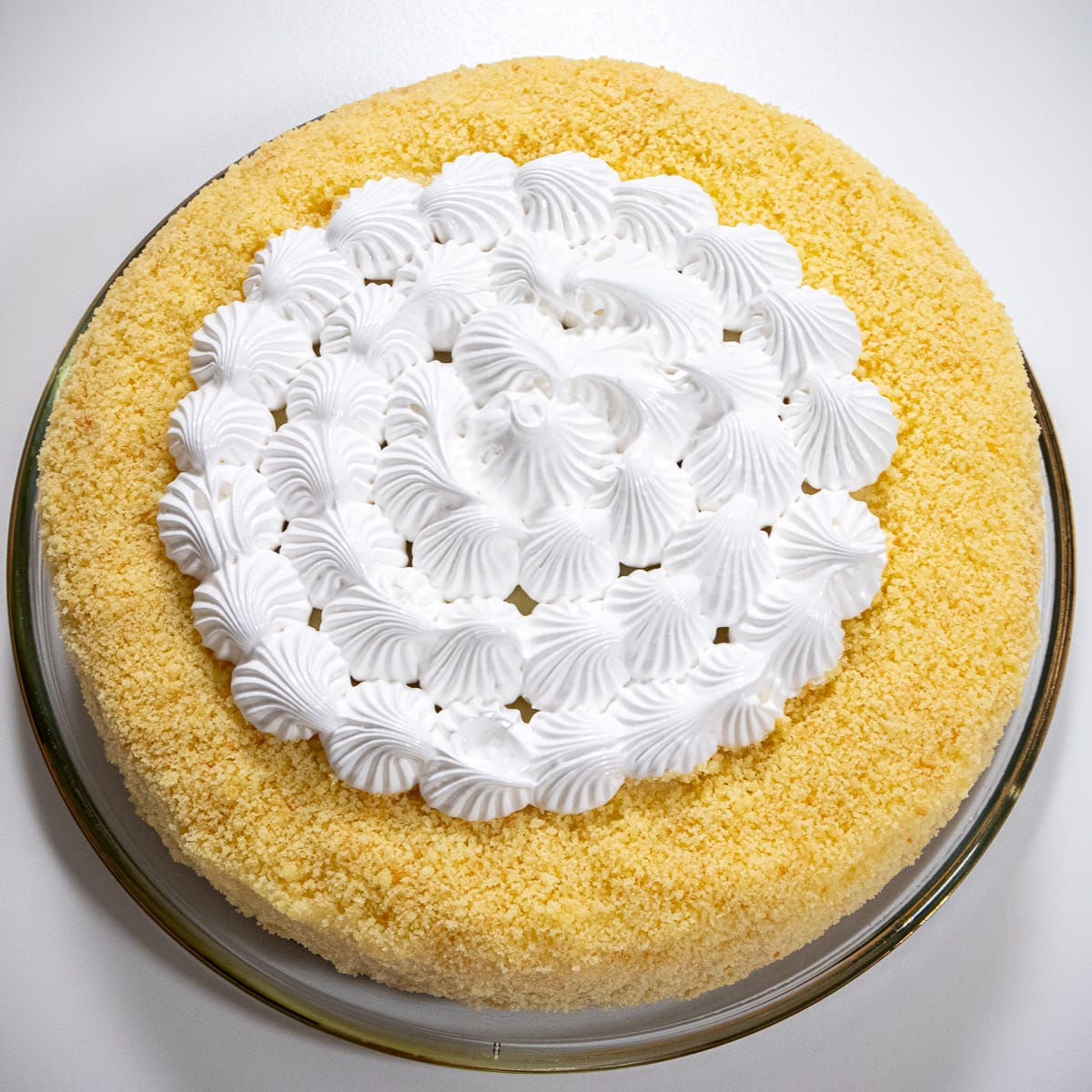
Triple Lemon Cake
A show stopper of a dessert, this easy Triple Lemon Cake has make ahead component parts to be assembled when needed.
Servings: 12 servings
Calories: 346kcal
Equipment
- 9x3 cheesecake or springform pan
Ingredients
Genoise Cake
- 6 eggs, room temperature
- 3/4 cup granulated sugar (150 grams or 5 1/3 ounces)
- Zest from 1 large lemon
- 1 1/4 cups cake flour (155 grams)
- 1/4 cup unsalted butter (60 grams, or 1/2 stick)
Lemon Filling
- 2/3 cup water
- 2/3 cup granulated sugar (130 grams)
- 3 large eggs, separated
- 3 tablespoons cornstarch (25 grams)
- 1/4 cup lemon juice
- 1 teaspoon lemon zest
- 1/4 teaspoon salt
- 2 tablespoons butter (30 grams)
Lemon Soaking Syrup
- 1/2 cup lemon juice
- 1 cup sugar (200 grams)
Swiss Meringue
- 2 egg whites from above
- 1/2 cup sugar (100 grams)
Instructions
Genoise
- Preheat the oven to 350°F. Line the bottom of a 9x3” cheesecake or springform pan with parchment.
- Spray the middle of the paper only. Do not spray the sides. Set aside.
- Melt the butter and set aside to cool.
- Add the eggs, sugar and lemon zest to the mixing bowl. Beat until very, very thick , almost white and the mixture falls in ribbons from the beater.
- Sift half the flour over the egg mixture and fold in about 3/4 of the way. Repeat with the remainder of the flour.
- Add about 1 cup of the batter to the melted butter. Whisk vigorously to form an emulsion.
- Pour the emulsion back into the main batter and fold in.
- Pour the batter into the prepared pan, smoothing as necessary.
- Bake for about 23 to 28 minutes until a tester comes out cleanly and the cake bounces back when lightly touched in the middle.
- Cool completely in the pan.
- To release, go around the inside edge with a small, flexible metal spatula. Make sure the spatula stays to the side of the pan and not the side of the cake.
- Remove the side. Turn the cake upside down, remove the bottom and the parchment paper.
- Turn right side up. If not using immediately, freeze the cake, wrap it well and then freeze for several months. Partially thaw at room temperature to use.
Lemon Topping
- In a medium saucepan, whisk together the water, sugar, egg yolks, cornstarch, lemon juice, lemon zest and salt.
- Place over medium heat and, whisking constantly, bring the mixture to a boil. Boil for one minute. It will be very, very thick. Remove from the heat.
- Add the butter and allow to melt. Whisk into the mixture. Remove to a bowl
- Cover the topping with plastic wrap and chill, preferably overnight.
Lemon Soaking Syrup
- Combine the ingredients in a small pan and bring to a boil. Set aside.
Triple Lemon Cake Assembly
- If the genoise layer has been frozen, thaw it at room temperature until it is partially thawed but still firm. This will make it easier to cut.
- Slice about 1/8” off the top of the cake.
- Place in the processor. Pulse to make crumbs. Set aside.
- Put the cake back on the metal round from the cheesecake or springform pan.
- Brush the soaking syrup on the cake, allowing each pass to soak in before adding more. Use all the syrup.
- Break up the topping with a spatula. Aggressively whisk it until smooth.
- Apply a thin layer to the sides of the cake, making sure all of it is covered. Spread the remainder on top of the cake.
- Place the cake crumbs in a sheet pan. Pick the cake up in your left or right hand whichever is your preference. Scoop up some of the crumbs and press them lightly into the lemon. Secure the crumbs by pressing them into the topping on the side of the cake gently.
- Drop the remainder of the crumbs about an inch in from the edge of the cake.
Meringue
- Place the whites and sugar in a mixing bowl. Put the bowl over a pan of simmering water.
- Heat to about 130°F.
- Remove from over the water and place on the mixer fitted with a whisk attachment.
- Beat until very stiff and glossy.
- Place in a piping bag fitted with a large open star (#8 or 9 B tip) and pipe the meringue onto the lemon filling starting at the edge of the crumbs and topping and work towards the center. I simply piped straight down and immediately piped again.
- Alternatively, the meringue can be spooned on.
- Fill in completely to cover the topping so it can’t crust over.
- Refrigerate. Serve at room temperature.
Notes
There is always an abundance of photos to guide you in the post above. If you have questions, look at the photos or read the header of the article. Many of them will be answered there.
As always, I recommend using a scale for accuracy and consistency. Flour, in particular, is difficult to measure by volume. For my recipes, I use 140 grams per cup of unsifted all-purpose, bread or whole wheat flour and 125 grams of cake flour. Others may use different weights so use whatever they suggest.
____________________________________________
This Triple Lemon Cake is definitely best served at room temperature. The meringue top will cut better if it has been refrigerated overnight. Heat a knife under really hot water, dry it quickly and make a cut, letting the knife sink through the meringue, then cutting down through the cake. Repeat for each cut.
Folding the ingredients is extremely important when a recipe is leavened only by air. If the air is knocked out, the cake will be dense and dry. To fold, add the required amount of flour to the beaten egg mixture and gently plunge a rubber spatula to the bottom of the bowl. Scoop up some of the egg mixture and bring it to the top of the bowl turning it over the flour. Turn the bowl about an 1/8 of a turn and repeat until about 3/4 of the flour is incorporated. Add the remainder of the flour and repeat very gently but quickly folding all of the flour in. Continue as in the directions.
I've noticed lately with the egg shortage, that some of the cartons have more smaller eggs than usual. If you ever have to use a different size egg, they can be easily weighed when separating. The yolk weighs 17 grams in a large egg and the white 32 grams which equals 49 grams for the egg. The remainder is the shell. We weighed all of our eggs at the bakery to ensure the correct amount.
Baker's sugar is key to dissolving quickly and thoroughly when beating either creaming or beating with egg whites. It can be used cup for cup (200 grams in a cup) anywhere you need granulated sugar. I have seen it in the grocery store but it is much less expensive to make it yourself by processing granulated sugar it in small batches.
The cake will keep 3 days or so in the refrigerator but will cut best the next day.
Nutrition
Serving: 12servings | Calories: 346kcal | Carbohydrates: 61g | Protein: 6g | Fat: 9g | Saturated Fat: 5g | Polyunsaturated Fat: 1g | Monounsaturated Fat: 3g | Trans Fat: 0.2g | Cholesterol: 138mg | Sodium: 121mg | Potassium: 85mg | Fiber: 0.4g | Sugar: 49g | Vitamin A: 356IU | Vitamin C: 6mg | Calcium: 25mg | Iron: 1mg
