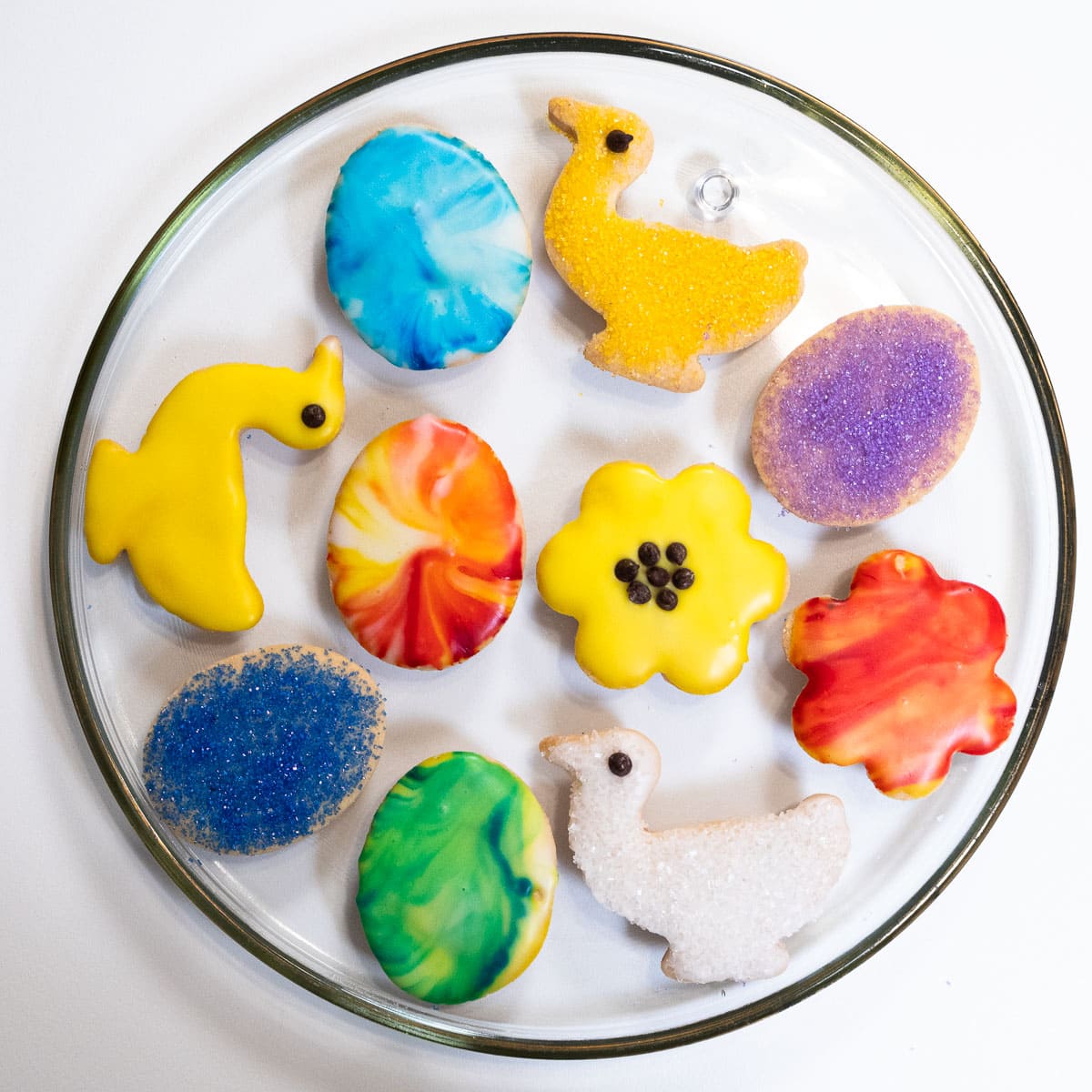
Easy Decorated Shortbread Cookies
I used two techniques - the first is painted cookies, either solid colors or the very simple swirly, marbelized ones. The second is even easier since you simply cover the unbaked cookie with colored sugar and bake. That's it.
Servings: 36 cookies
Calories: 111kcal
Ingredients
Easy Shortbread Cookies
- 1 cup unsalted butter, European preferred (225 grams)
- 2 1/4 cups all purpose flour (315 grams)
- 1/2 cup granulated sugar (100 grams)
Painted Cookie Glaze
- 2 cups powdered sugar (260 grams)
- 1/4 cup lemon juice or water
- 1 teaspoon almond or vanilla extract if not using lemon juice
Instructions
Easy Shortbread Cookies
- If using a processor, butter needs to be cold. If using a mixer, butter needs to be softened. Preheat the oven to 350°F. Line baking sheets with parchment paper and set aside.
Processor Method
- The cold butter needs to be cut into small pieces. Add the flour to the bowl of a processor. Pulse several times to sift. Place the cold, cut up butter in a circle on top of the flour. Process until the butter is indistinguishable. Add the sugar and process until it comes together. It will not form a ball.
- It will take some time for the dough to come together. Redistribute the dough in the processor several times to help it along. Using long pulses will help with the mixing. It will form large crumbs that should be poured onto the work surface and kneaded together.
Mixer Method
- For this method, the butter needs to be softened. Combine the butter with the sugar in the bowl of a mixer. Beat until light. Add the flour all at once and beat until it comes together to form a solid mass.
Cutting the Cookies
- Divide the dough in half. Roll half of it between wax paper to a thickness of 1/4 to 1/3 inch. See the post on the Cut Out Cookies Using the Wax Paper Technique for the easiest way. Repeat for the second half.
- Cut the cookies into the desired shapes. Leaving them on the wax paper, place them in the freezer until hard. Pop them out or use a spatula to remove them to the parchment lined baking sheets. Freeze or refrigerate
- Bake 12 to 15 minutes depending upon the thickness of the cookies until lightly browned. Cool completely before decorating.
Painted Cookie Technique
- Make sure the glaze is colored in a bowl just large enough for the largest cookie and your fingers. You do not want the glaze spread out into a large bowl.
- Divide the glaze into different bowls. Cover with a wet towel to prevent it from skinning over. Start a new bowl whenever the current one becomes too murky.
- Dots of color are added around the perimeter of the bowl and in the middle however you wish. Swirl in a few colors and add more if desired. With a bamboo skewer or toothpick, swirl the colors around in a marbleized fashion.
- Holding a cookie upside down by the edges of your fingers, dip it into the glaze making sure the entire top is covered. Allow the glaze to drip back into the bowl. It can drip to one side of the bowl to keep the paint undiluted as long as possible.
- Place the cookie on parchment to dry which can take up to a day if it is humid.
- After dipping some cookies, more or different colors may be added and swirled in to freshen the paint.
- Dry the cookies completely, making sure they are not just dry to the touch and still wet underneath. After drying, drips down the sides can be scraped off with a sharp knife. Store in an airtight tin with paper between the layers.
Sugared Cookies
- Prior to baking, heavily cover the cookies with colored sugar and lightly pat into place. Bake as above.
- The number of cookies will depend upon the cutters you use and the thickness of the cookies.
Notes
There is always an abundance of photos to guide you in the post above.
As always, I recommend using a scale for accuracy and consistency. Flour, in particular, is difficult to measure by volume. For my recipes, I use 140 grams per cup of unsifted all-purpose, bread or whole wheat flour and 125 grams of cake flour. Others may use different weights so use whatever they suggest. ___________________________________________________________
-
- The cookies can be cut out and frozen for months before baking. They can also be baked and held, unpainted in an airtight container for days before decorating.
-
- Unsalted European style butter has a higher fat content than American butter and as such, imparts a deeper butter flavor into the cookies. I use this butter whenever I made a butter heavy cookie.
-
- Wax paper and freezing the cookies are key to a cookie with clean edges that won't lose their shape. Just cut out the cookies, leave them on the wax paper, place them on a cookie sheet and freeze until hard. Then just pop them out or remove them with a pancake turner and place them on a parchment lined baking sheet.
-
- Lemon juice, water or liqueur makes a somewhat harder glaze than does milk.
-
- Always us gel colors to impart brighter colors and reduce the amount of liquid added to the glaze. It's necessary to use more liquid coloring to obtain the same bright colors than it is to use gel colors.
-
- When swirling the colors for the painted cookies, start with 3 different colors and do not swirl too much in the beginning. Additional colors can be added as you go along. However, at some point, the glaze will become murky looking. At that point start over.
-
- The glaze can be broken down into smaller bowls to use when it is no longer useable. Just cover them with wet towels so they don't skin over. We did this at the bakery when we had hundreds of cookies to glaze.
-
- Be sure to let the painted cookies dry completely before storing them. The tops may appear dry but they can still be wet underneath. The glaze will usually wrinkle up when picked up and shaken a little if wet underneath.
-
- If you have children or grandchildren around let them help. This is a great family project. Just be ready for a bit of a mess that is easily cleaned up.
Nutrition
Serving: 36cookies | Calories: 111kcal | Carbohydrates: 16g | Protein: 1g | Fat: 5g | Saturated Fat: 3g | Polyunsaturated Fat: 0.2g | Monounsaturated Fat: 1g | Trans Fat: 0.2g | Cholesterol: 14mg | Sodium: 1mg | Potassium: 12mg | Fiber: 0.2g | Sugar: 9g | Vitamin A: 158IU | Vitamin C: 1mg | Calcium: 3mg | Iron: 0.4mg
