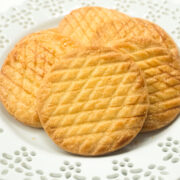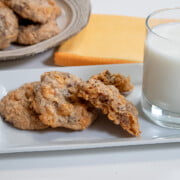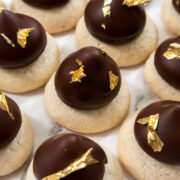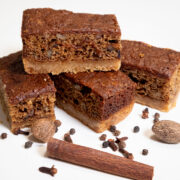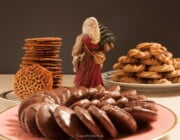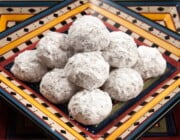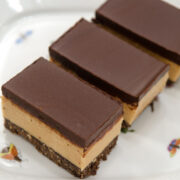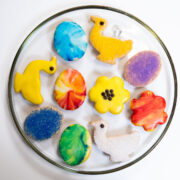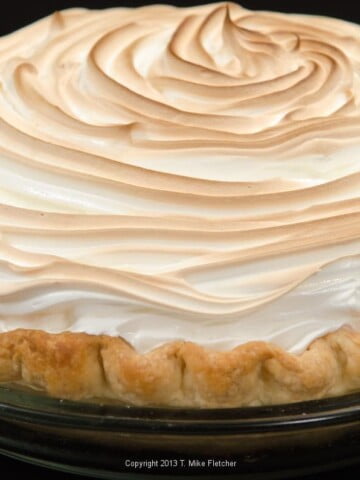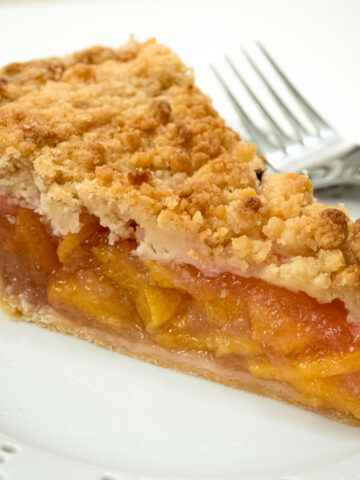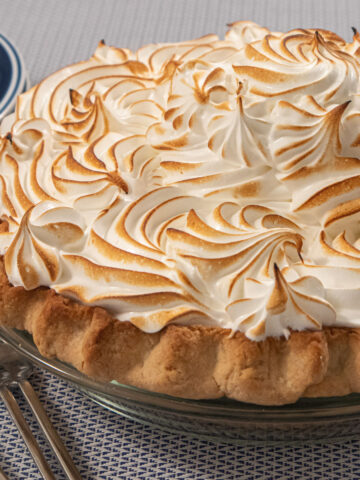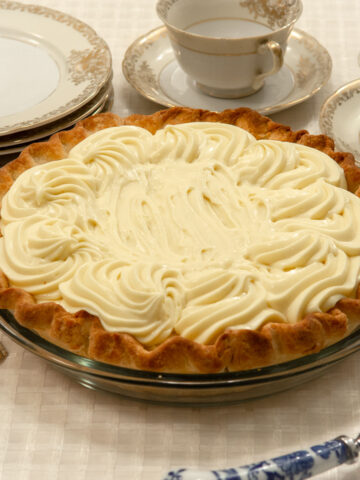


Happy Thanksgiving to all. I have much to be thankful for including the fact you are here. Have a wonderful day.
Modified: · Published: by Helen S Fletcher · This post may contain affiliate links · 6 Comments


Happy Thanksgiving to all. I have much to be thankful for including the fact you are here. Have a wonderful day.
Modified: · Published: by Helen S Fletcher · This post may contain affiliate links · 2 Comments
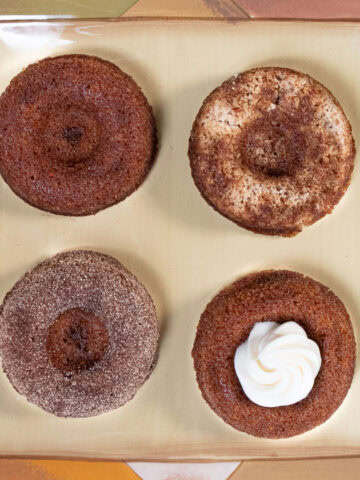
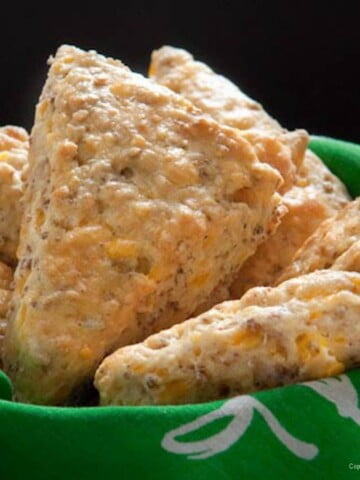
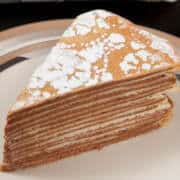
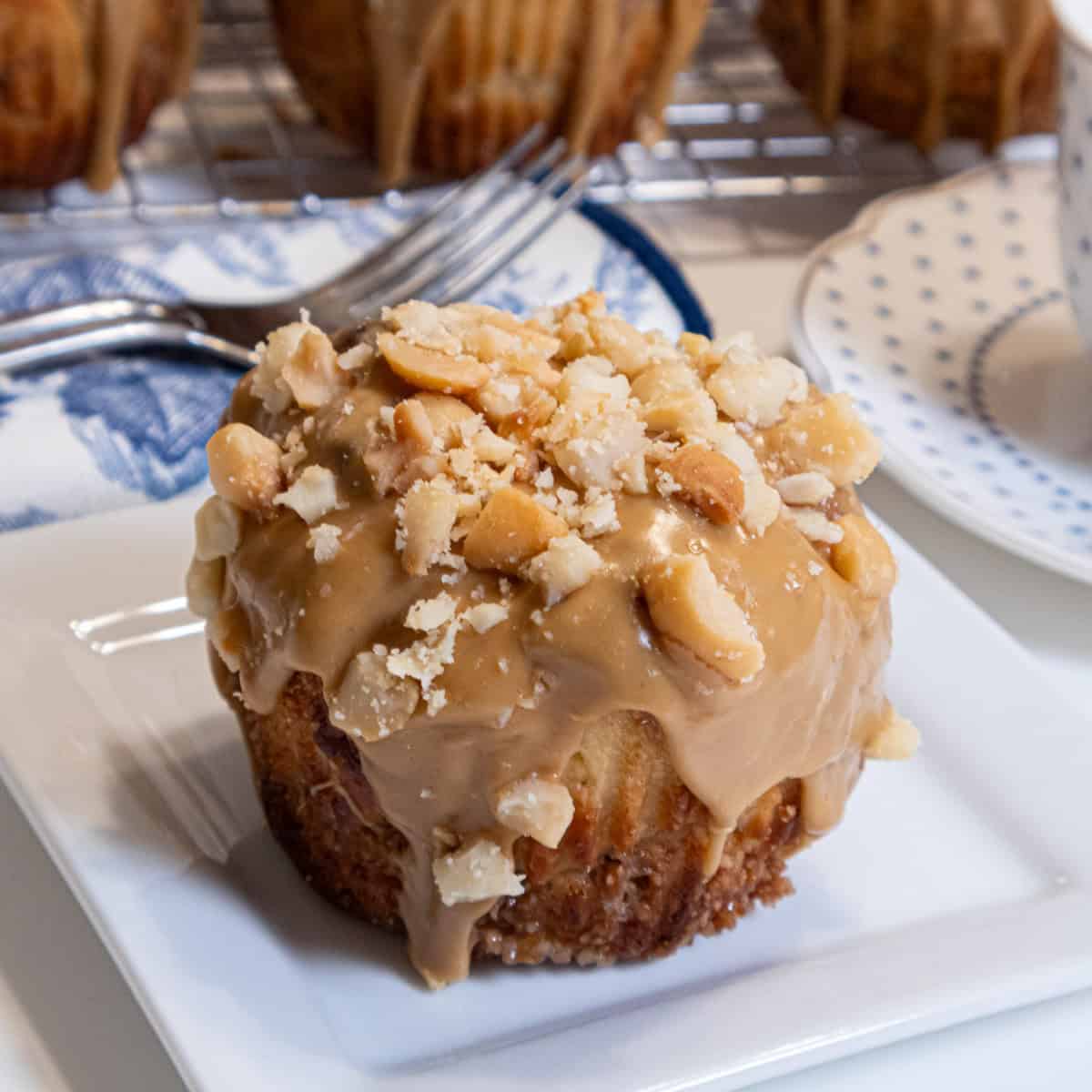
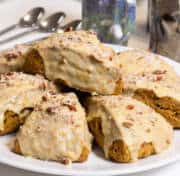
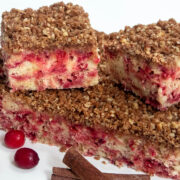
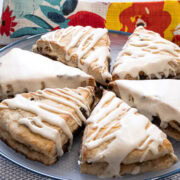
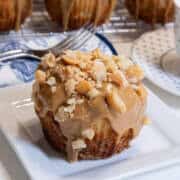
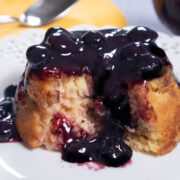
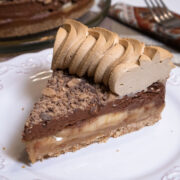
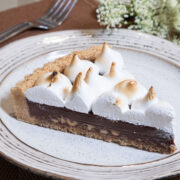
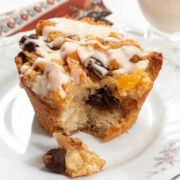
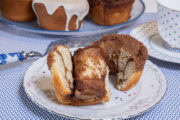
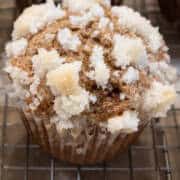
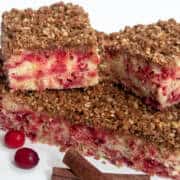
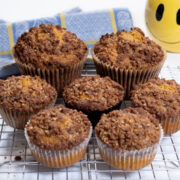
Keep everyone happy and out of the kitchen with these delightful breakfast and brunch treats. These muffins, scones, and coffee cakes can be made ahead, filling your home with wonderful aromas as the turkey roasts.


For more Thanksgiving inspiration, don't miss these: Thanksgiving Pie and Tart Perfection, A Thanksgiving Roundup, Thanksgiving Recipes from Breakfast to Dessert
Modified: · Published: by Helen S Fletcher · This post may contain affiliate links · 22 Comments
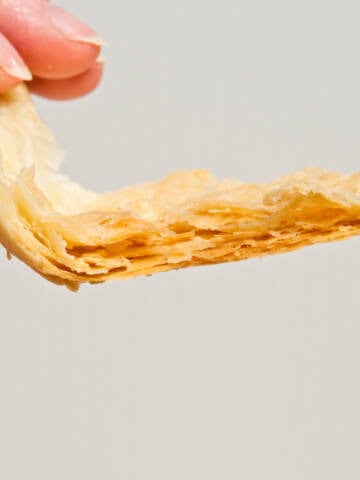
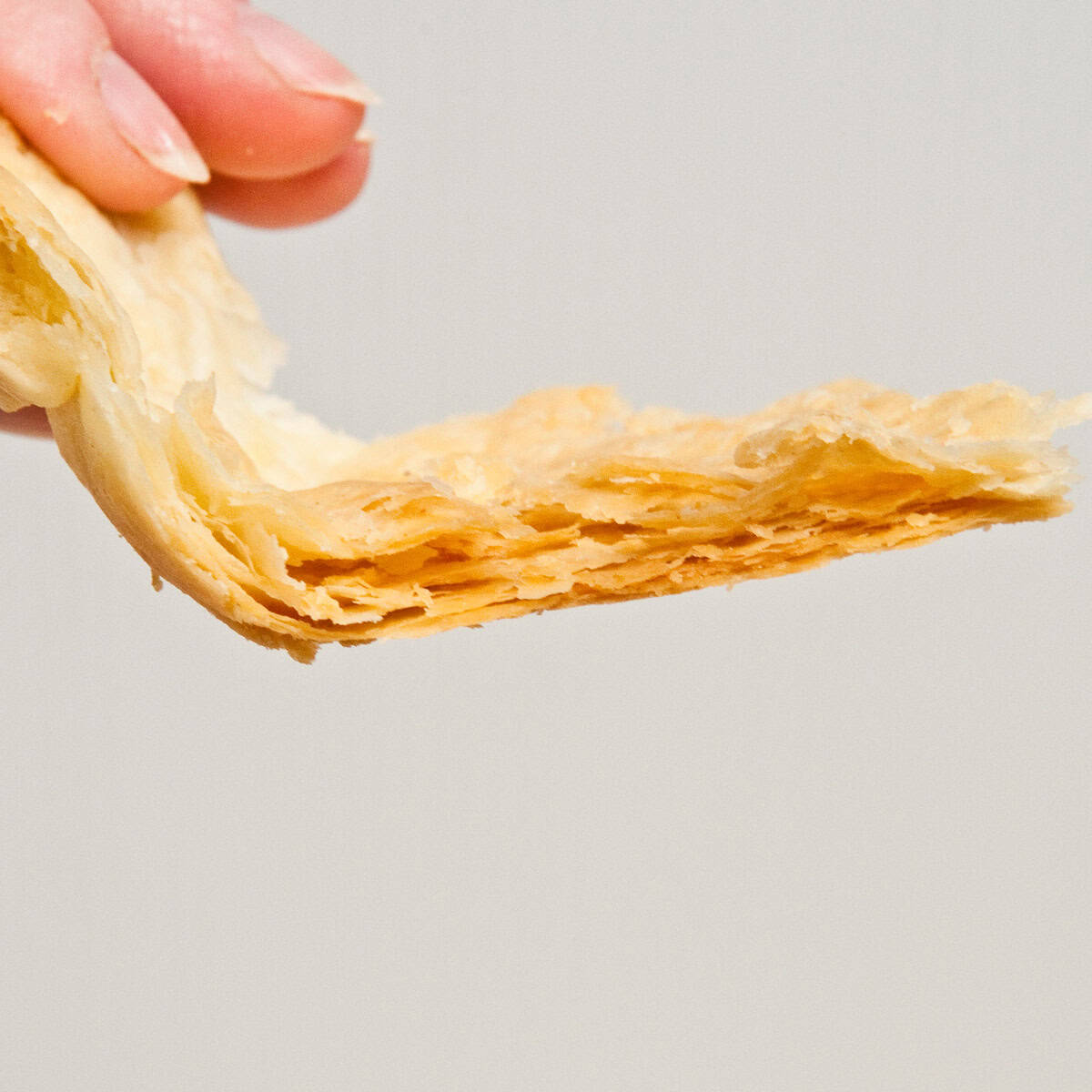
This American Pie Crust From Scratch Tutorial is for beginners as well as seasoned bakers. Many a great cook or baker is still intimidated by a pie crust. Trying to wrangle a few ingredients into a flaky crust that will bake beautifully without sliding down the pan or hold a juicy filling without getting soggy is a challenge and with good reason.
Follow along in this deep, deep dive into how to make a pie crust from scratch that lets you master this most important element in baking with lots of step by step photos to guide you. But be ready, this challenges many of the most popular recipes but it works!

Several years ago, Midwest Living magazine asked me to provide a “no fail pie crust”. The results elicited this comment from the food editor: “We share a test kitchen with Better Homes and Gardens, Traditional Home, Successful Farming, Diabetic Living and more. The staff is educated in food science or through a culinary school. We used your crust for all the pies and they were blown away with the recipe. Not only does it taste great, it was easy to work with. You became a sensation! One of the staffers refuses to make any other crust at home and she’s been on staff for almost 20 years. I hope you feel the love!” I think you will too after making this melt in your mouth crust.
For More information on how i devised this pie crust please see my white paper
Many elements go into a pie crust and an understanding of how they work will help allay any misgivings you have. First of all, let’s talk about flour. The type of flour used will determine, almost completely, the outcome of the crust due to the protein count of the gluten. In making pastry dough, the fat is cut into the flour so that the two proteins in flour, which make up the gluten, cannot come together to link up and form a chain or strand. On the other hand, bread dough is worked vigorously by kneading in order to link the two proteins to form a chain. Whereas the elasticity gained by working the dough is desirable in bread, it is not in pastry, which is why pastry dough is handled and worked as little and as quickly as possible with a lower protein flour.
Bread flour has the highest percentage of gluten followed, in descending order, by all- purpose flour, pastry flour and cake flour which has the very least. It would seem reasonable that if the lowest amount of protein is desired then cake flour would be the choice. Using all cake flour does make a very tender crust, however it is rather mealy and without good texture.
Because pastry flour is not commonly available to the consumer, many recipes combine two thirds all-purpose flour with ⅓ cake flour. While this yields a better crust, reversing it and using a larger amount of cake flour with just a little all-purpose yields the requisite tenderness and flakiness without sacrificing the crispness, texture or strength. In addition, it can stand a little more handling than crusts made with other flours – a boon to beginners.
The most important item is the fat used. The colder and harder the fat, the flakier the crust. At every point while and after adding the fat, the pastry should be worked quickly and kept cold. Lard, a very hard fat, is advocated by die hard pie crust makers as providing the flakiest crusts. This is true, but its very definite flavor along with its very high cholesterol and the difficulty of finding it in the supermarkets make this the least used choice.
The second flakiest crust will be obtained with vegetable shortening, as it is 100 percent fat, although not as hard as lard but it doesn't have any flavor. Butter, with a fat content of 75 to 80 percent, will not produce as flaky a crust, but the taste is superior. To maximize flavor and retain flakiness a combination of butter and shortening is used in this recipe. Both are used frozen. Under no circumstances use butter substitutes such as I Can’t Believe it’s Not Butter, etc. They have a lot of water in them that alters the proportions of fat and water.
Liquids make the dough cohesive. Water, although the main liquid usually used in pie crusts, is not the only one to be considered. Egg and lemon juice play an important part also. Ice cold water is used to slow down the formation of the gluten strands. Several ice cubes placed in a cup of water 5 to 10 minutes before using are sufficient to chill it. Egg in the crust adds firmness, crispness and color and is particularly good when making pies with juicy fillings. When less than a whole egg is called for, beat a whole egg with a fork until the yolk and white are completely mixed, then measure the amount called for. Lemon juice, because of its acid content, acts as a tenderizer on the gluten. Vinegar can be substituted. I have seen crusts that use vodka but I haven't seen that it substantially improves the crust.
Measuring the flours is very important to the finished pastry which is why I suggest using a scale. It makes all the difference in the world for consistent outcomes when baking. As a professional baker, I weigh everything and recommend home bakers do also. If you don't, stir the flour in the bag or canister lightly, dip the cup in and fill to overflowing. With the back of a knife or anything flat, sweep the excess flour off. Be sure to use a dry measure – one that has no lip on the top.
At this point you are ready to mix. There are several ways to mix the dough. But the best way is to use the food processor. The only caveat is you mustn’t over mix – use pulses as they are easy to control. Frozen butter and shortening are cut into the flours with pulses. You want the pieces to remain the size of peas so when the pastry is rolled out the fat gets trapped between the layers of flour. When it bakes, the fat melts and the steam causes the pastry to puff and become flaky. After the fat is cut in, the liquids are combined and pulsed in until large crumbs are formed.
The food processor allows you much more control than does a mixer. By using pulses you can more easily control it keeping the butter and shortening in large pea size pieces. It's also easier to keep the gluten in the flour under control and shows you how to make a pie crust from scratch.
To roll the pastry, use as little flour as possible. You may think a photo of "lightly floured surface" is ridiculous but I have had students that use so much flour you can't see the surface of the table. Extra flour rolled into the dough at this point will only serve to toughen it.
To keep a round shape when rolling, roll from the middle out to the edges. If, no matter what you do, the shell does not form a good circle you can help it along. Cut away the bulging part of the pastry, moisten the edge of the pastry that needs help with water and patch it with the cut piece overlapping to make a seam. Sprinkle lightly with flour and roll lightly. The seams will not adhere to each other without the water.
Roll the pastry into a circle about 12 ½ to 13 inches round for a 9" pie pan. To make sure the pastry fits into the corner of the pan and is not being stretched, ease about one eighth of the pastry at the side of the pan gently toward the middle. Now bring the pastry back to the rim and slide it down the side of the pan so you can see it fits the angle at the bottom. Continue around the pan in this manner. Trim the overhang a uniform 1 ½". Turn it under and flute the edges if making a single crust. Both a single and double crust are shown below.
The crust can be baked at this point or it can be frozen for several months. It can also be rolled out flat, frozen, stacked with parchment paper between them and frozen for several months. Simply remove a crust, thaw in the refrigerator and use as directed.
Baking an empty shell is called “blind” baking the shell. The biggest obstacle here is the tendency towards shrinking when baking. To forestall this, it is necessary to freeze the shell first then weight it. I am always amused by the pictures of a few aluminum weights on the bottom crust or something that looks like a string of beads. These will do nothing to help your cause.
Line the frozen pie crust with foil that has been sprayed with a releasing agent (do not use parchment paper – it doesn’t have enough strength when removing), lightly pressing it, sprayed side down on bottom of the crust and against the sides letting it stick up over the top. Fill the crust completely to the top with dried beans such as pinto or lima beans. It will take about two pounds of beans for a nine inch crust. Preheat the oven to 425°F. Bake for 20 minutes with the beans. Remove the foil and the beans and bake for 15 to 18 minutes more for a full baked crust. It is important for the finished shell to have color so it remains crisp and flaky. Cool the beans completely and store in a covered container to use over and over. I have had mine for years.
To par bake (or partially) a shell reduce the time after removing the beans to about 10 to 12 minutes. The crust should be firm but not browned as for the fully baked crust. This crust is used when it will be filled and baked again. Be sure to cover the edges of the crust after it is filled and before it goes into the oven. Be sure to change the oven temperature to whatever your filling suggests.
Anytime a pie is going to bake for 30 to 40 minutes the crust should be par baked.
If you are baking a pie longer than 30 to 40 minutes, the edges need to be covered or they will become overly brown. It is much safer to do this before baking instead of waiting until it is halfway or more done then trying to cover it while hot. After the top is put on the pie, simply tear off strips of foil about 3 inches wide and cover the edges. These are left on for about half the baking time and then removed so these edges can bake also.
The color of the pans will alter the baking times. I see mostly dark ware for consumers these days, very little aluminum. Dark metal or glass pie pans require a twenty five degree reduction in heat in order not to over brown or burn. My preference is aluminum or glass.
To figure out how much filling you need, a standard pie pan requires about 6 cups of fruit, plus sugar and thickeners. The deep dish pie pans require about 8 cups of fruit plus sugar and thickeners.
By following the steps you see here, you will be assured your pie crusts will be fast, flaky, fantastic and fail-proof because you learned how to make a pie crust from scratch.

FRONT ROW: Salt, egg, lemon juice
MIDDLE ROW: Unsalted butter, shortening (such as crisco)
BACK ROW: Cake Flour, ice water, all-purpose flour
Be sure to see the recipe card below for the full ingredients and instructions.
Make sure the butter and shortening are frozen before proceeding.

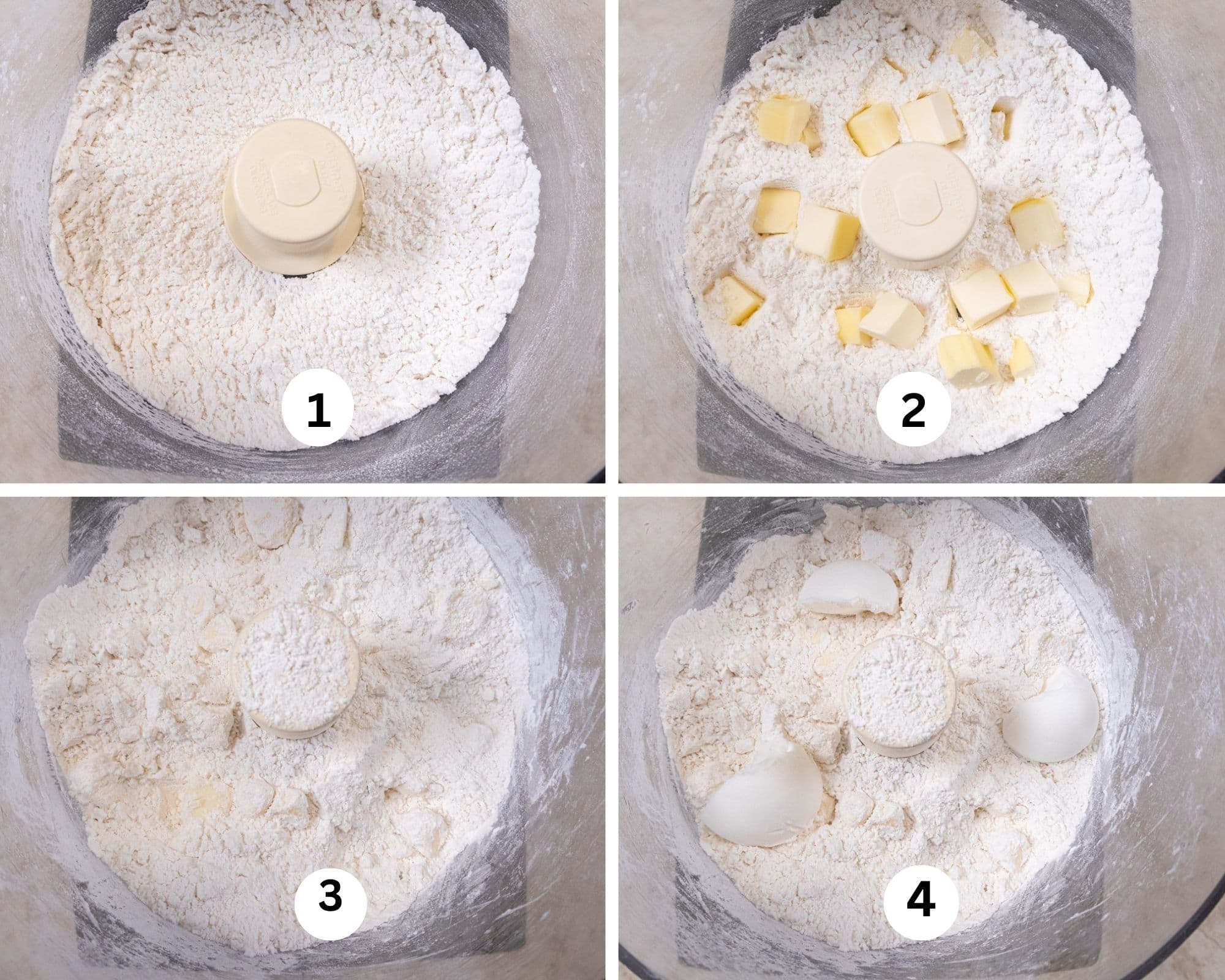
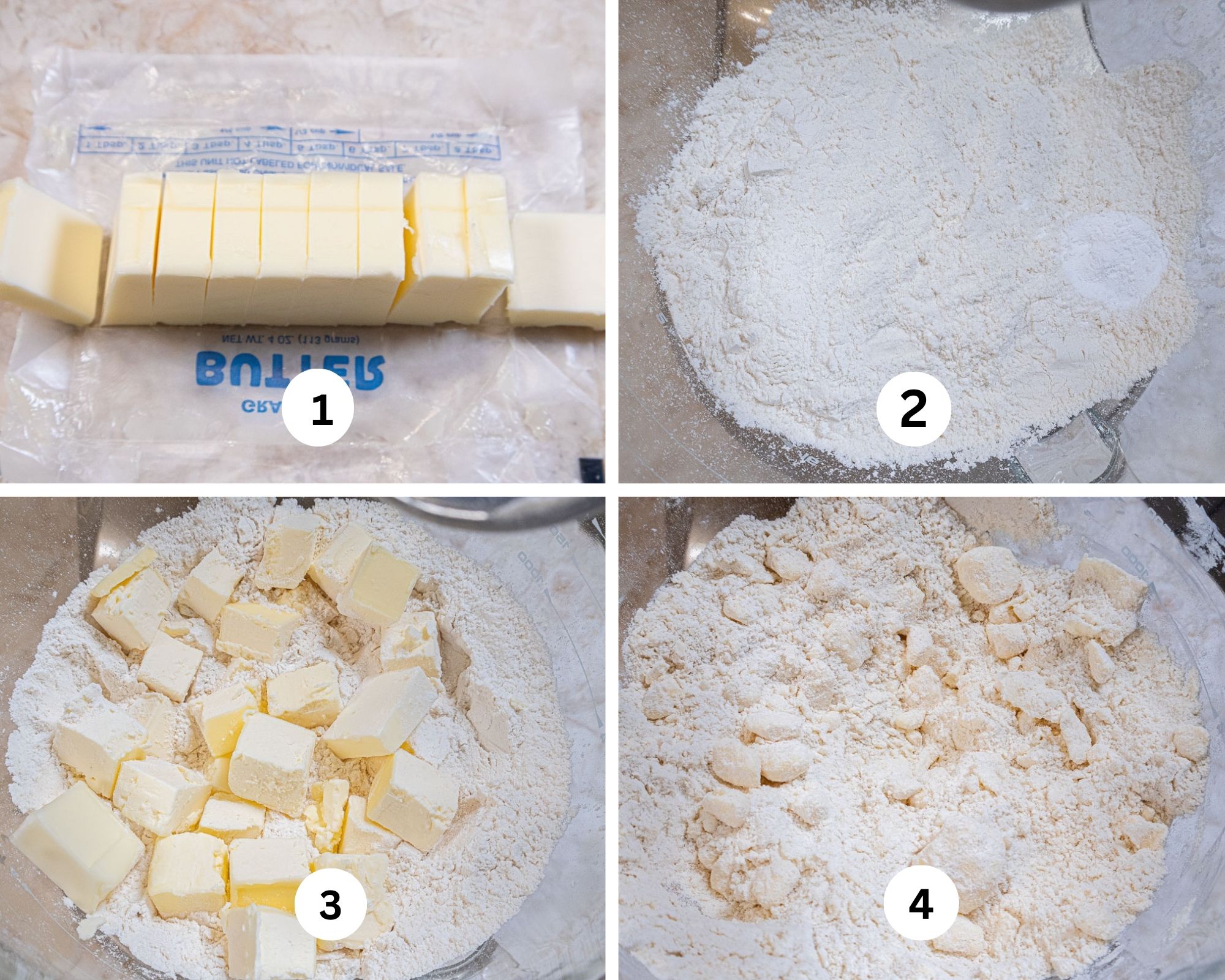
Step 1. Combine the flours in the bowl of a processor and pulse several times. Step 2. Step 2. Add the frozen butter. Step 3. Pulse a few times to break it up in large clumps. Step 4. Add the frozen shortening.

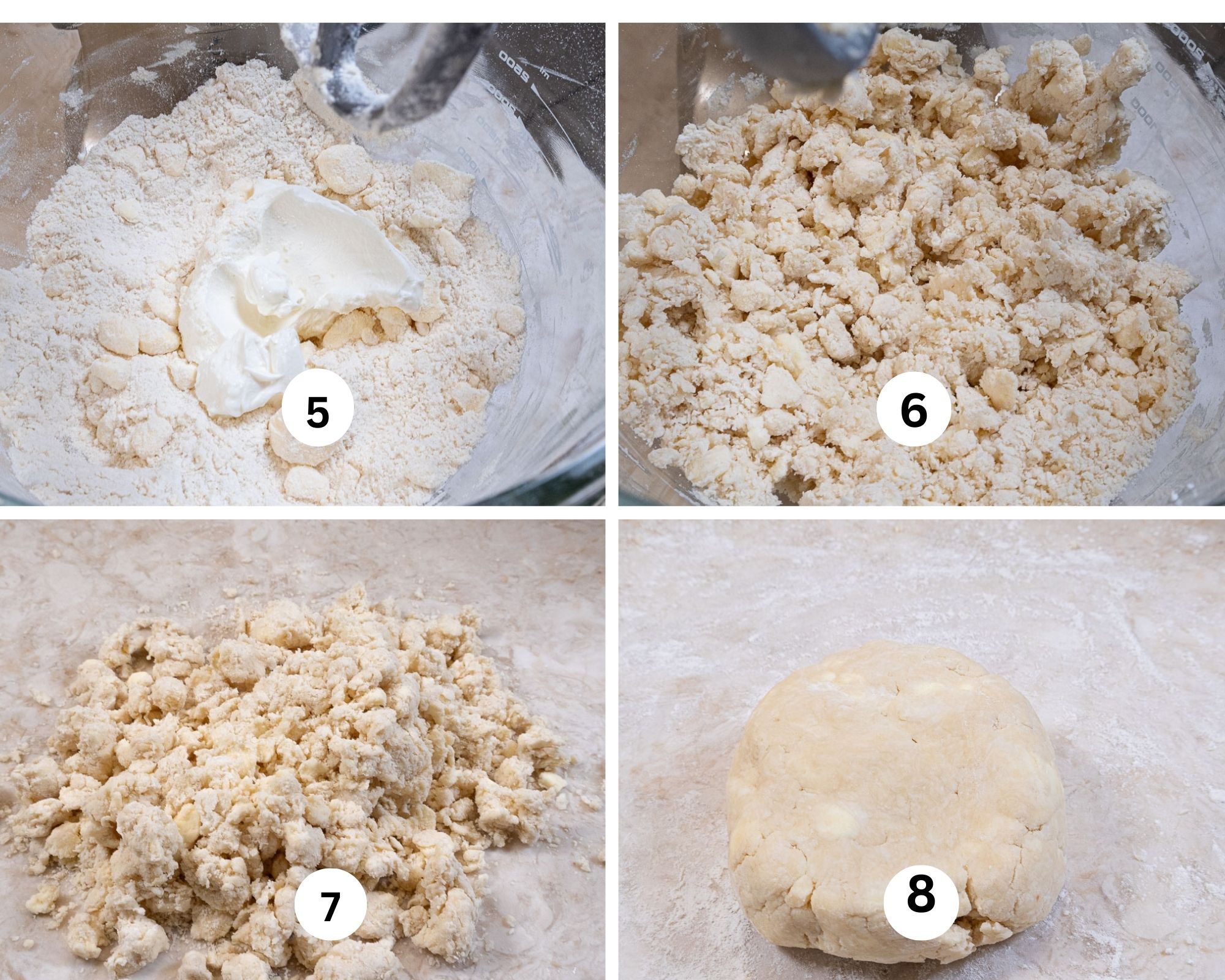
Step 5. Beat the egg to until completely combined. Combine the the 2 tablespoons egg, lemon juice and water. Step 2. Pour it in a circle over the processor contents. Step 7. Pulse until large clumps of dough form. Do not over process. Step 8. Pour it out onto a work surface. Note: One of my long time readers came up with an alternative way to add the liquid that worked better for her. After cutting in the butter and shortening, she removed everything to a large bowl. Then added the liquids and stirred them in by hand to prevent the butter and shortening from being cut into too small of pieces.

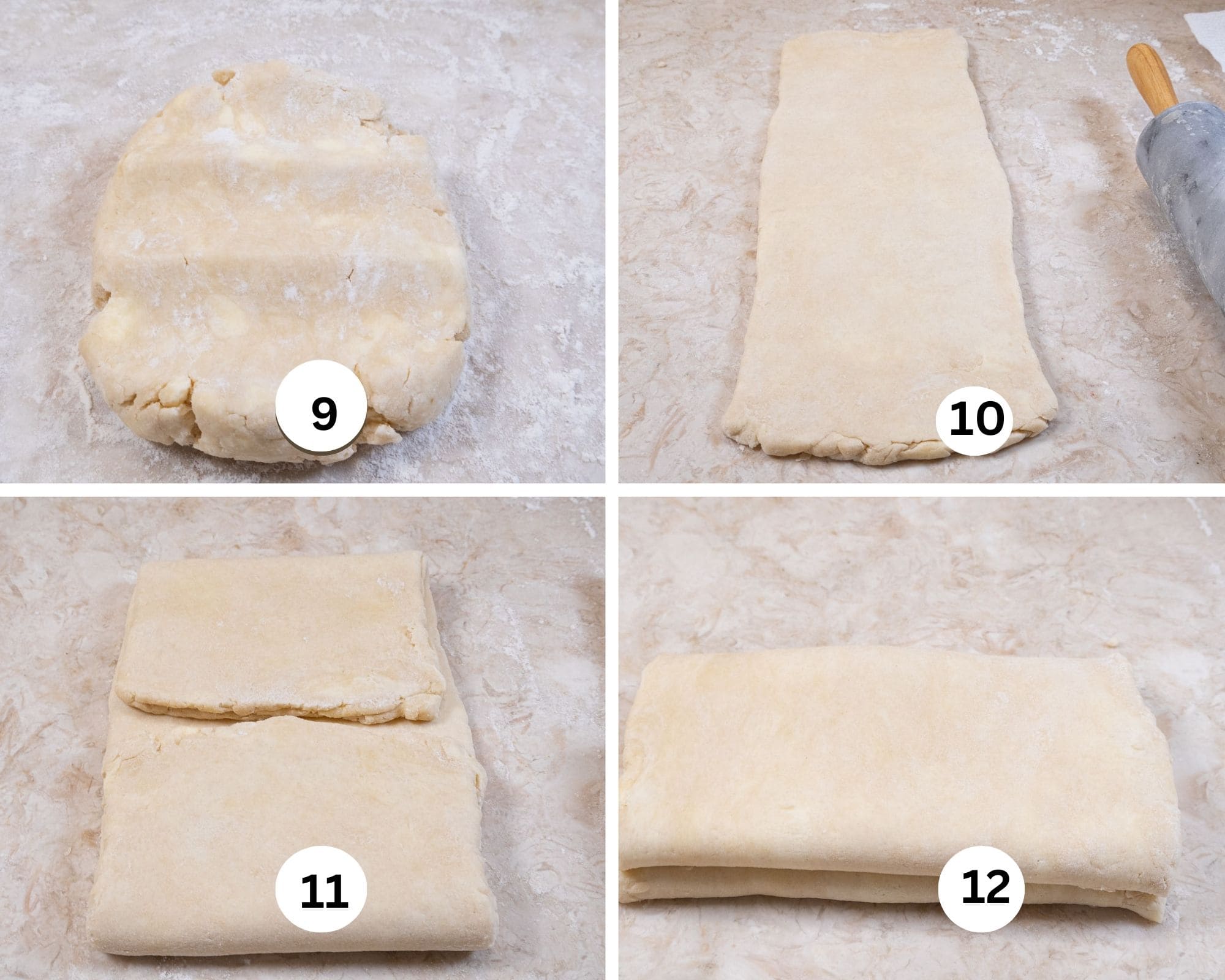
Step 9. Push the dough together in a cohesive block. Step 10. Knead it several times and shape it into a round 1" thick. Here you can plainly see butter pieces in the dough. Step 11. Wrap it in plastic wrap and refrigerate a minimum of 2 hours or overnight. Step 12. Lightly flour your work area. It may seem unnecessary to show you this, but I have seen people really heavily cover their surfaces with flour. All of that flour going into your crust will toughen it and inhibit the flakiness.

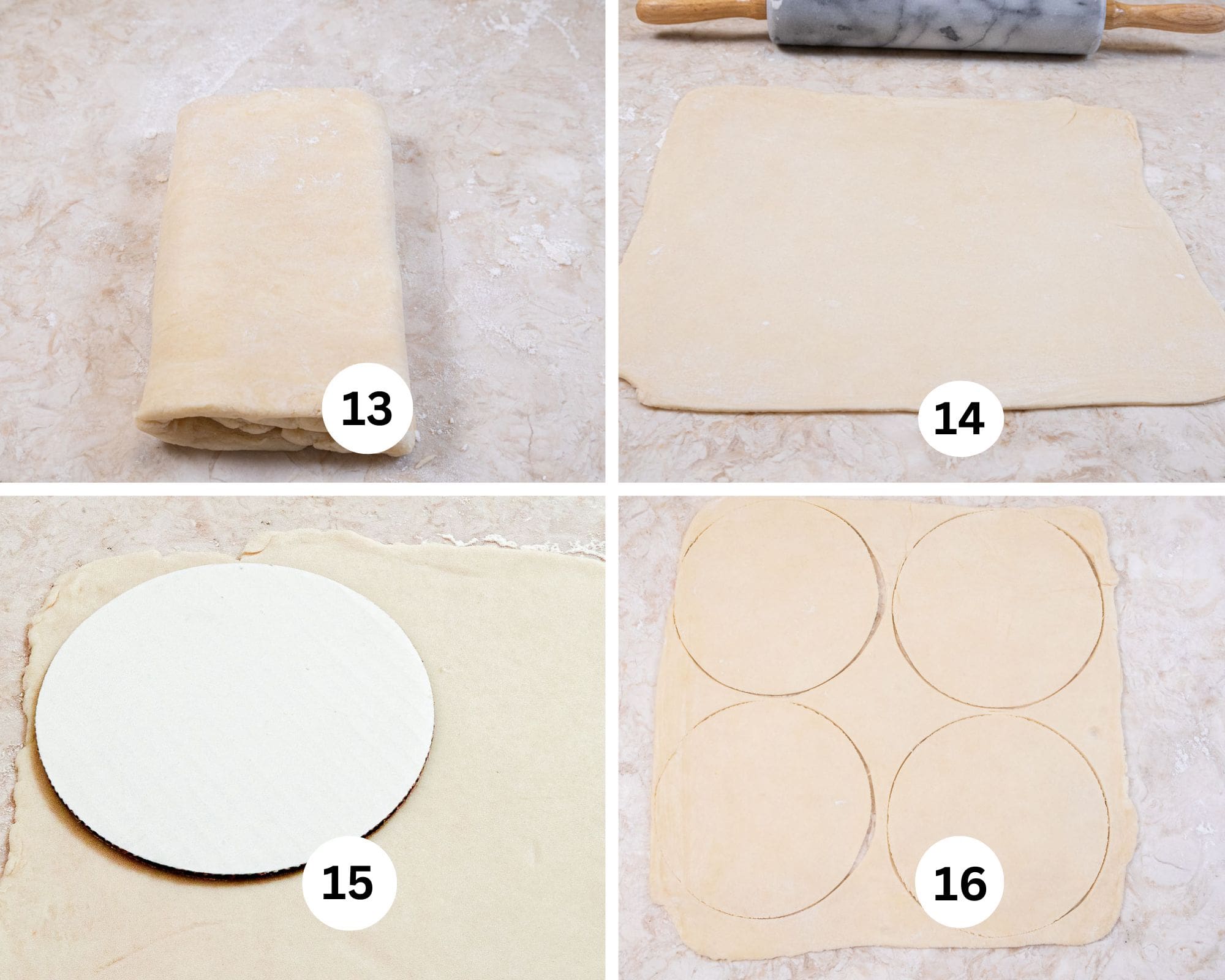
Step 13. Remove the dough round from the fridge and place it on the lightly floured surface. Step 14. With a rolling pin, press the dough down in 3 or 4 places to make rolling out easier. Step 15. Roll the dough out to about 13" for a 9" pie pan. Step 16. This is an optional step, but I place a 12 inch cardboard on my rolled out dough and then cut it slightly larger to ensure a 13" round. This makes a uniform amount of dough being turned under at the edge.

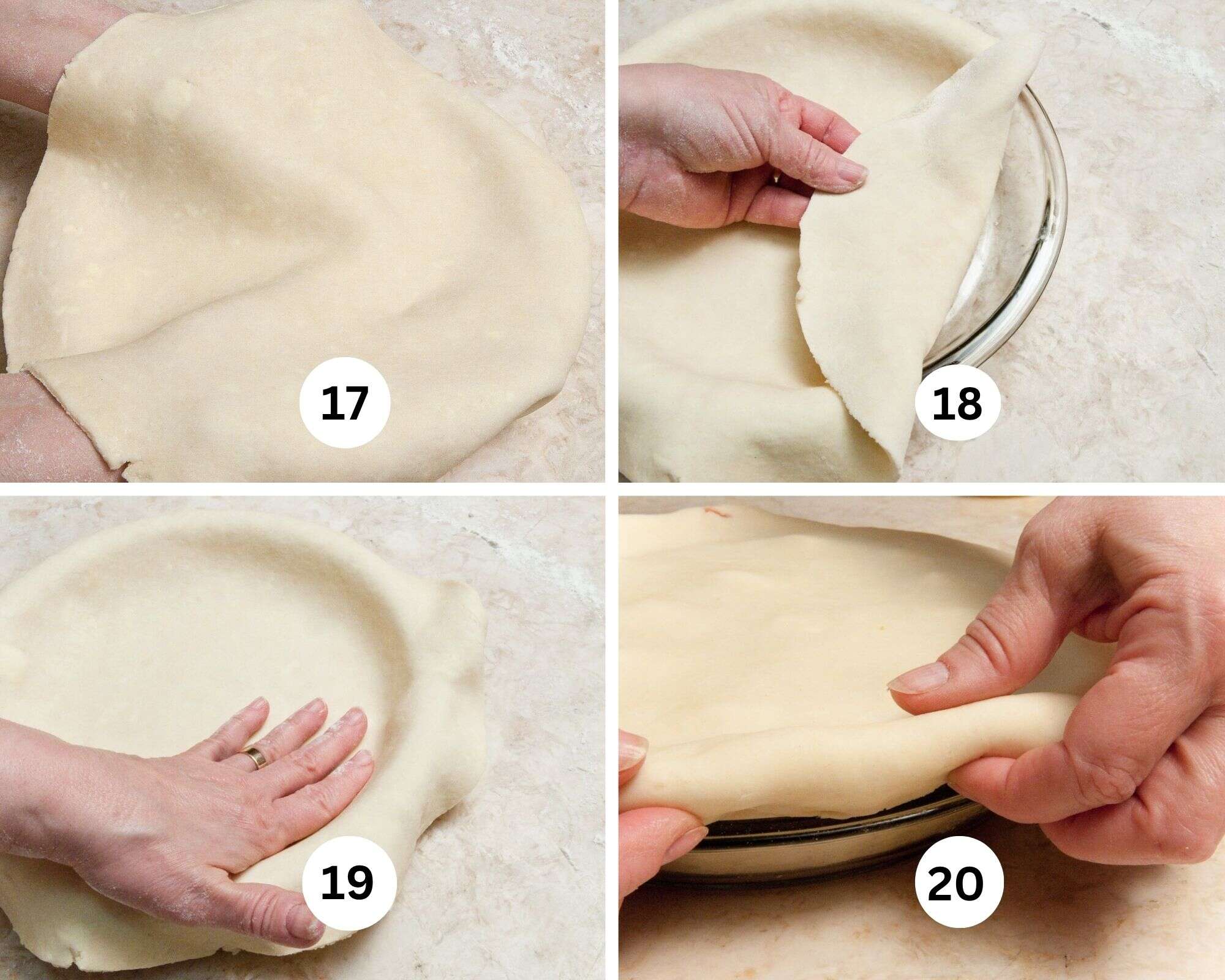
Step 17. Pick the crust up by slicing both hands under the crust and transferring it to the pie plate making sure it is evenly set in. While I do this with my hands, you can also roll the dough loosely around a rolling pin and simply unroll it in the plate. Step 18. Going around the edge of the pan, pull the dough back and make sure it is securely seated to the edge. Step 19. Press it lightly against the side and the bottom. Step 20. Tuck the overhang under the top edge of the crust.

Step 21. Flute the edges of the crust by placing your finger on the inside of the crust and pinching it from the outside or however you wish. Step 22. Go around the entire edge to finish the crust. I do not dock mine with a fork. Freeze the crust until it is rock hard. Step 23. To keep the crust from sliding down the side of the pie plate, spray a large piece of foil with a non-stick baking release and place it, sprayed side down, onto the crust. Make sure the foil fits well into the edges of the crust. Fill it to the top completely with beans or rice. Step 24. Bake as called for removing the foil and beans about half way through to allow the crust to bake completely.

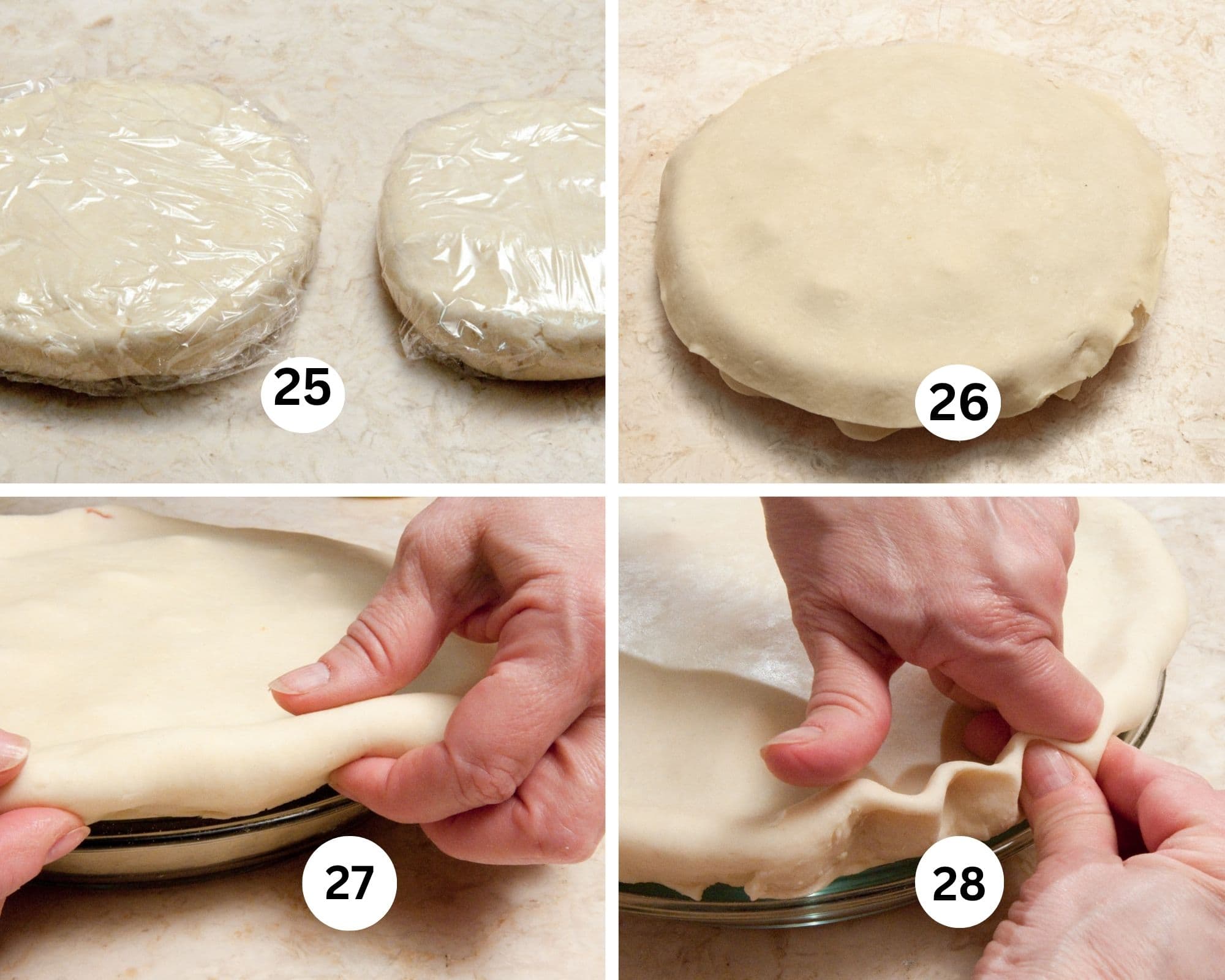
Step 25. Divide the dough as called for. Step 26. Roll the crust into a 13" round as above and place it evenly in the pie plate as for the single crust. Step 26. Roll the top crust about 12" round. Wet the overhang on the bottom crust and place the top crust on. Step 27. Press the two edges together. The water will seal the top and bottom edges. Turn them under. Step 28. Flute the edges as above or however you please.

Step 29. Brush the top of the crust with a beaten egg for a beautiful top. Step 30.Cut a vent or vents into the top of the pie. This will prevent the crust from splitting on its own. Sprinkle the pie with sanding sugar for a sparkly look. Step 31. Place the finished pie on a foil lined baking sheet to catch any drips. This is one of the most important steps. Cover only the edges of the pie with foil before it goes into the oven. They will over bake and burn with the long baking time needed if not protected. By covering them now and removing the foil half way through, you don't have to take the pie out of the oven and cover them when the pie is hot. We used this method at the bakery. Step 32. This is your pie, beautifully golden brown with a flaky crust that you will be proud to serve. BhuBBhuB= srBuBBuBuBiB sr SaveSaveSaveSave
This helps in a couple of ways. One it helps bake the bottom crust and secondly, the burst of hot heat starts the butter and/or shortening to melt fast and start the layers separating for a flaky crust. The temperature is then lowered to finish the baking.
Because they are all fat. Butter contains water so it doesn't have as high a percentage as the lard and shortening.
If a recipe calls for both butter and another shortening, then yes it can be made with all butter but it may not be as flaky and tender.
The crusts can be made ahead frozen at several different times for several months. When it is initially made into the 1" round, when it is rolled out or when it is in the pie plate. If more than one crust is frozen when rolled out, separate with parchment paper. If frozen in the pie plate it is safest to use a metal pan or make sure the glass pie plate will go from freezer to oven safely. In any case, freeze the crusts hard, then wrap well in foil or place in freezer proof bags. If frozen flat, thaw in the fridge for the best result.
SaveSave

A lot of work goes into each of my recipes and my only ask is that if you like the recipe or even the looks of it, please leave me a star rating to help me rank better. It’s important and I appreciate it and I appreciate you.
Modified: · Published: by Helen S Fletcher · This post may contain affiliate links · Leave a Comment
The countdown to Thanksgiving is on! A show stopping dessert is a must, and these pies and tarts have something for everyone. From classic pumpkin to decadent chocolate pecan, find the perfect recipe to complete your feast.


Modified: · Published: by Helen S Fletcher · This post may contain affiliate links · Leave a Comment
There's nothing quite like the satisfaction of a freshly baked loaf or rolls. From savory popovers to sweet, swirled babka, these incredible easy bread recipes are surprisingly simple and guaranteed to impress your family and friends.


If you love baking breads and rolls, you'll also enjoy these: Rye Raisin Bread with Bakery-Style Flavor, Best Cinnamon Crunch Rolls Recipe, German Chocolate Sweet Rolls
Modified: · Published: by Helen S Fletcher · This post may contain affiliate links · 1 Comment
Get a head start on the season with these totally autumn recipes that are perfect for a chilly weekend. These recipes are filled with all the classic fall flavors like pumpkin, apple, and warm spices that will have everyone asking for more.


If you love autumn baking, you'll also enjoy these: Irish Apple Cake, (Almost) No Bake Pumpkin Tart, Pumpkin Cheesecake with Salted Caramel Sauce, Pumpkin Cake Doughnuts, Apple Fritters with Speculaas Spice
Modified: · Published: by Helen S Fletcher · This post may contain affiliate links · 9 Comments
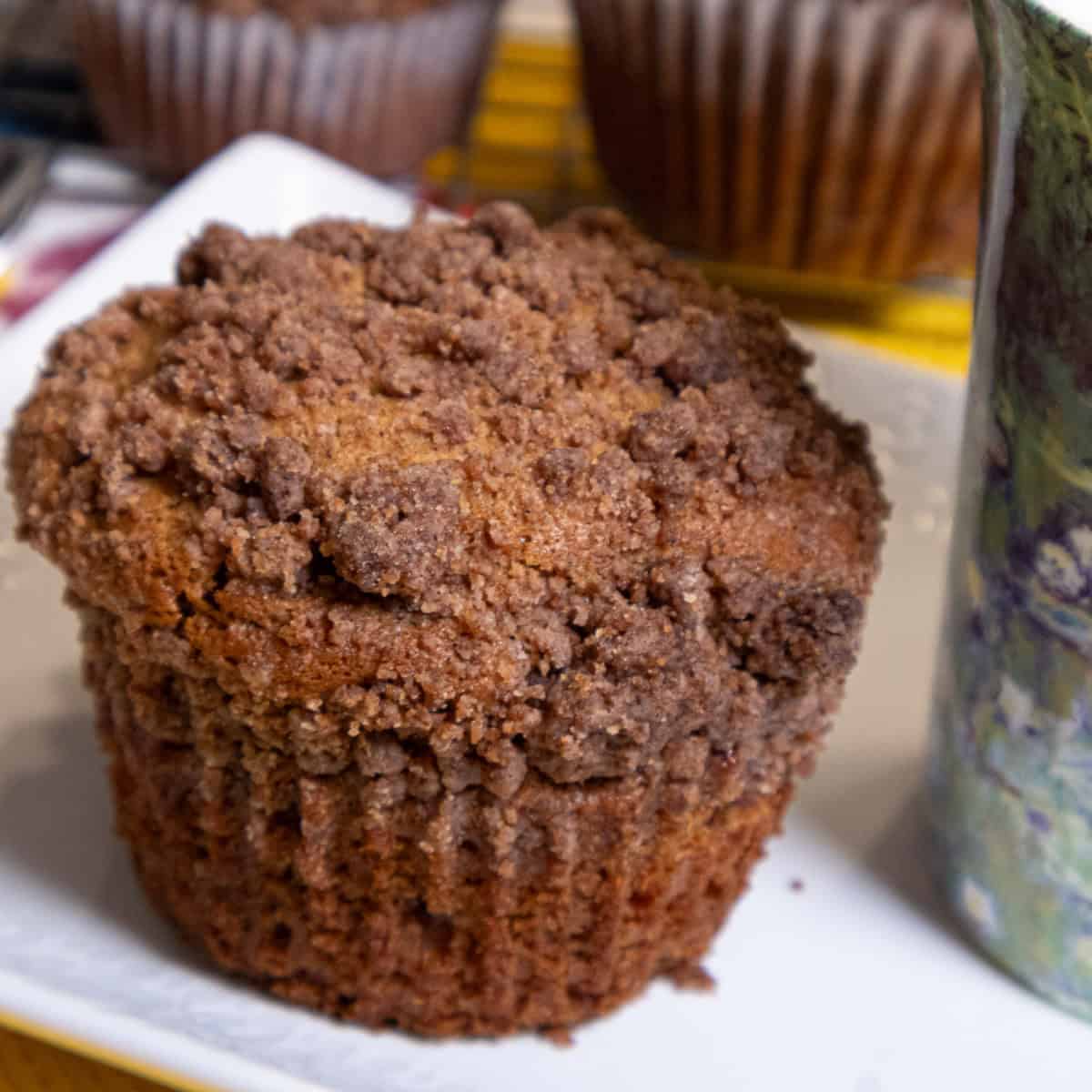
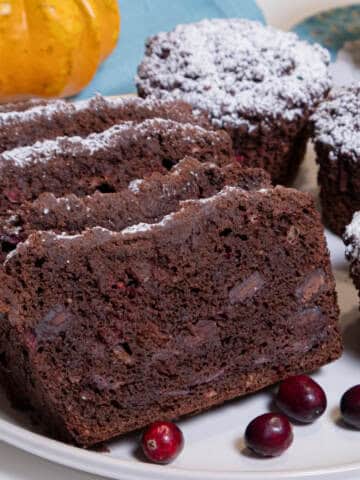
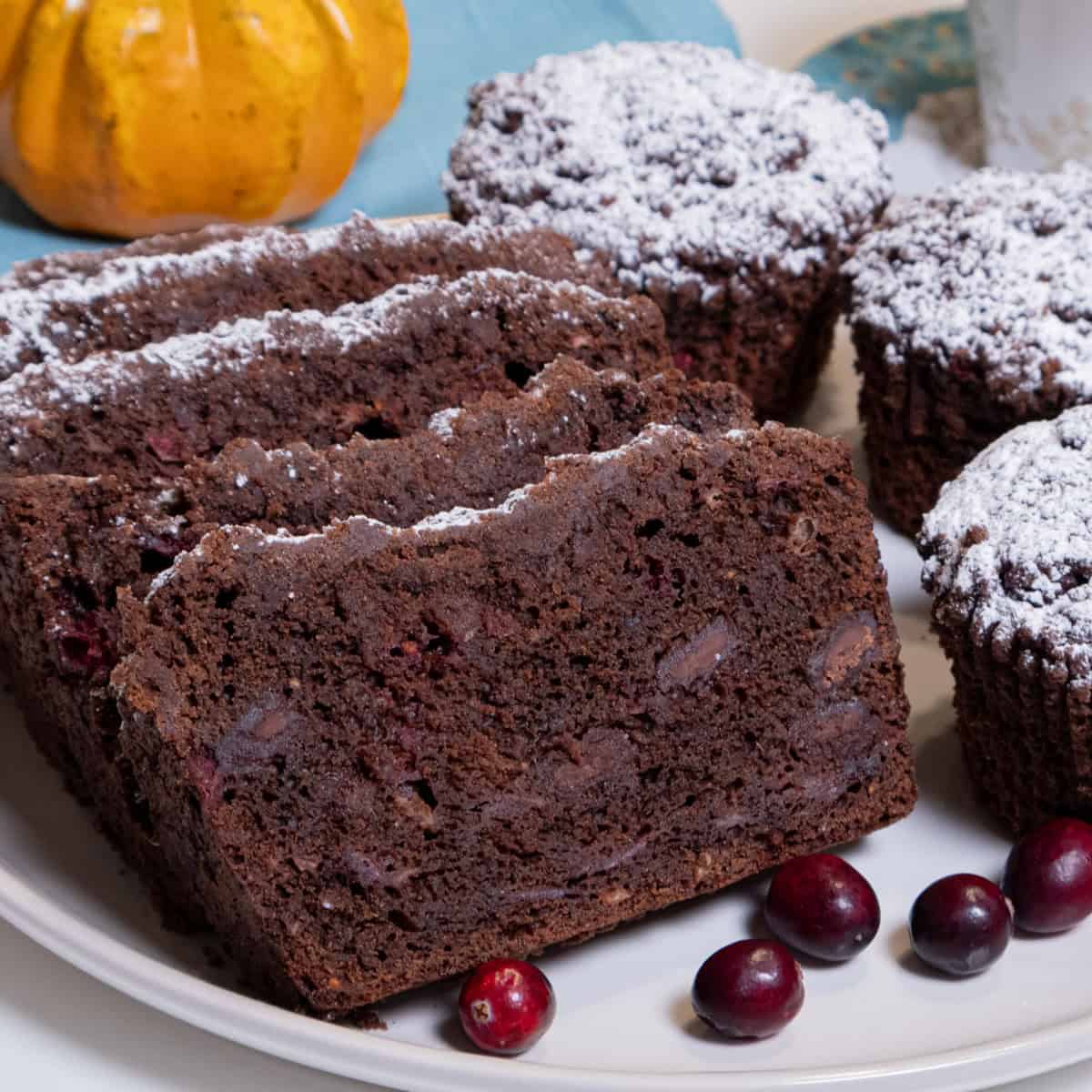
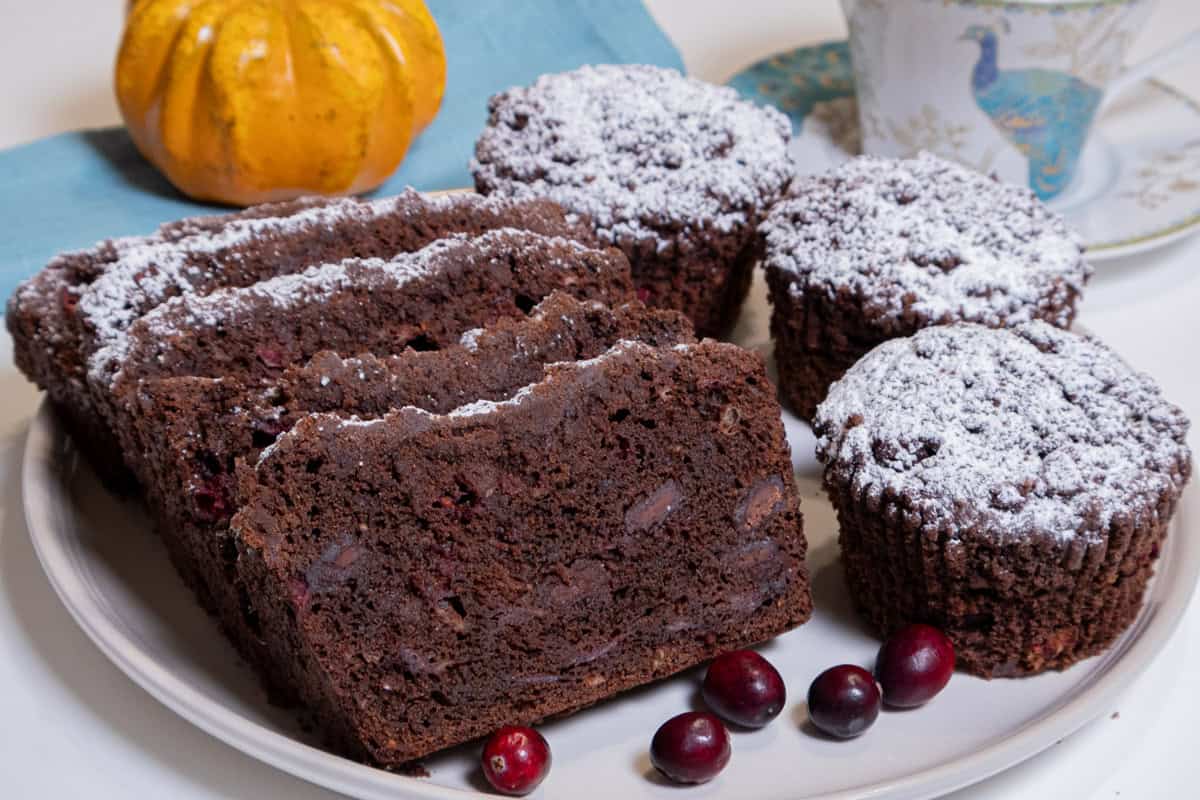
Chocolate Cranberry Quick Bread is not only variable but can be stashed in the freezer for a quick addition to breakfast, brunch or snacking. This is definitely a treat for anyone who loves chocolate - two different chocolates including a chocolate crumb topping and Dutch cocoa for the most chocolatey taste and look.

This recipe has been updated with new photography as well as step by step instructions. In addition to the quick bread, it makes great muffins.
Other great quick breads include: Simple Pumpkin Pecan Scones Recipe, Cream Biscuits, Best Two Step Banana Bread, Cinnamon Filled Buttermilk Scones, and Heavenly French Toast with Blueberry Compote.
Baking pans are not all created equal. Thicker pans will often take a bit longer to bake than lighter ones. Color is also important. The darker the color the quicker the product will brown. So if a recipe is not fully baked within the time given, just add a few minutes to the baking time until it tests done. Conversely, if baking in a dark pan, check the item sooner. All of this depends upon the temperature of your oven being correct. For more in-depth information on the materials used and it affects baking, see my post Baking Pans.
Looking for more amazing bread recipes? Check out Unforgettable Breads to Bake and Share.

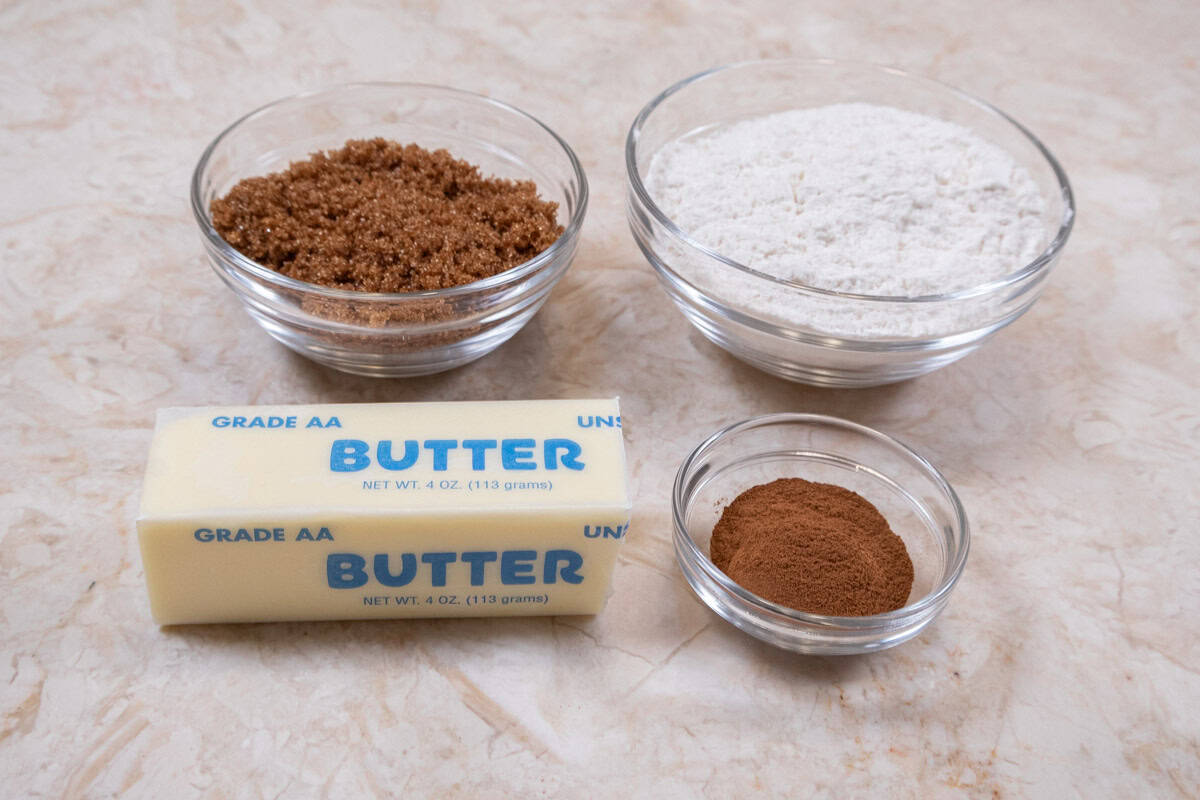
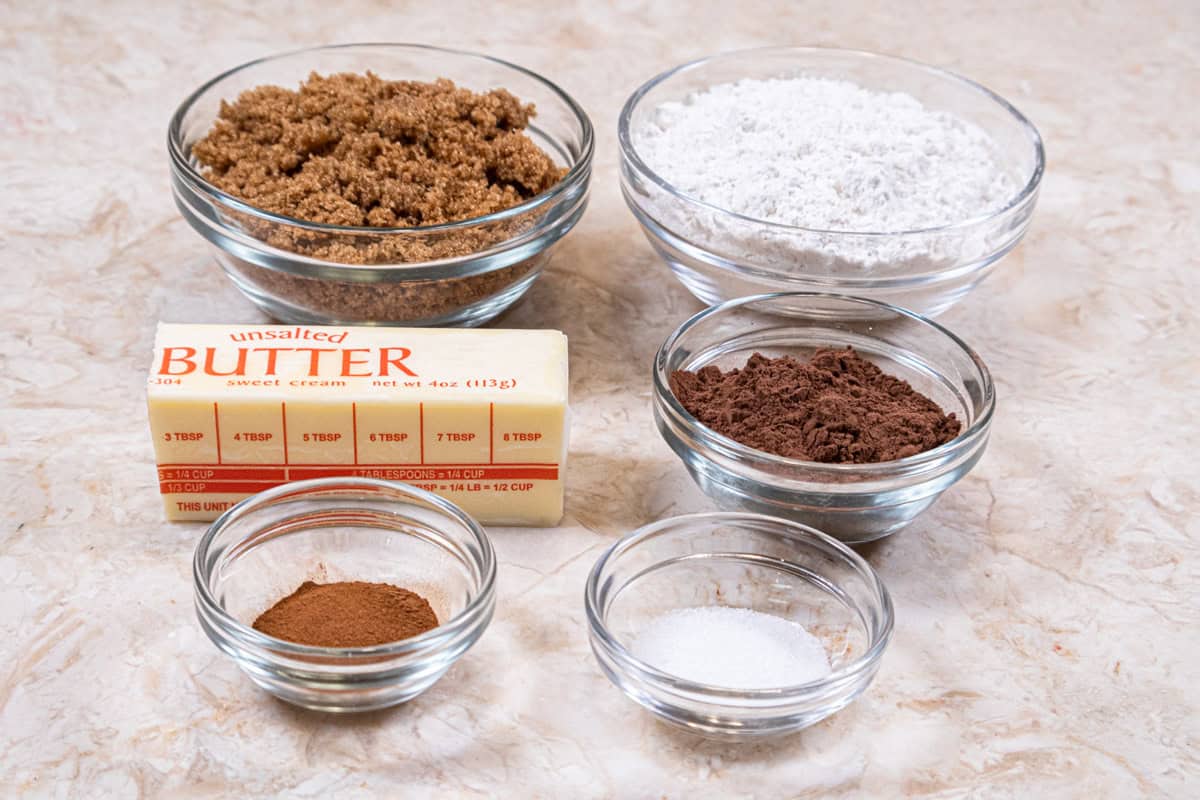
FRONT ROW: Cinnamon, table salt
MIDDLE ROW: Unsalted butter, cocoa
BACK ROW: Brown sugar, all-purpose flour

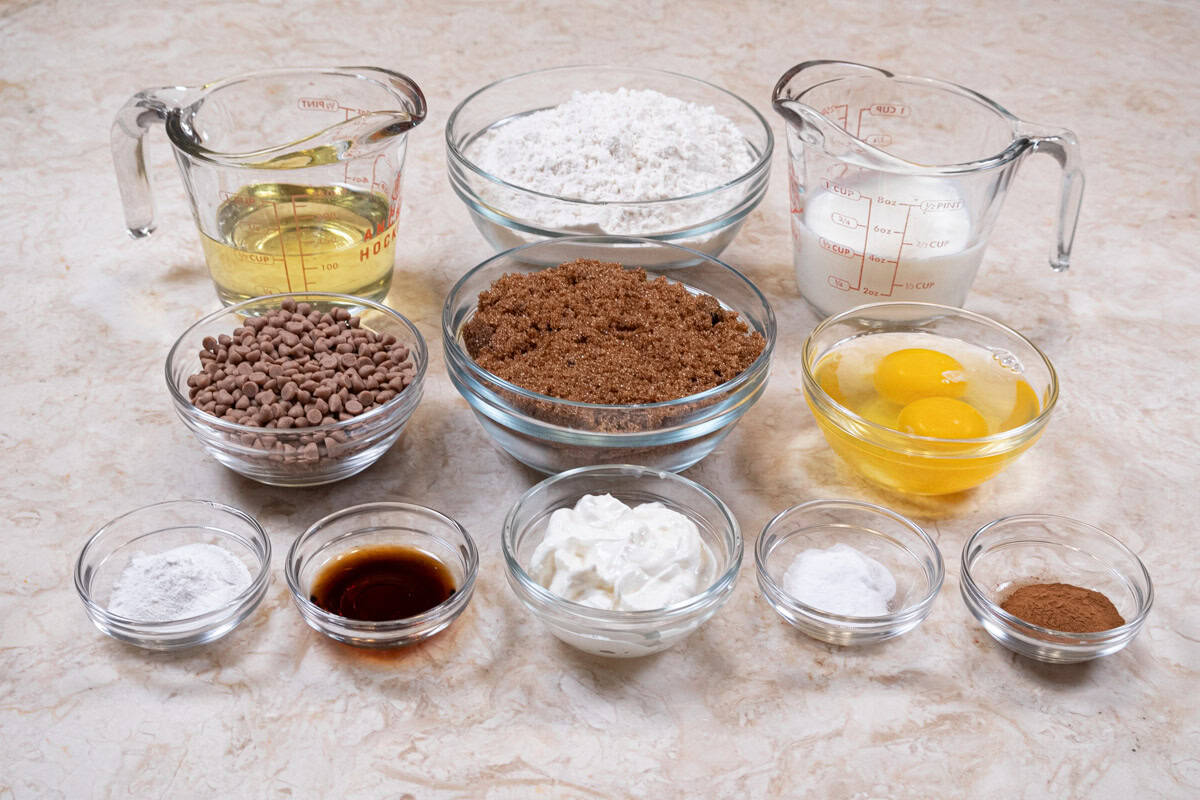
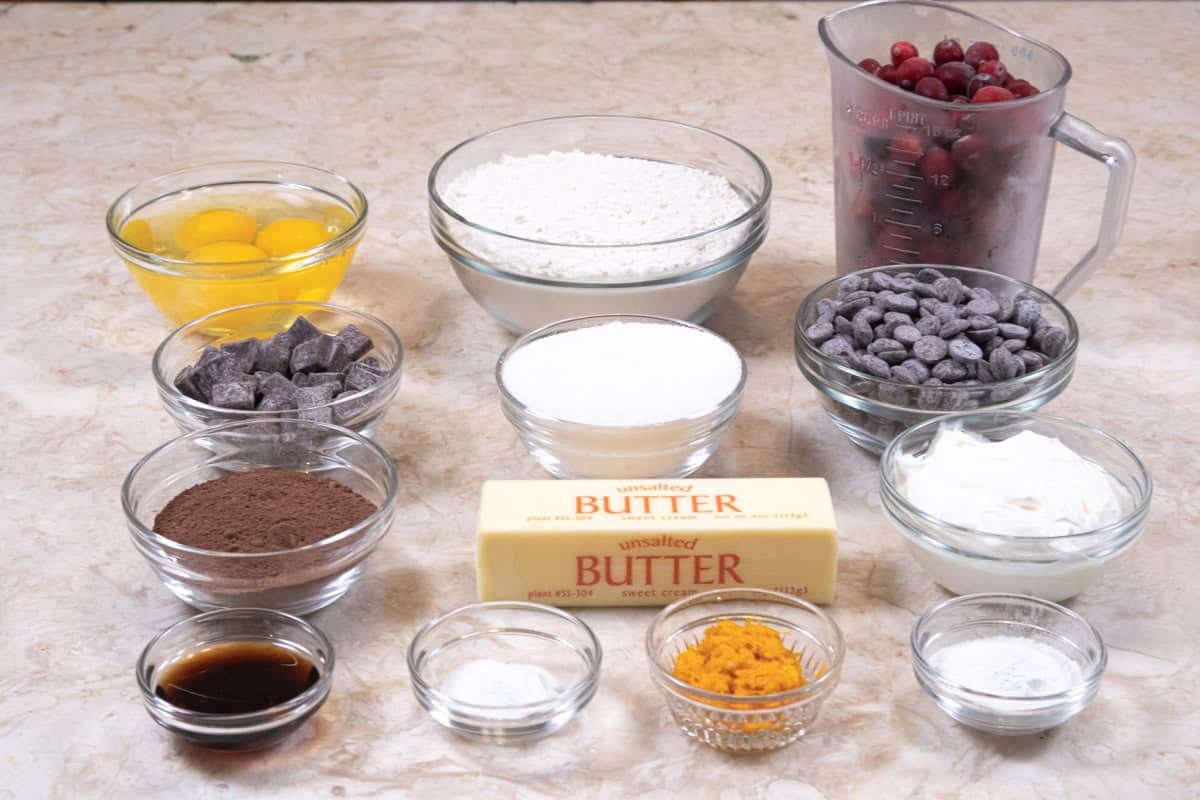
FRONT ROW: Vanilla, baking soda, orange zest, baking powder
SECOND ROW: Cinnamon, unsalted butter, sour cream
THIRD ROW: Chocolate Chunks, granulated sugar, semisweet chocolate
BACK ROW: Eggs, all-purpose flour, frozen cranberries
Be sure to see the recipe card below for the full ingredients and instructions.
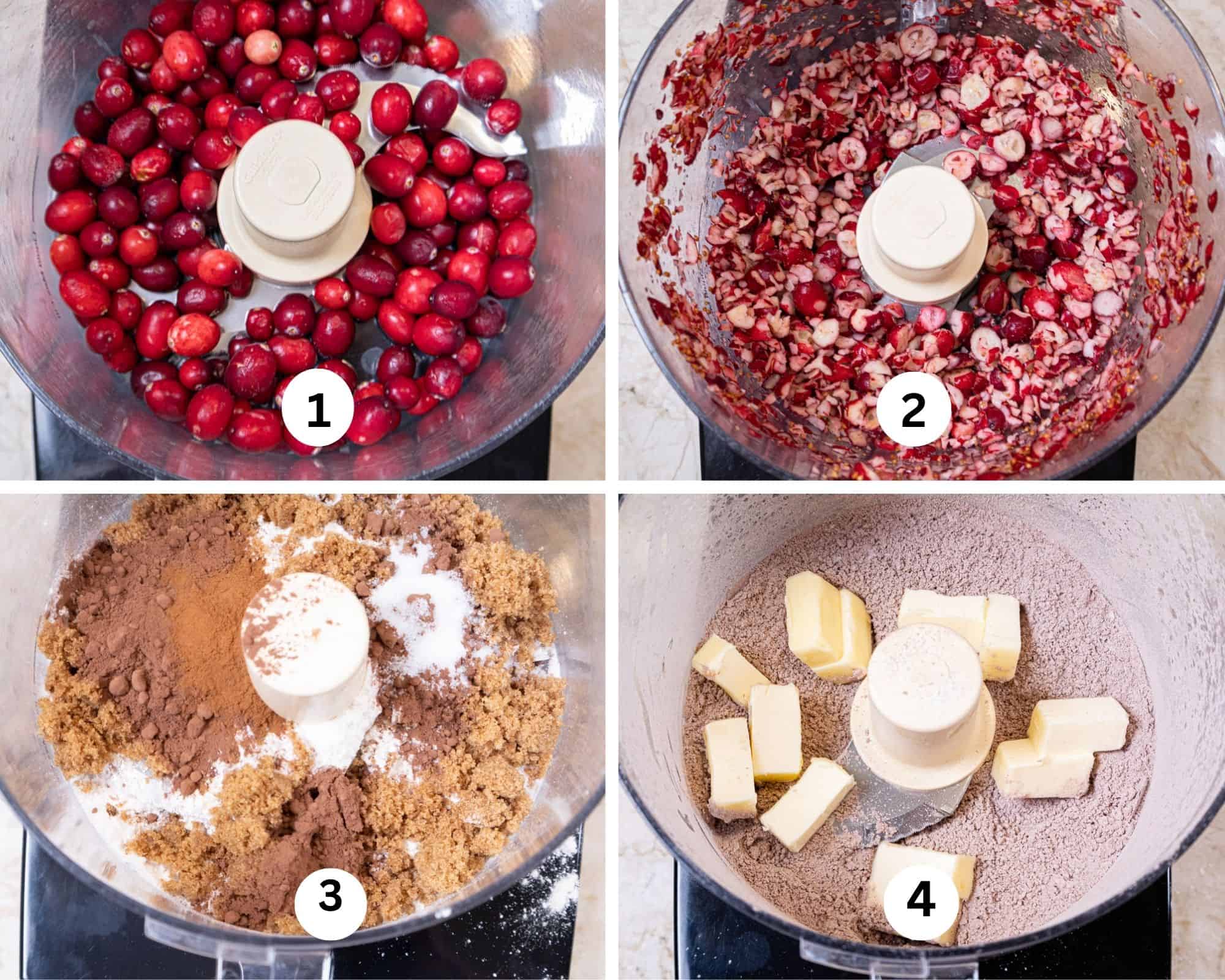
Be sure the cranberries are solidly frozen before proceeding.

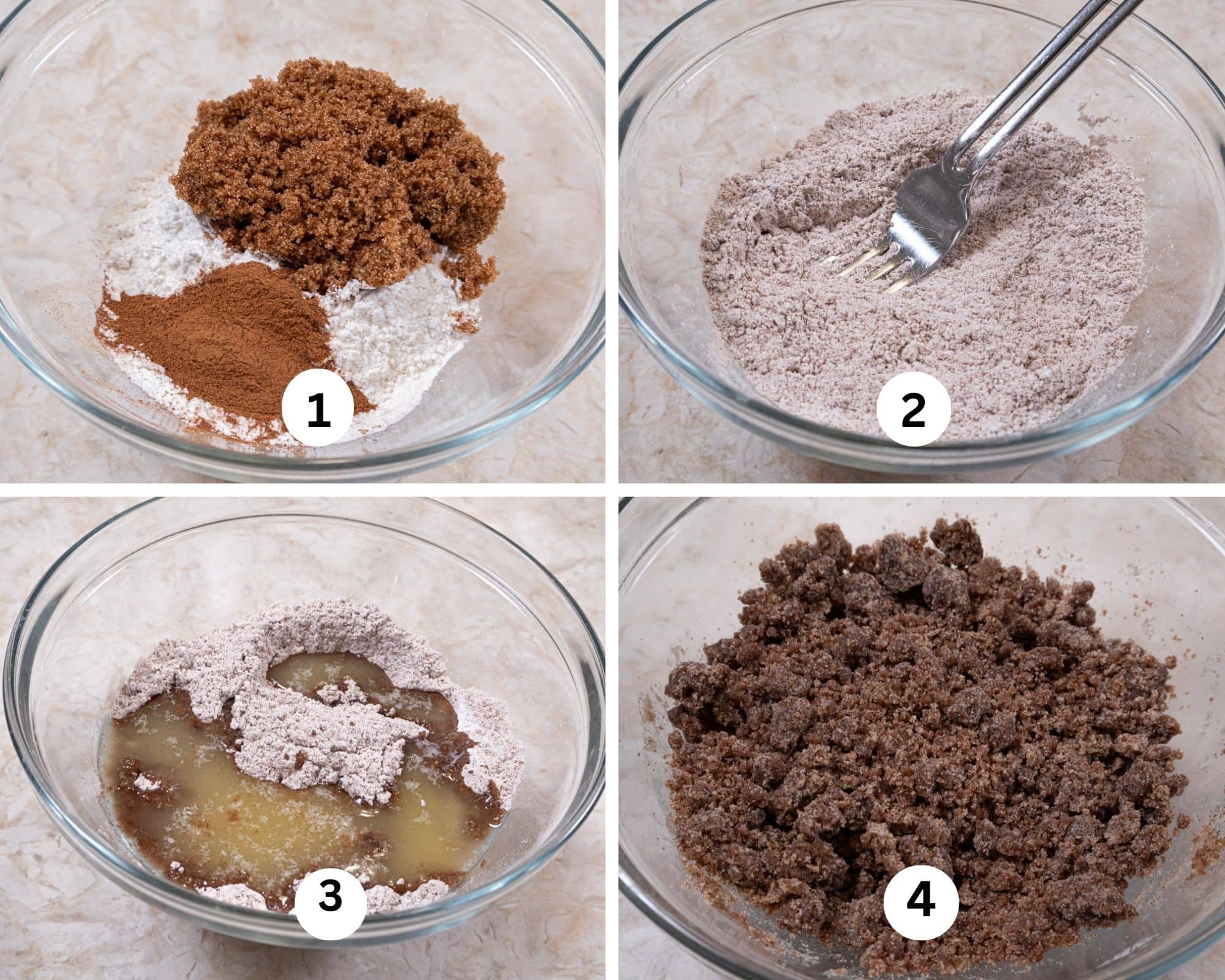
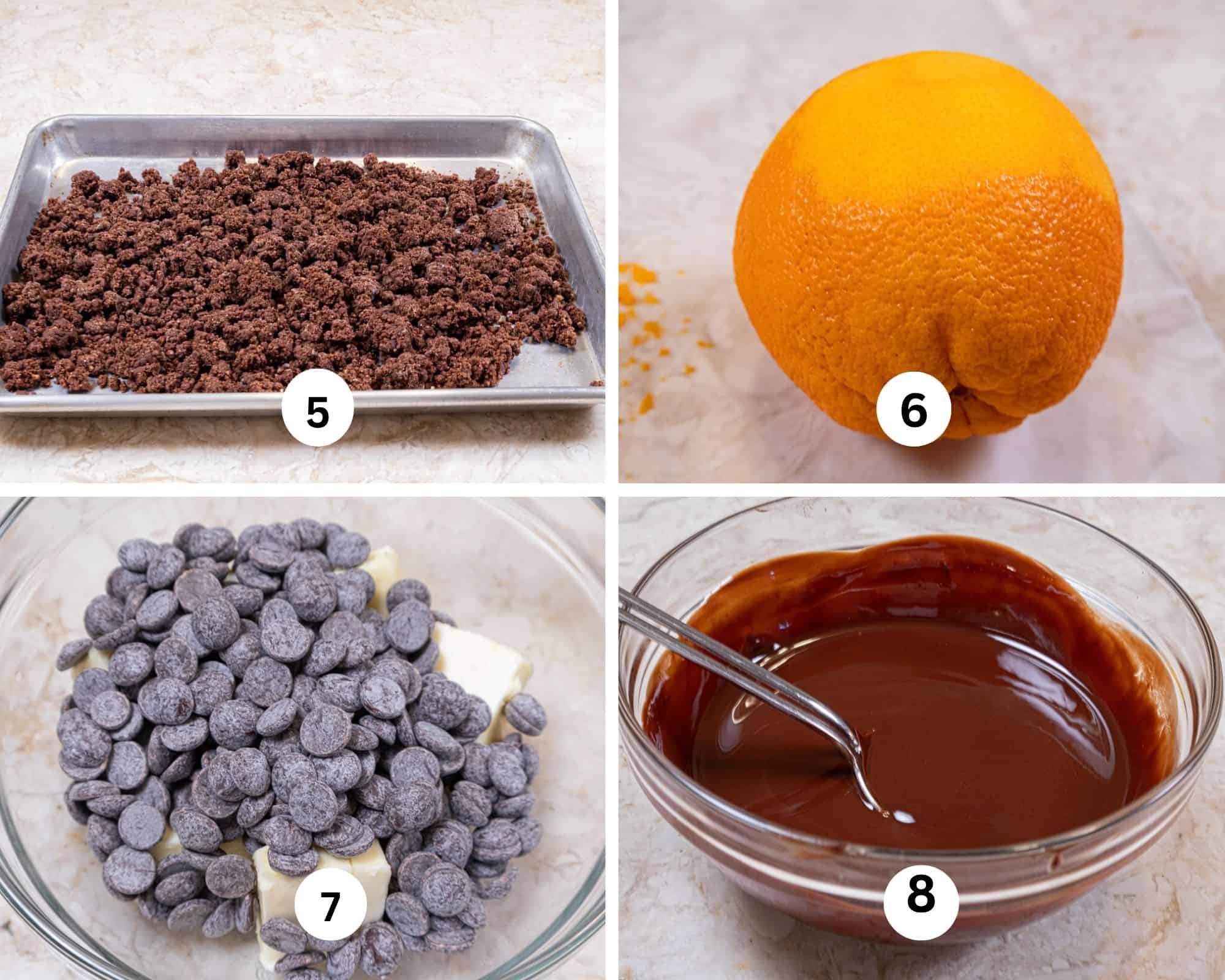
Step 1. Place the frozen cranberries in the bowl of a processor. Step 2. Process briefly with pulses into large, small and some whole cranberries. Transfer the cranberries to a bowl and place in the freezer. Step 3. Place all the dry ingredients for the chocolate crumbs in a processor bowl. Process to mix. Step 4. Add the butter to the processor in a circle over the dry ingredients. Process briefly to bring the ingredients together. Pulse with long pulses until it forms crumbs. Be patient and scrape down. Make quicker pulses as it starts to come together. Do not over process or it will form a paste.

Step 5. Pour the crumbs onto a quarter sheet pan and refrigerate while proceeding. Step 6. Zest the orange. Do not go too far into the pith or it will be bitter. I like to use a microplaner instead of a box grater. Navel oranges yield more zest than juice oranges. Step 7. Place the butter and semisweet chocolate together in a microwave bowl. Microwave on half power until the chocolate appears shiny and the butter is melted. Step 8. Whisk together. If chocolate is not completely melted, let it sit for a couple of minutes and whisk again. If still not smooth briefly microwave at half power again.

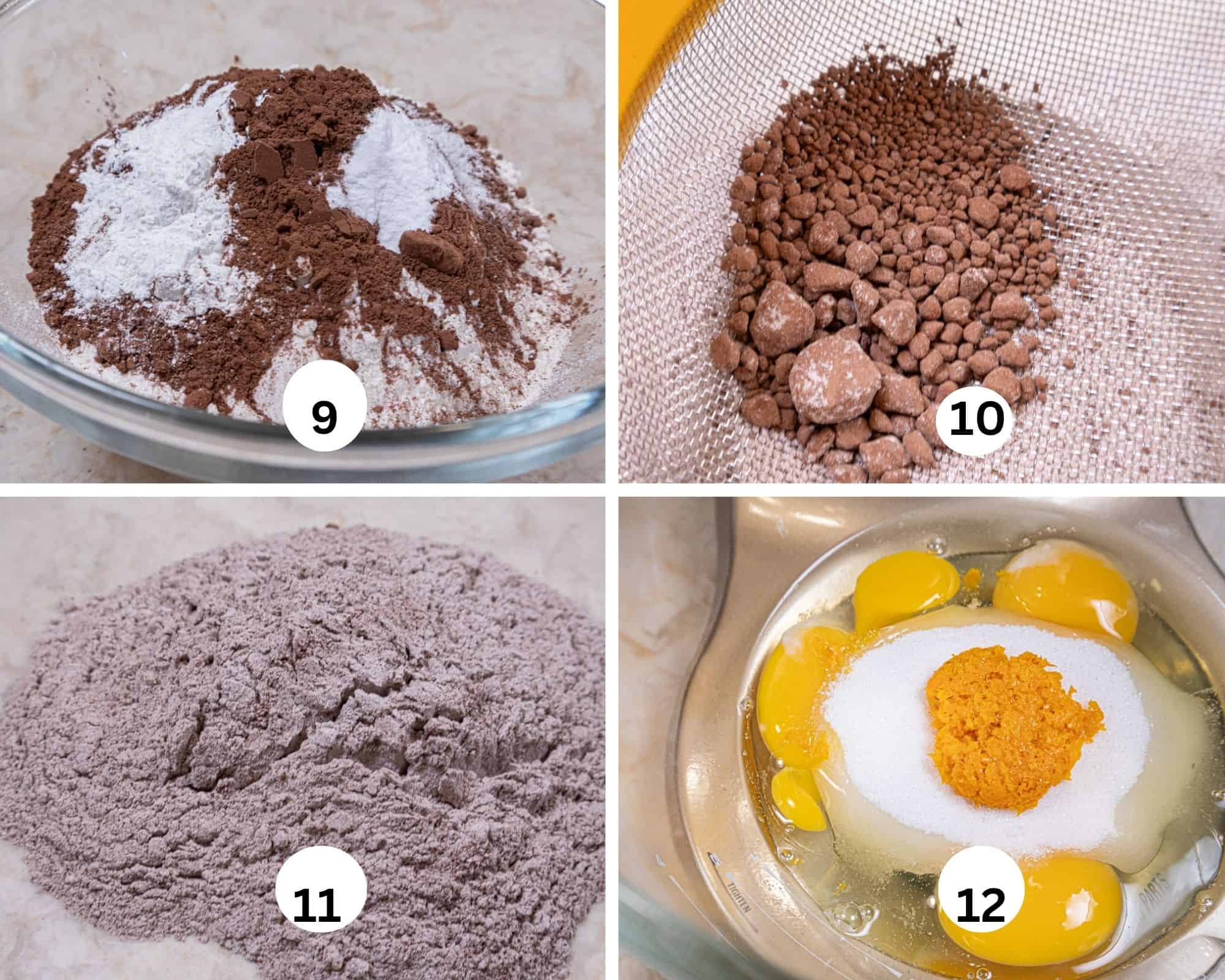
Step 9. Combine the flour, cocoa, baking powder and baking soda together. Step 10. Sift the mixture over waxed paper. Cocoa often has lumps in it that will not break down with just whisking it together. Push the lumps through with a spoon. Step 11. Whisk together. Step 12. Place the eggs, granulated sugar and orange zest in the bowl of a mixer.

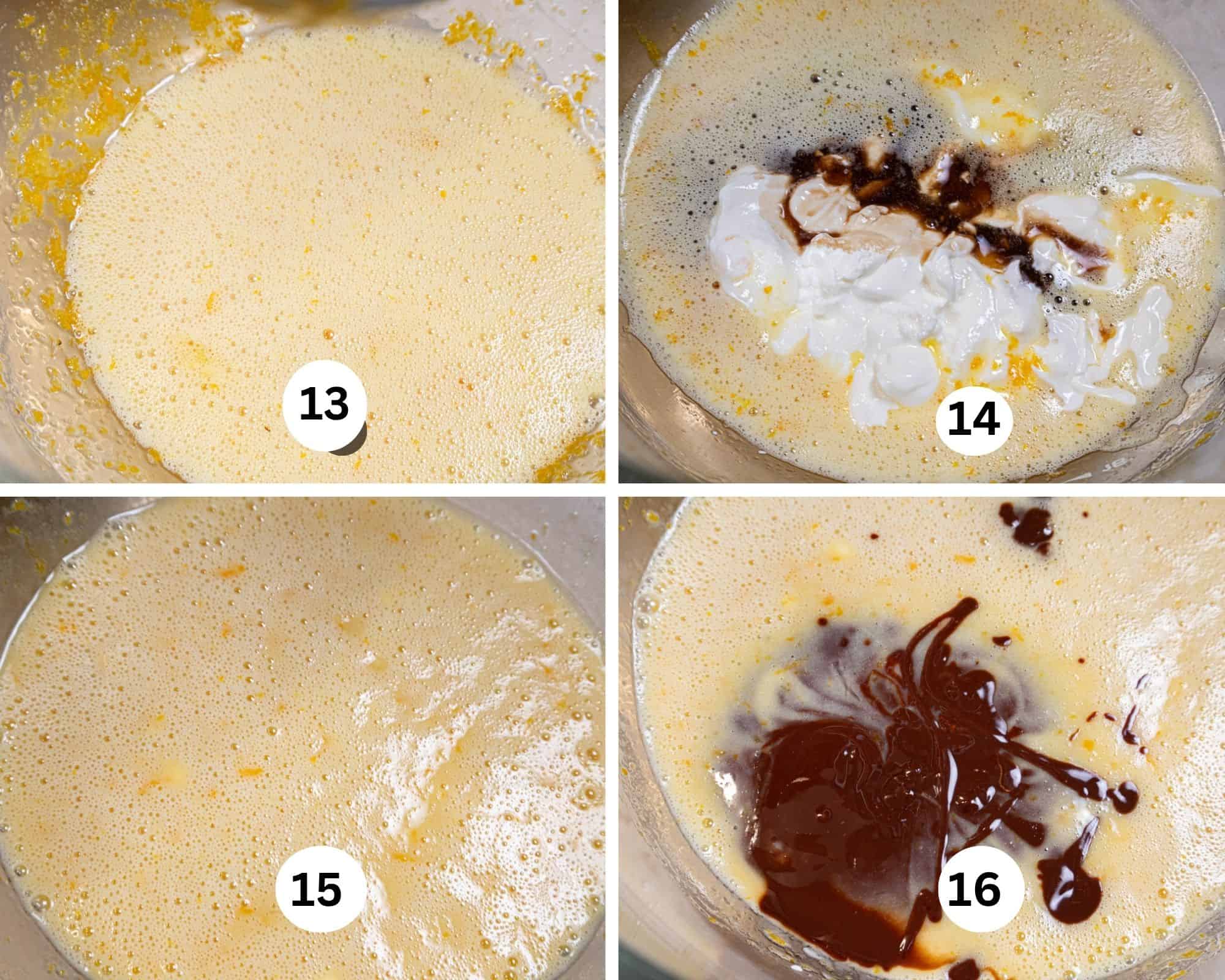
Step 13. Mix until thoroughly combined. This took about 3 minutes on medium in my Breville. Scrape down as needed. Step 14. Add the sour cream and vanilla. Step 15. Beat on low until completely combined, scraping down as needed. Step 16. Add the cooled chocolate/butter mixture.

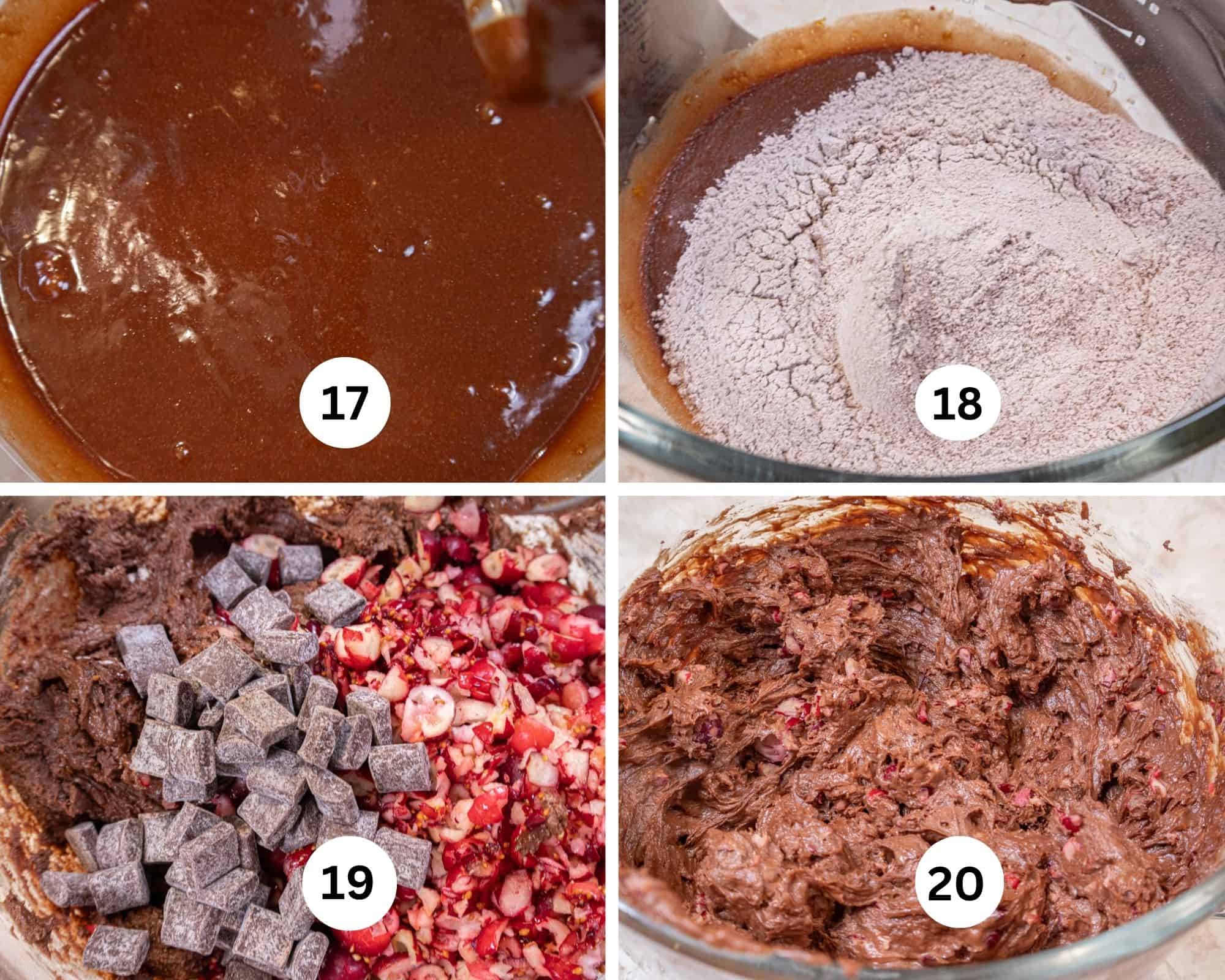
Step 17. Mix on low until combined, scraping as needed. Step 18. Add all the flour and once and beat on low to combine. Step 19. Add the cranberries and chocolate chunks into the batter. Step 19. Beat until combined.

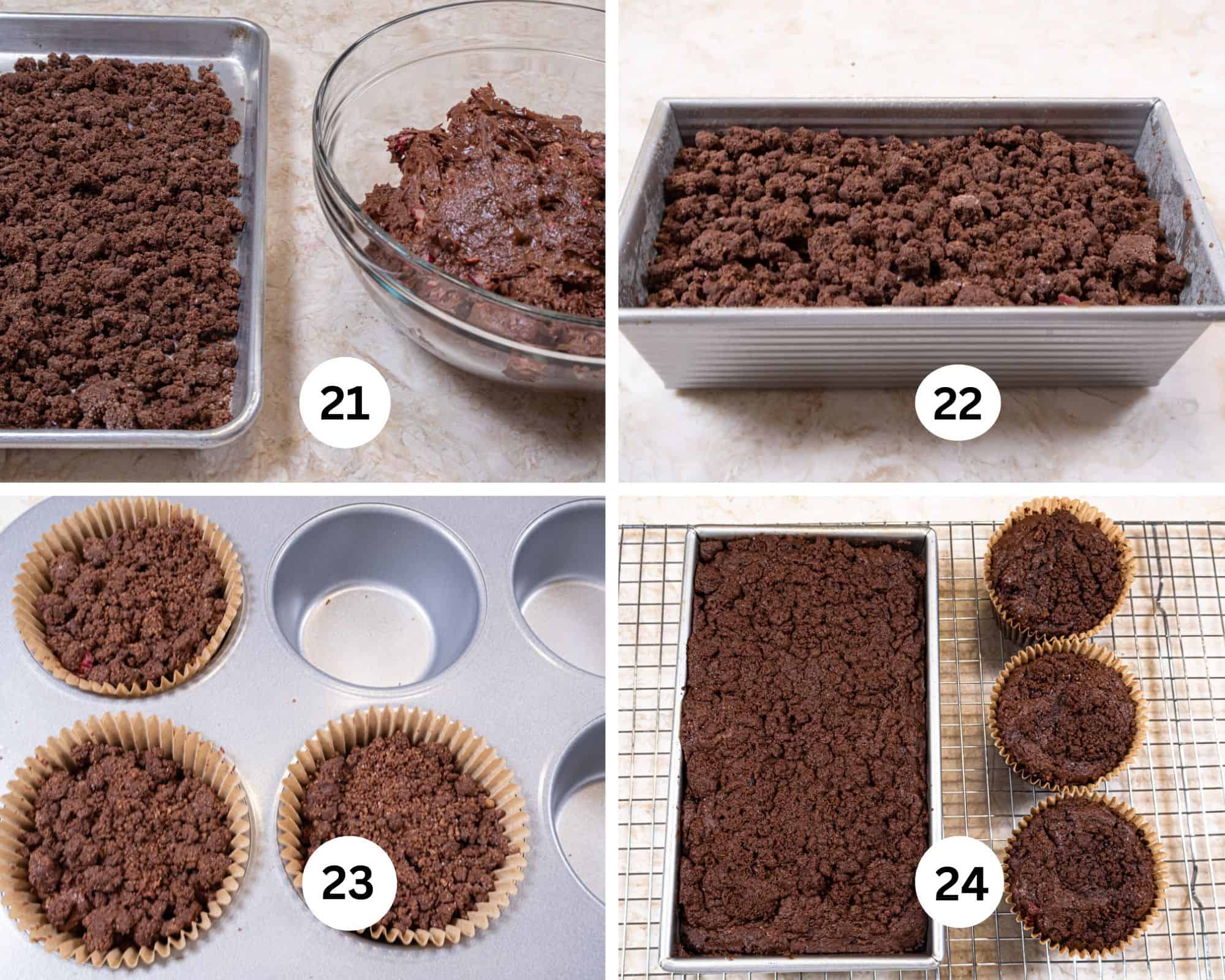
Step 21. Have the crumbs and batter ready. Step 22. Place a parchment liner on the bottom of the pan and spray the entire pan, including the parchment with a non-stick baking release. Fill the loaf pan about with about ¾ of the batter or 915 grams. Top with about ¾ of the crumbs or 170 grams. Step 23. Line three jumbo muffin pans with paper cups and divide the remainder of the batter between them. Top with the crumbs. Step 24. Bake as directed.
Not for this recipe. It is important to use the fresh cranberries so they can be frozen and chopped. They also taste differently than dried cranberries as their flavor is concentrated due to drying.
Quick breads use baking soda and baking powder which are chemical leavening agents for quick breads. They will cause the bread to rise quickly, hence the word quick breads. While yeast also leavens bread, it is a much slower process resulting in a different outcome.
Banana Bread, Zucchini Bread, Cheddar Cheese, Carrot Bread, Soda Bread. Also, muffins, pancakes, waffles, scones, popovers, tortillas and cornbread are all considered quick breads.

A lot of work goes into each of my recipes and my only ask is that if you like the recipe or even the looks of it, please leave me a star rating to help me rank better. It’s important and I appreciate it and I appreciate you.
Modified: · Published: by Helen S Fletcher · This post may contain affiliate links · 35 Comments
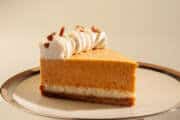
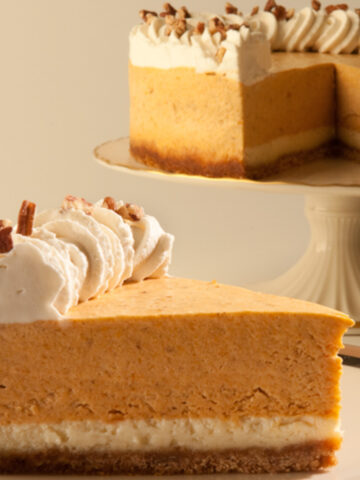
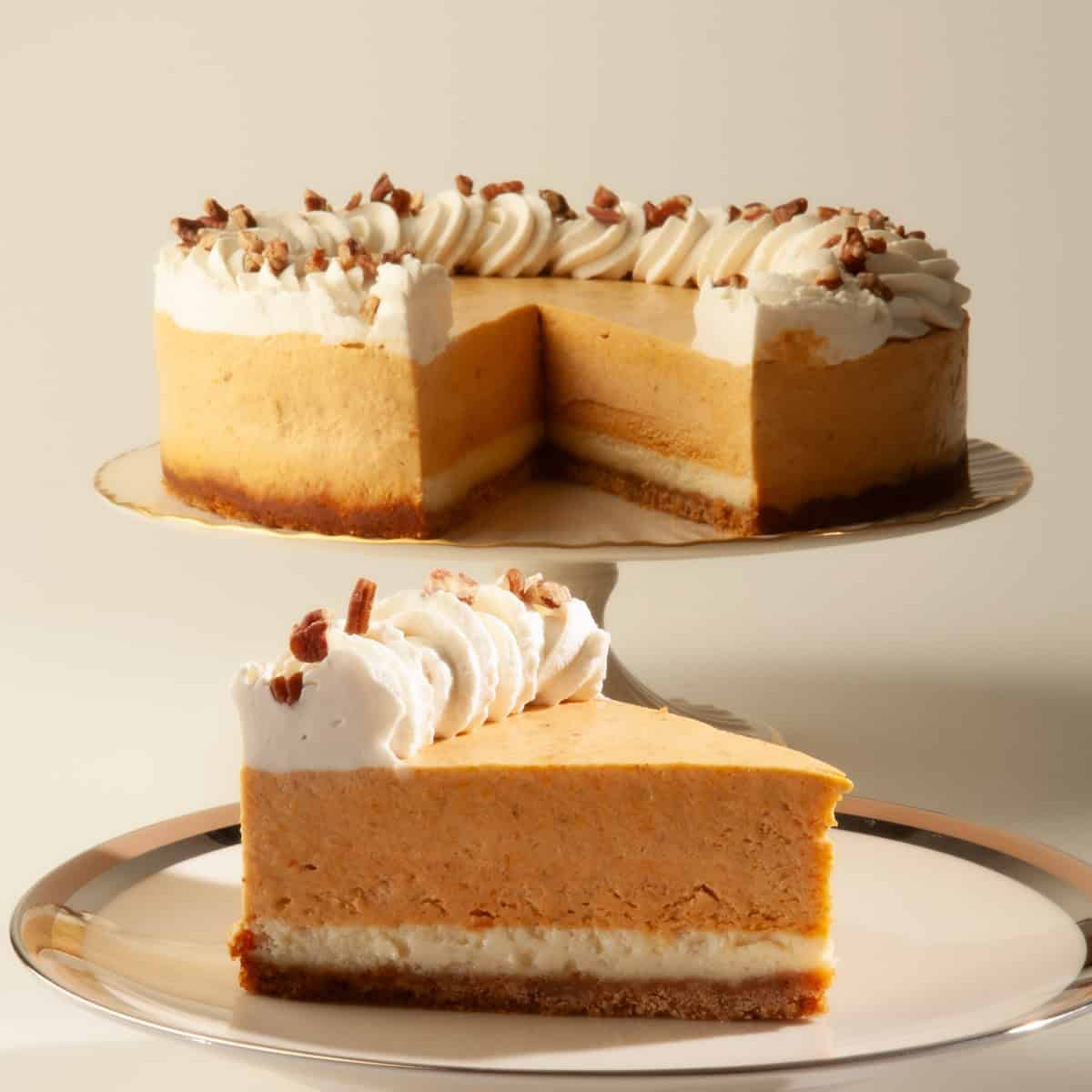
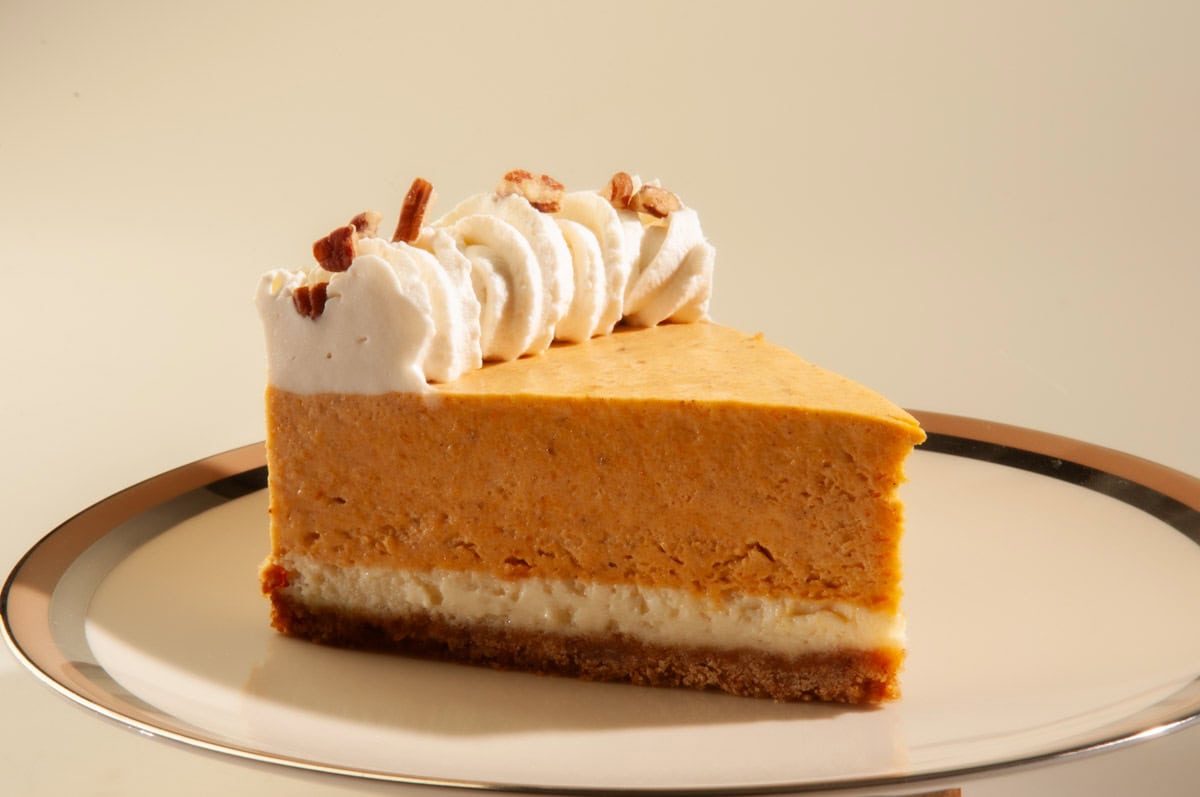
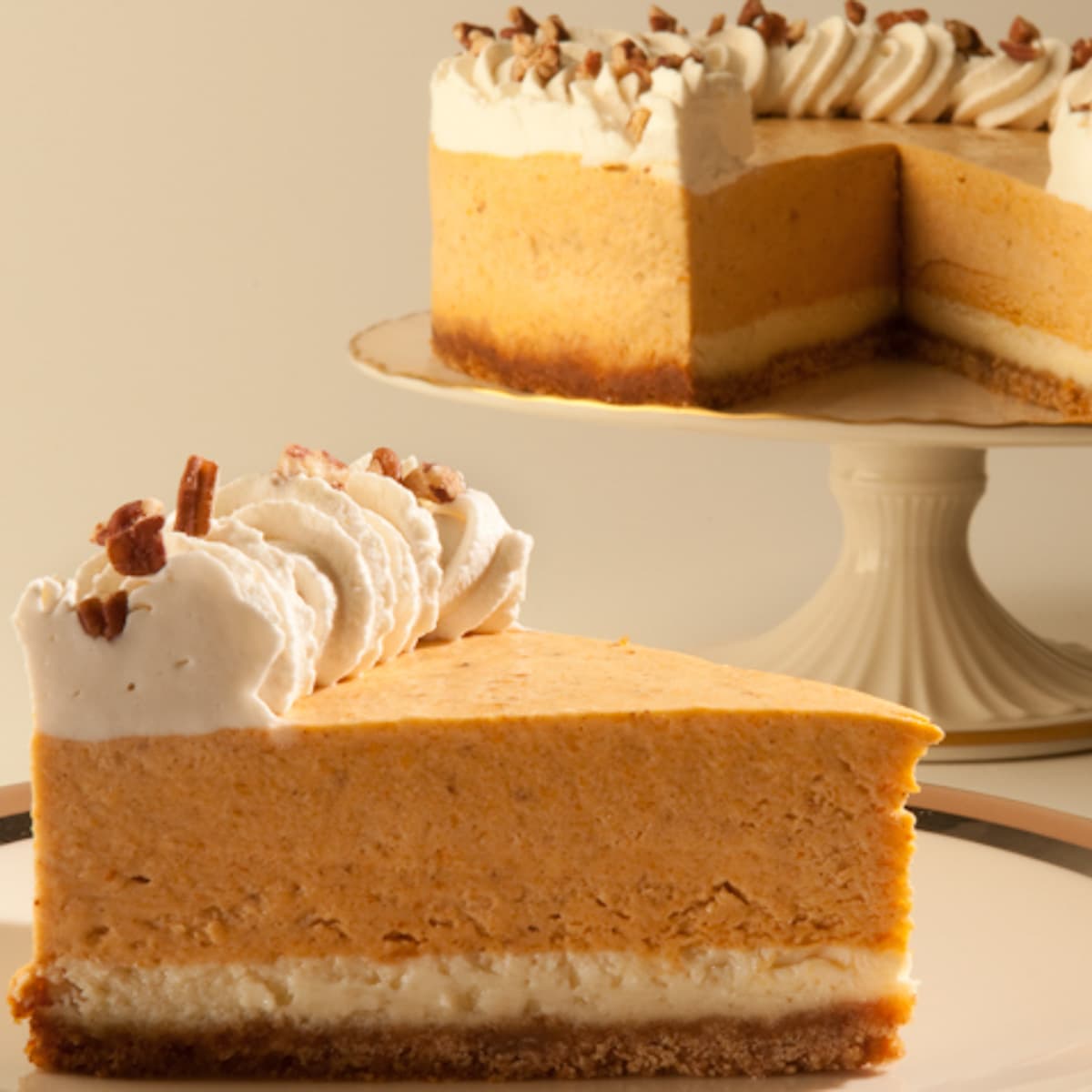
This Pumpkin Mousse Torte Recipe is exactly that new dessert you're looking to serve during the holidays. This was, without question, the most popular dessert we made at the bakery for the fall months including Thanksgiving. The crumb crust, topped with a cheesecake layer and finished with a light, but intense pumpkin mousse soon became everyone's favorite.
This is an update of the original recipe that included raw eggs which I removed due to concerns about them. I found they were completely unnecessary as the torte is every bit as good without them.

Pumpkin Mousse Recipe is an easily made dessert that can be made ahead and frozen. In fact, that is exactly how we sold them to our clientele when I had the bakery. It takes one more thing off of a busy to-do list for Thanksgiving.
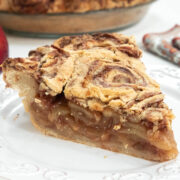
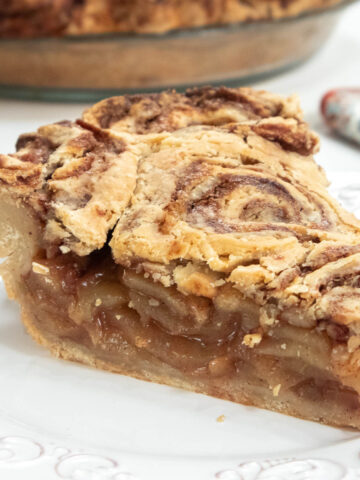
Looking for more than one fabulous dessert for the holidays? Here are a few more suggestions: Almost No Bake Pumpkin Tart, Cinnamon Bun Apple Pie, Cranapple Pie with a Pleated Crust (so much easier than a tradition pie), Butter-Rum Pecan Tart, Chocolate Caramel Pecan Tart, Pumpkin Cheesecake Tart with Caramel Rum Sauce, or try one of our snackables Cranberry Muffins Recipe, Really Easy Pumpkin Muffins (with a streusel top), the Pumpkin Cake Donut Recipe, the easiest ever Apple Cake Doughnuts and Fill Your Home With Autumn Baking.
I know how irritating it is to use a portion of a product and be stuck with the rest. What are you supposed to do with it? Well I have some really tasty ideas to get you started. You can actually make several of these out of the remaining puree.

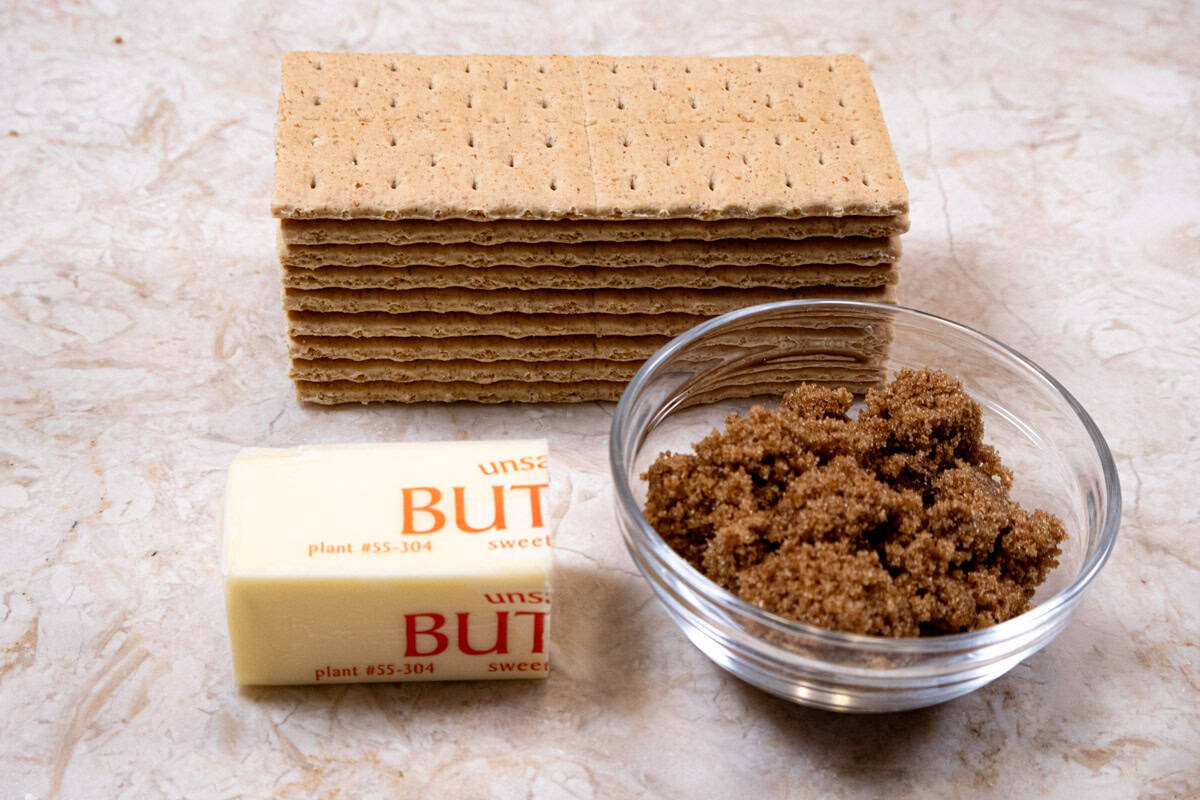
FRONT ROW: Unsalted butter, brown sugar
BACK ROW: Graham Crackers

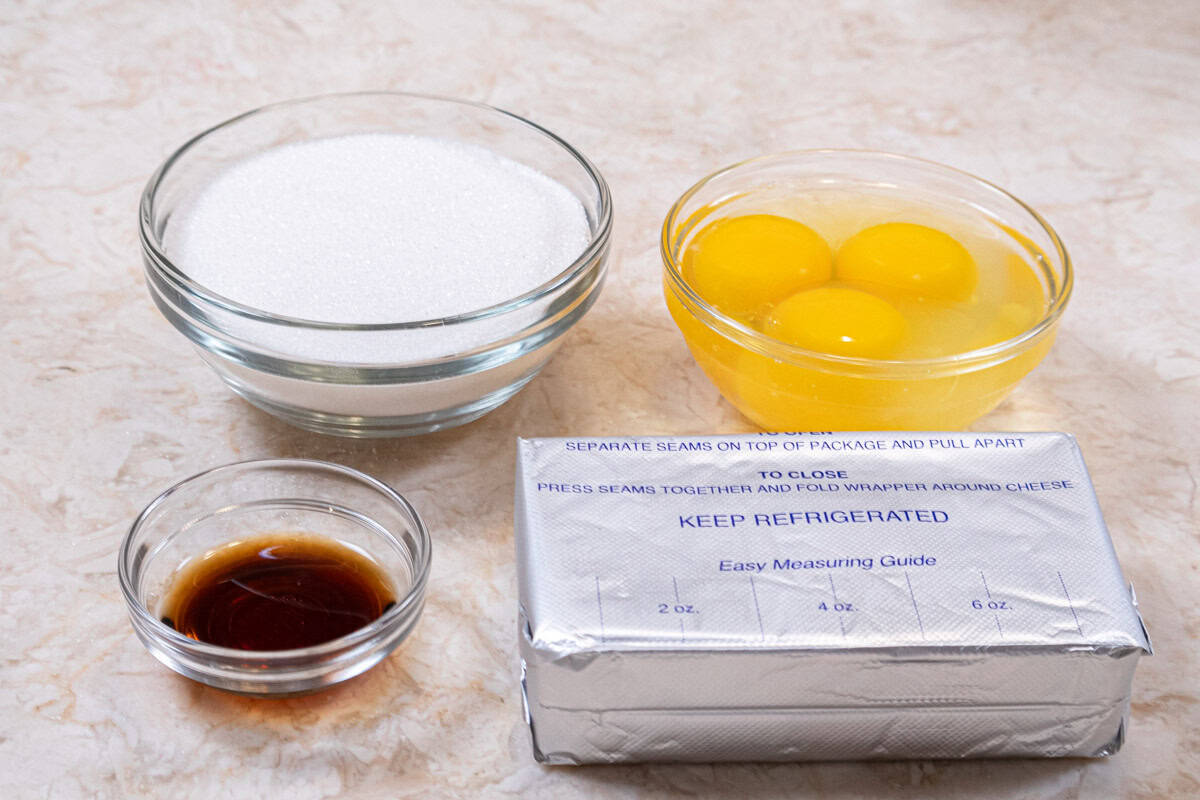
FRONT ROW: Vanilla extract, cream cheese
BACK ROW: Granulated sugar, eggs and egg yolk

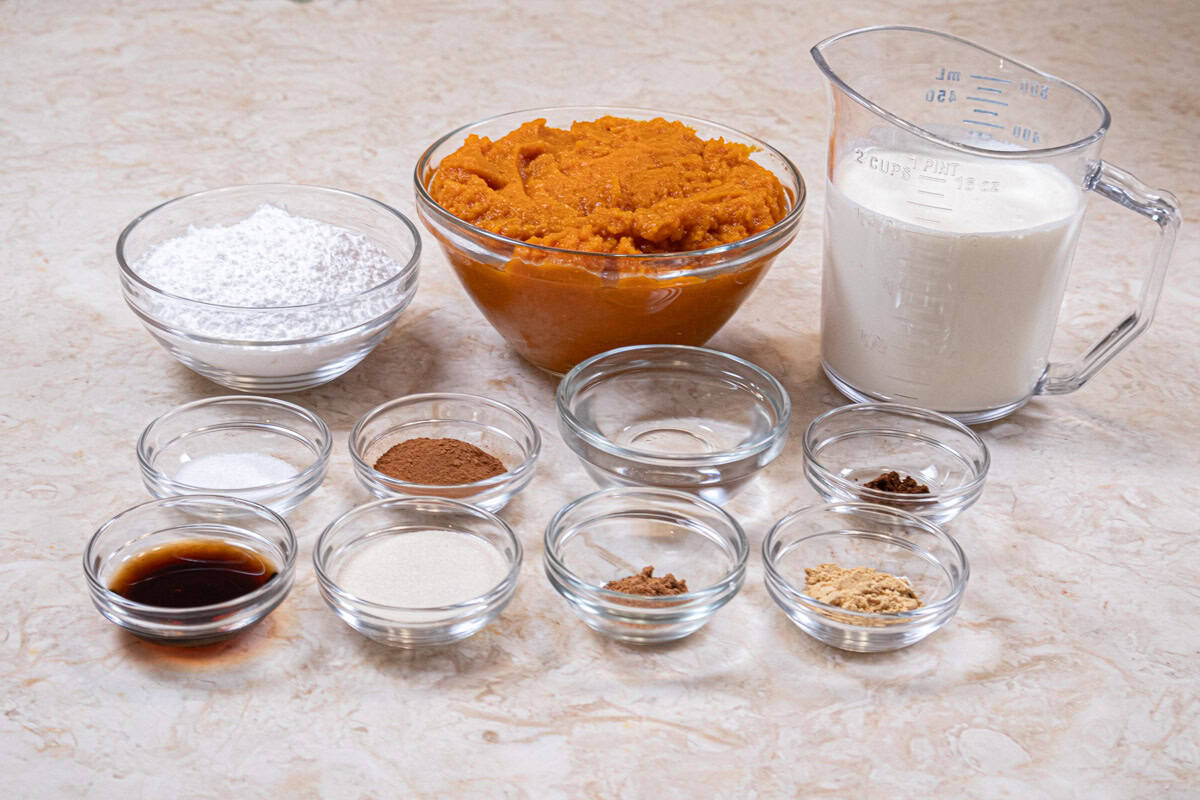
FRONT ROW: Vanilla extract, gelatin, nutmeg, ginger
MIDDLE ROW: Salt, cinnamon, water, cloves
BACK ROW: Powdered sugar, canned pumpkin, heavy cream

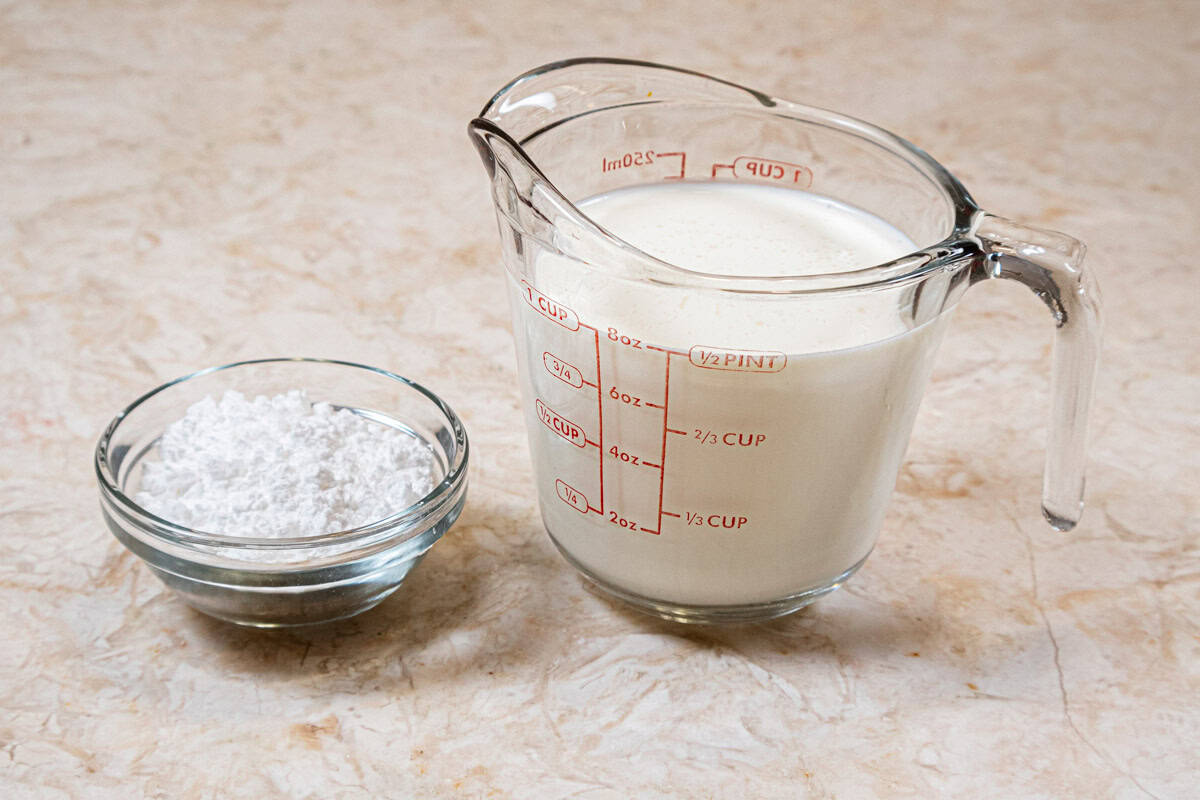
LEFT TO RIGHT: Powdered Sugar, heavy cream
Be sure to see the recipe card below for the full ingredients and instructions.

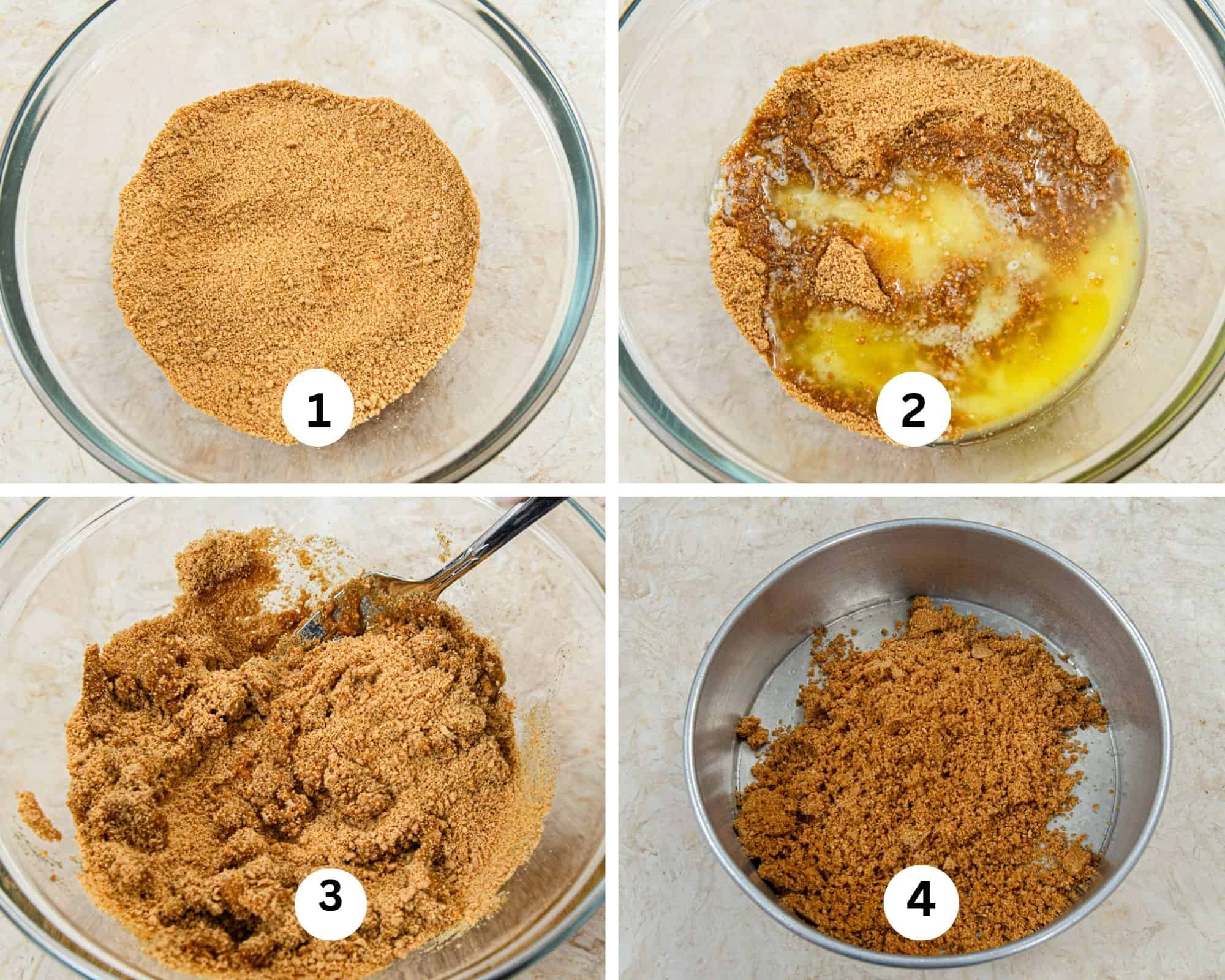
Step 1. Combine the crumbs and brown sugar in a bowl. Step 2. Add the melted butter. Step 3. Start mixing with a fork to moisten the crumbs. I usually end up using my hand because it's faster and does a better job. Step 4. Pour the crumbs into a cheesecake or springform pan that has been sprayed with a non-stick baking release.

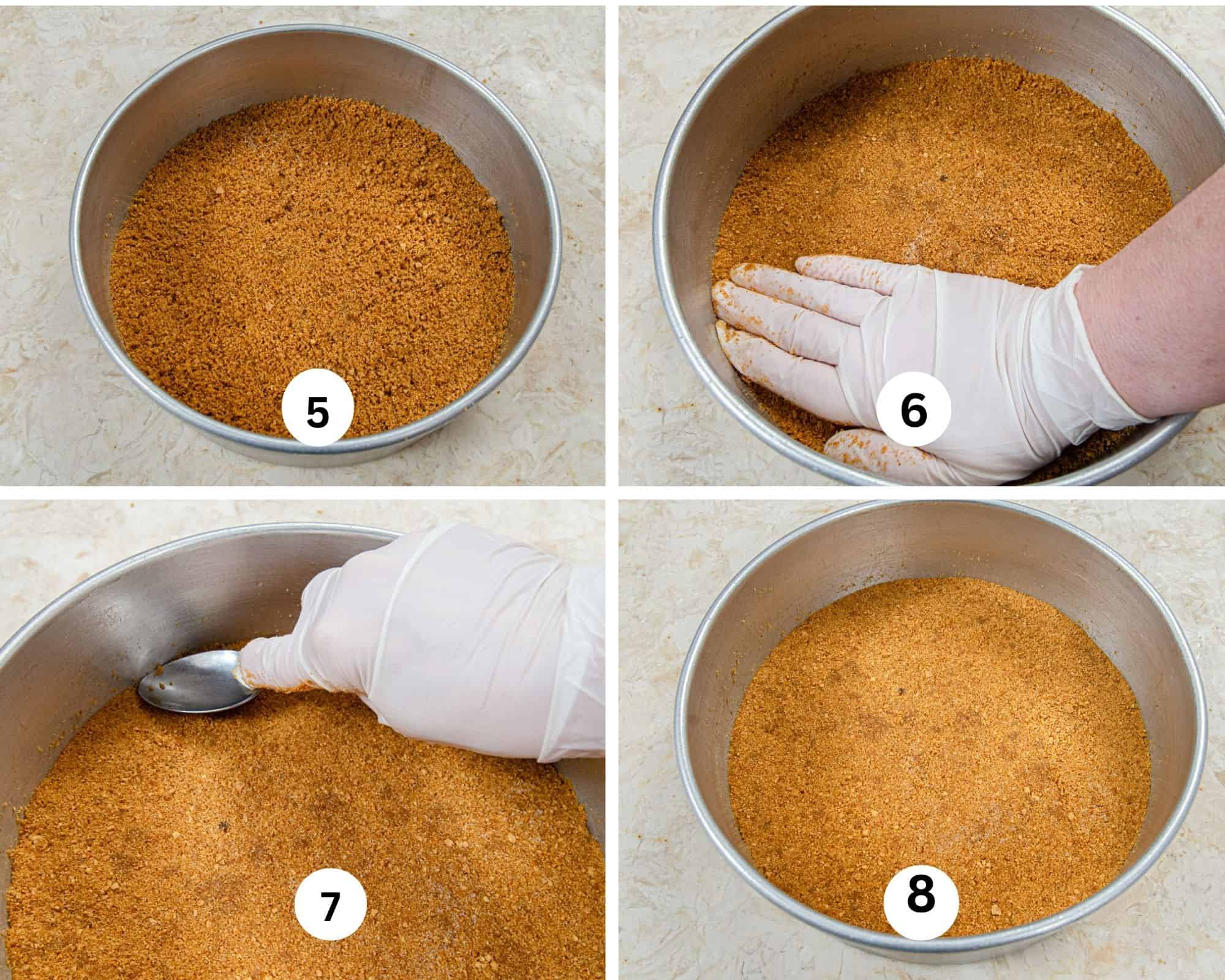
Step 5. Distribute the crumbs evenly over the bottom of the pan. Step 6. Press them firmly into the bottom. Step 7. Using the back of a spoon, press the edges firmly into the side of the pan so no filling can leak under the crust. Step 8. This is what the finished crust should look like. Bake as called for.

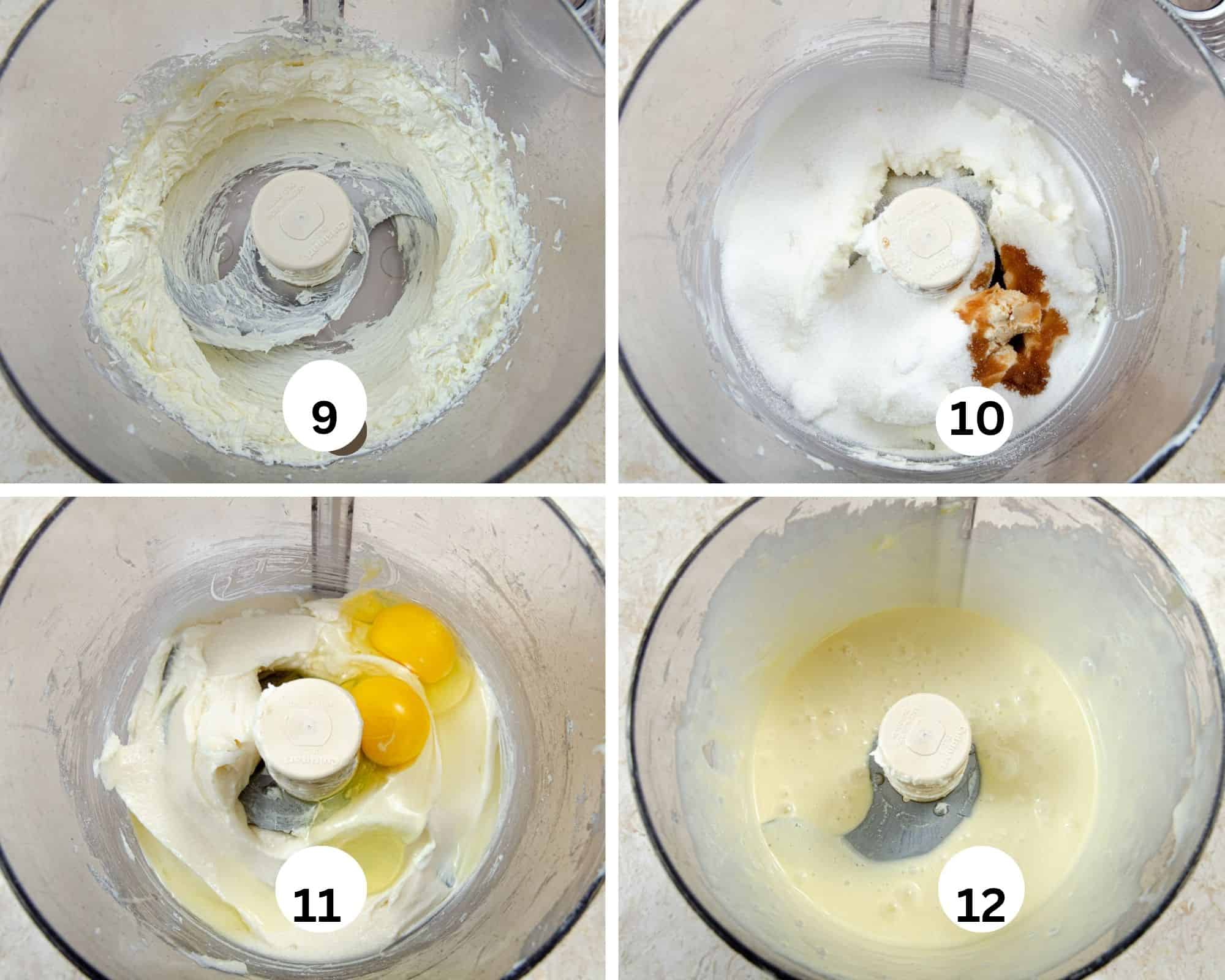
Step 9. Cut the room temperature cream cheese into 4 pieces and add it to the processor. Process until smooth. Step. 10. Add the sugar and vanilla, processing until smooth. Scrape down as necessary. Step 11. Add the whole eggs and yolk. Step 12. Process, until everything is combined and smooth. Make sure to scrape well so no lumps are left.

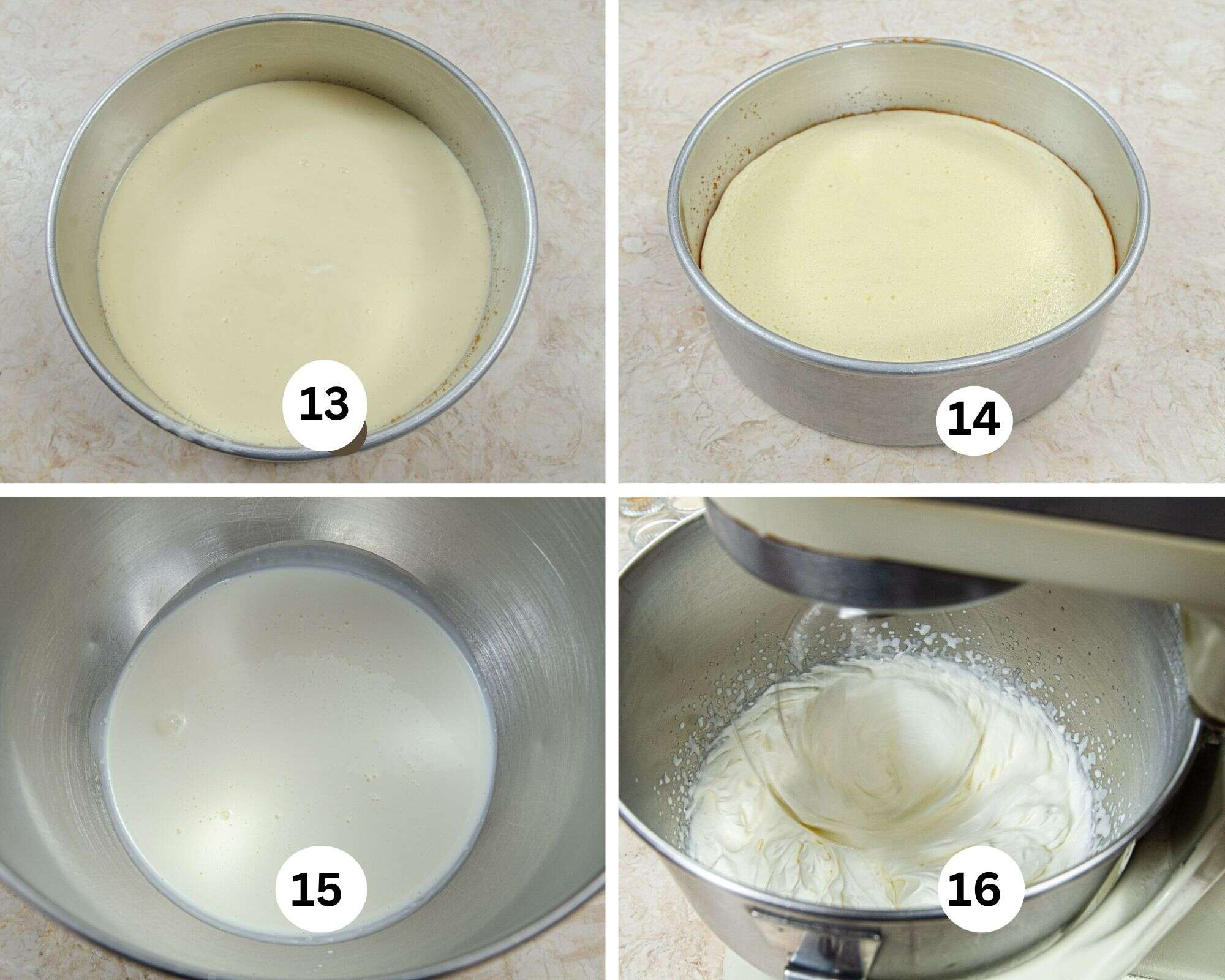
Step 13. Pour the cream cheese layer over the baked crumb crust. Step 14. Bake as called for. It should be browned around the edge of the pan only. The top will be white with no wiggle. Cool completely before proceeding. Step 15. Pour the cream into the bowl of a mixer. Step 16. Using the whisk attachment, beat the cream until medium stiff peaks form. Do not beat to stiff peaks. Remove the cream to another bowl and set aside. There is no reason to clean the bowl before continuing.

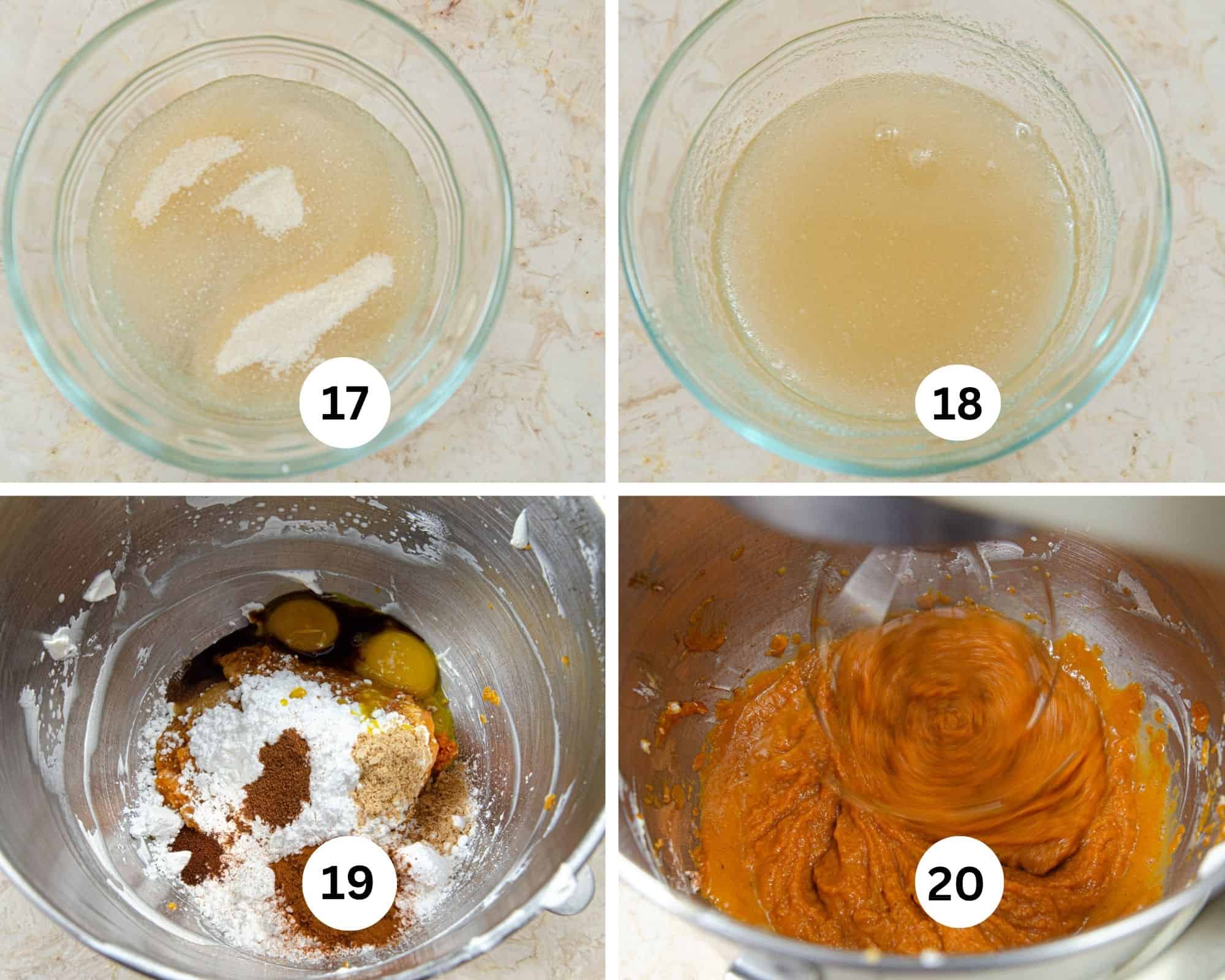
Step 17. Combine the water and gelatin. Stir together to moisten all of the gelatin. Step 18. Set aside to let it bloom. Step 19. Place all of the ingredients for the mousse except the cream and gelatin in the mixing bowl. (In this photo there are eggs. This is an updated version and they have been removed from this Pumpkin Mousse Recipe.) Step 20. Mix the ingredients just until combined. Liquify the gelatin in the microwave for a few seconds and pour it into over the ingredients. Immediately, mix it in completely but gently.

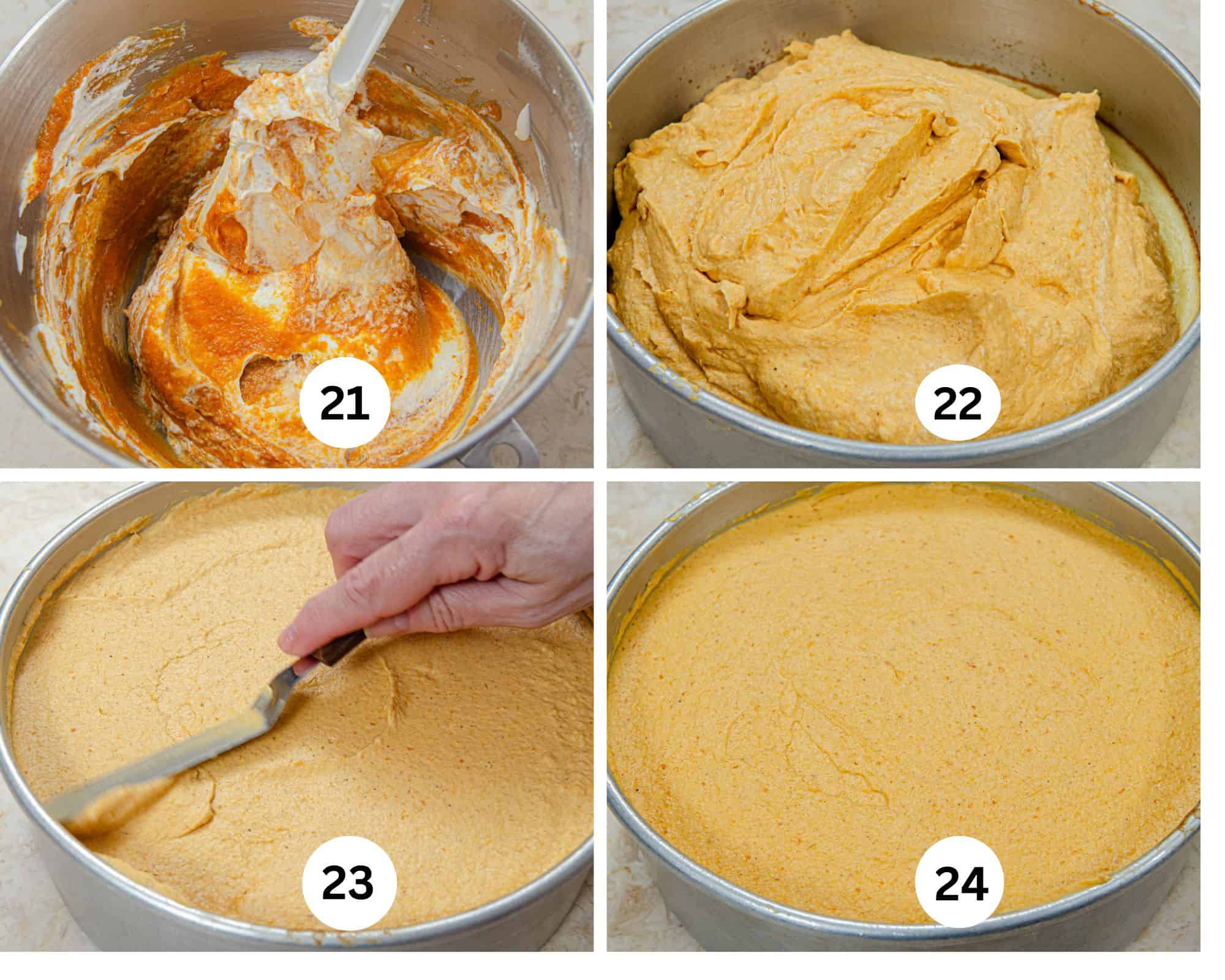
Step 21. Return the whipped cream to the bowl and fold together. Step 22. Pour the mousse over the cheesecake layer Step 23. Using a small offset spatula, smooth out the filling. Step 24. The finished torte should be refrigerated overnight or for a couple of days.

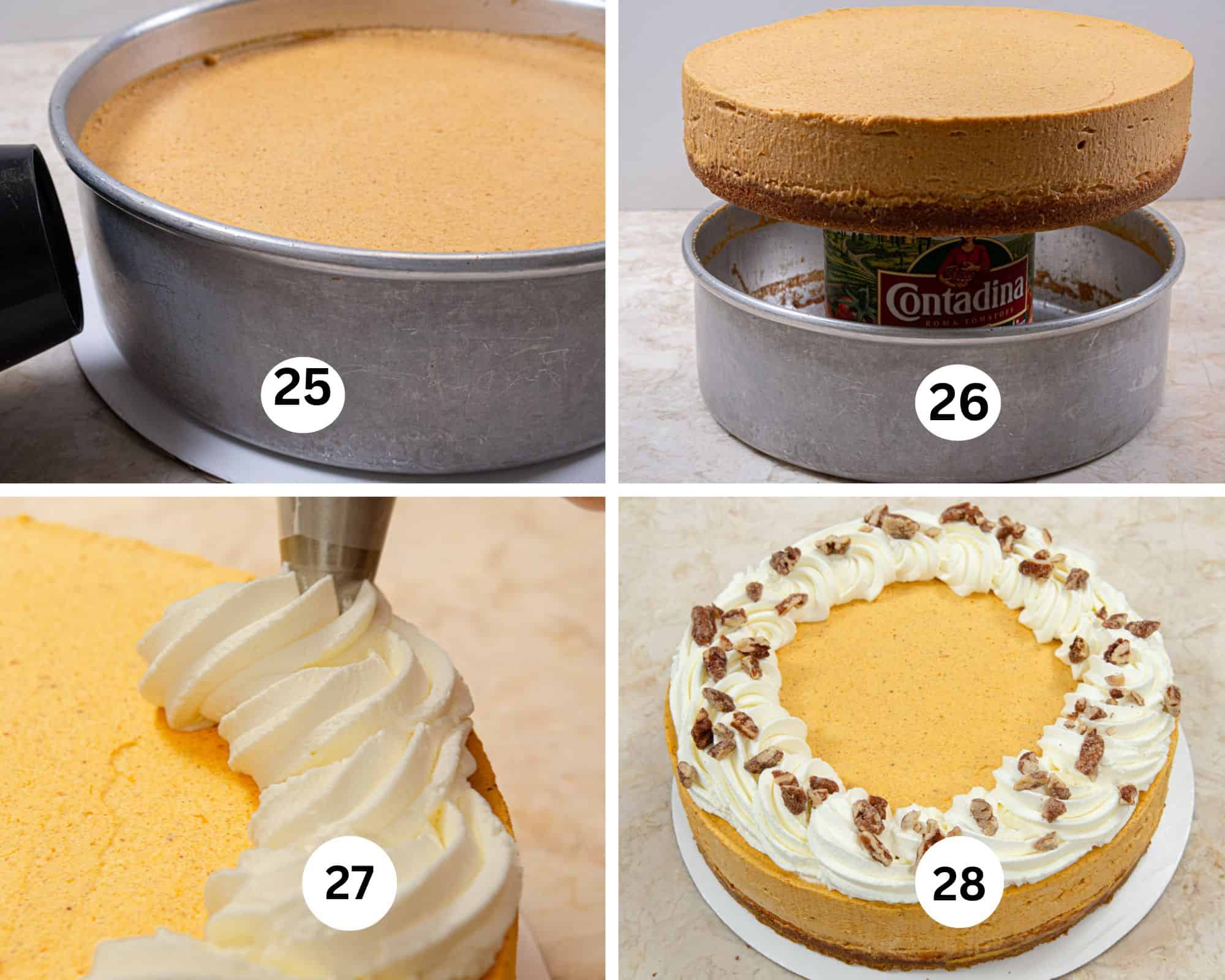
Step 25. To release the cake go around the edge of pan with a blow dryer about a quarter inch away. This will gently heat the torte. Step 26. Place the pan on a wide can (a 28 ounce can is perfect) and slide the rim of the pan down. Place the torte on the table and use two pancake turners placed between the cake and the metal bottom. Lift it off onto a cake round or serving plate. Step 27. Whip the cream for the whipped cream wreath until fairly stiff. Fit a piping bag with a #5 or #6 open star and fill it with the cream. Pipe a wreath around the edge of the Pumpkin Mousse Recipe. Step 28. Sprinkle the wreath with coarsely chopped pecans if desired. Refrigerate until serving.
It is best to freeze the Pumpkin Mousse Recipe without the whipped cream wreath as it can be damaged easily. Thaw it in the refrigerator overnight. Remove it from the pan if frozen in the pan and finish with the wreath.
George H.W. Bush in 1989.
They are a fruit because they grow from a flower and contain seeds. The entire plant, including the flower and seeds can be eaten. The word pumpkin comes from the Greek word "pepon" meaning "large melon.
Cinnamon, ginger, nutmeg, cloves and sometimes allspice.
The Pumpkin Mousse Recipe can be stored in the fridge for up to 4 days. It can be frozen for a month. If freezing it is best to do so without the whipped cream wreath around the edge. Simply freeze it in or out of it's pan then wrap it well in foil. Thaw it in the fridge then finish it.

A lot of work goes into each of my recipes and my only ask is that if you like the recipe or even the looks of it, please leave me a star rating to help me rank better. It’s important and I appreciate it and I appreciate you.
Modified: · Published: by Helen S Fletcher · This post may contain affiliate links · 5 Comments
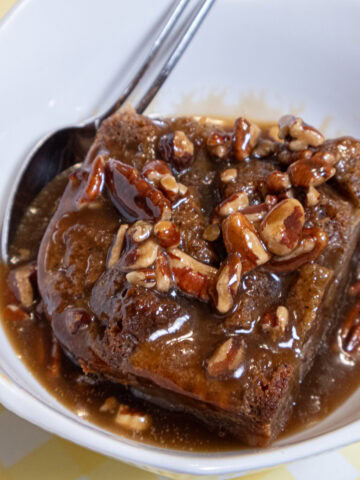
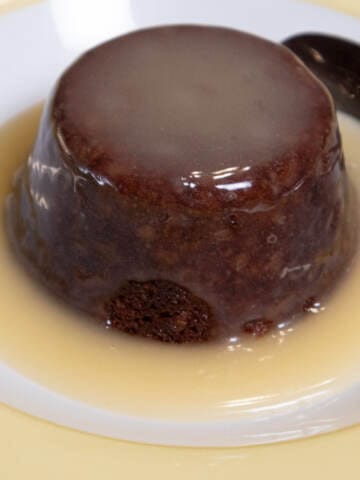
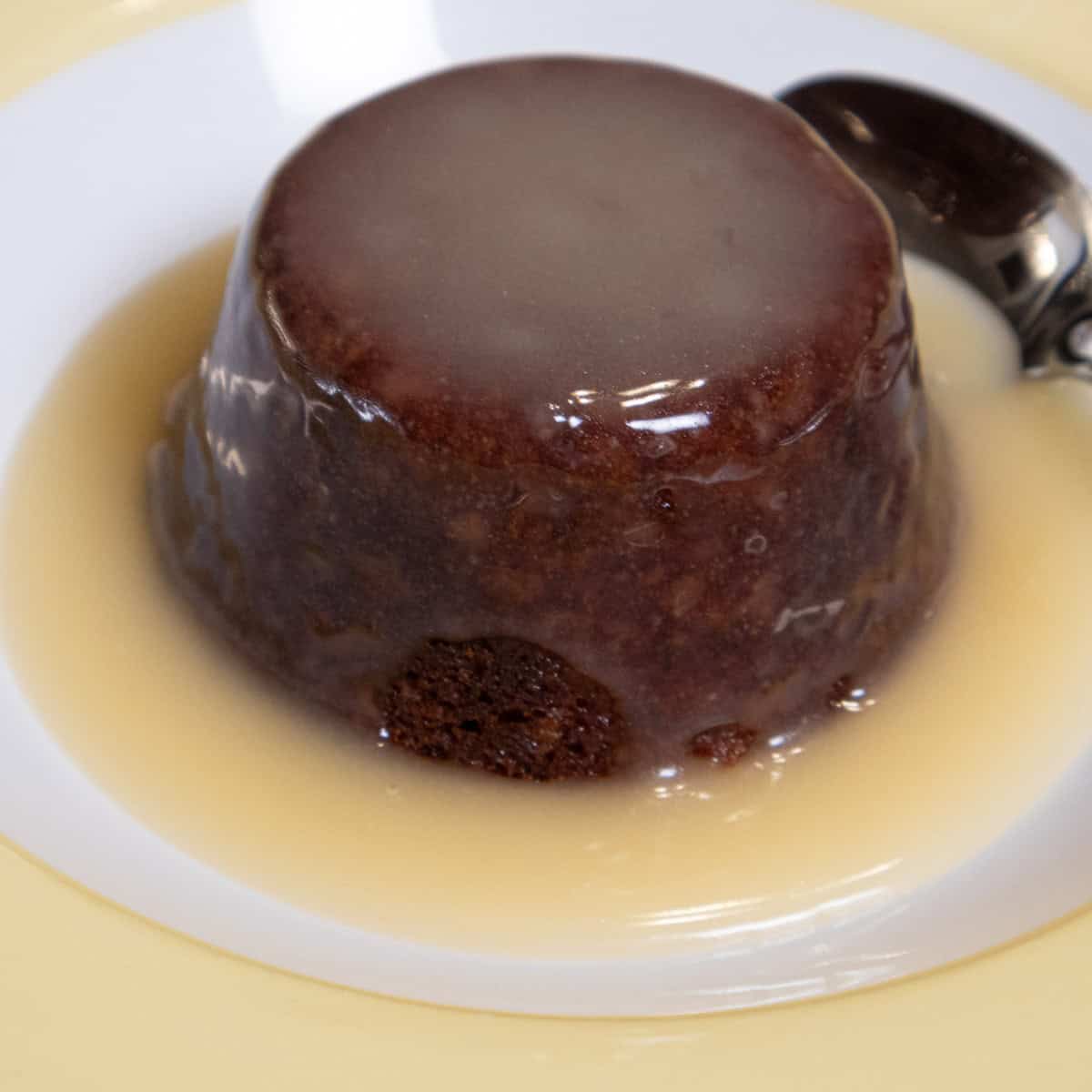
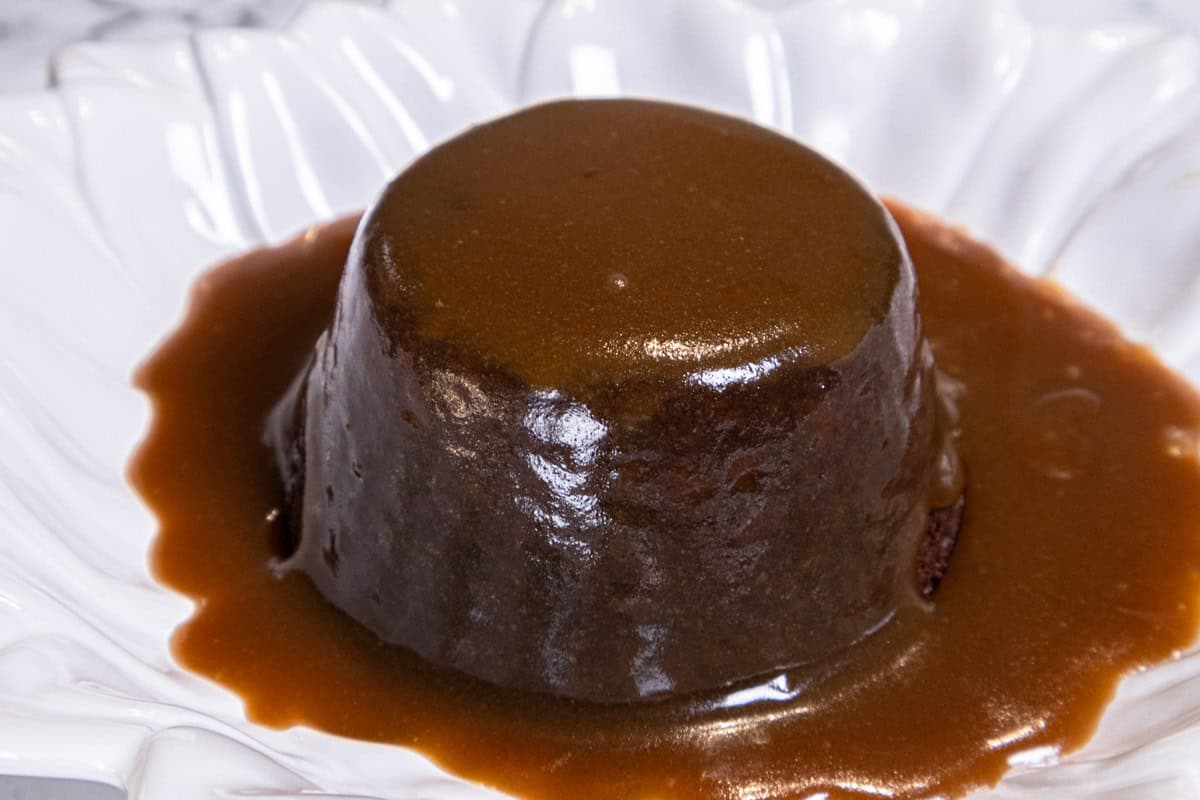
If you're looking for a low stress quickly made holiday dessert this Non Traditional Sticky Toffee Pudding is not to be missed. While often thought of as overwhelmingly sweet, this one is not. The easily made individual sponge cakes are rich, moist, served warm with one of two sauces - traditional Toffee Sauce or a Lemon Rum sauce for a change.
So why is this non traditional? Because the dates are cooked with a bit of Kahlua which enhances the taste and both sauces contain a bit of dark rum for depth.

I had a bit of fun researching this recipe. I found it is steamed, it isn't steamed (at least not anymore), it has spices, oh, no it doesn't, it can be soaked in toffee sauce but doesn't have to be, it's served hot but can be served cold (if you are a bore), it is accompanied by whipped cream, no make that ice cream.
The two things everyone agrees on it is made with dates that are softened in hot or boiling water and it is served with toffee sauce accompanied by whipped cream, creme anglaise, or ice cream or just toffee sauce. Or it used to be - now there's a Lemon Rum Sauce to go with it.
Looking for another impressive dessert? Try these Tiramisu Parfaits.
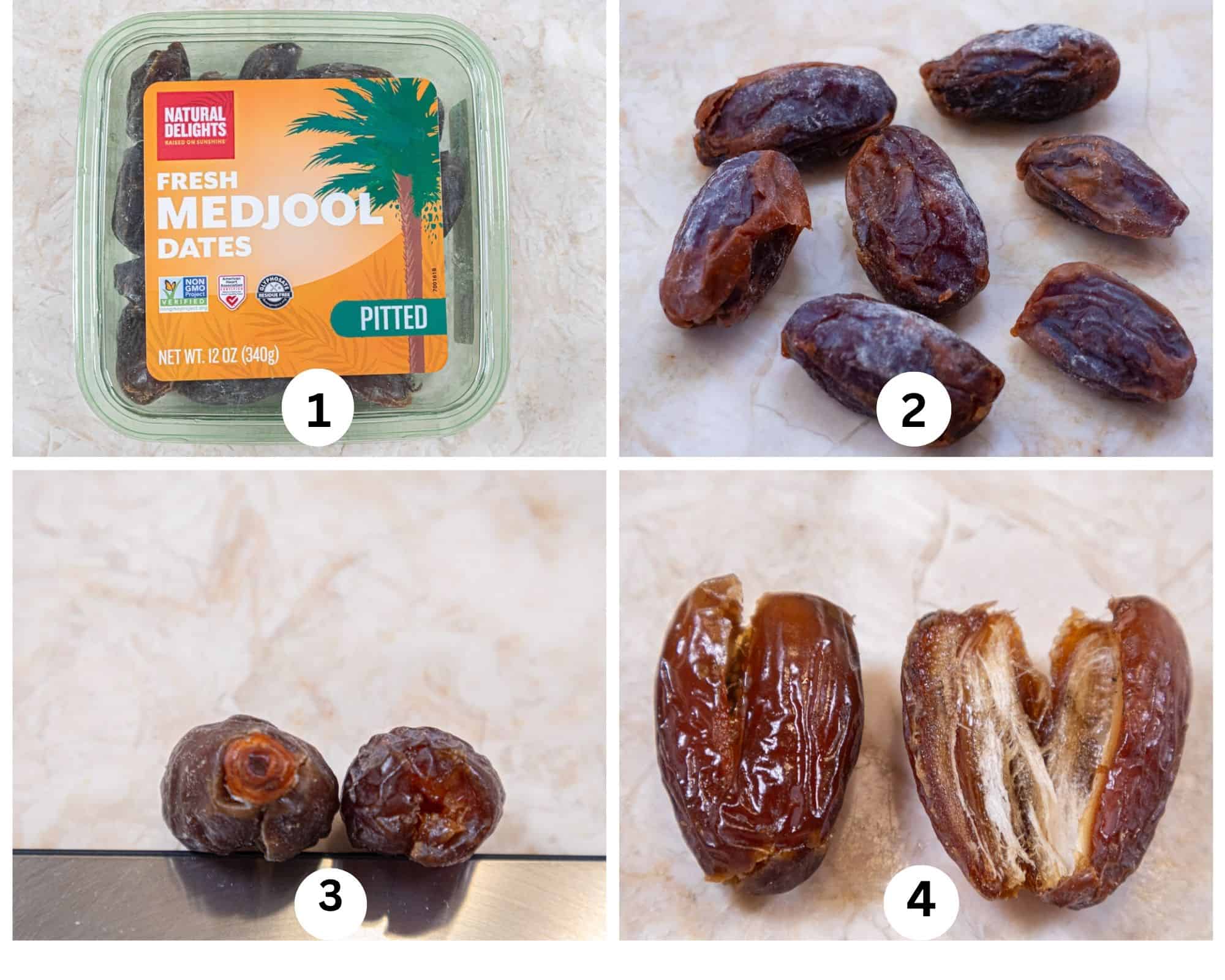
[feast_advanced_jump_to]For the purposes of this recipe all dates are not created equal. The premier date is Fresh Medjool Dates. Native to Morocco, Medjool dates come from the date palm tree and are now grown in warm regions of the United States, the Middle East, South Asia, and Africa. There are a couple of great articles, 6 Benefits of Medjool Dates and Everything you Need to Know About Medjool Dates that fill you in on all the benefits of this amazing fruit.
Fresh Medjool dates are not the same as dried dates and therein lies the difference for me. They are harvested at their peak of ripeness when their moisture content is high making them soft and chewy with a caramel like texture. On the other hand, "dried dates" are dehydrated making them firmer in texture and sweeter. I made this several times because the first time I used a package of dates found in the dried fruit department of the grocery store. I found it to be bland. So I went to my usual go-to Medjool dates and it made a big difference.
Here are a few things to look for when preparing them to cook with:

1. Medjool dates come pitted and with pits. I'm not sure about you but I have better things to do than pit dates. 2. The size of the dates is at least twice as big as other dates and they are moist as opposed to dry. 3. Look carefully at the dates as some of them still have their stem end on as you can see on the one on the left. On the right date, I have removed it. 4. The other thing to look for is the pit or stone. These dates are split from top to bottom so it is easy to open them to make sure there are no pits.
There are three really good ways to use these up. The first is the Crumb Topped Orange Date Muffins. While the recipe calls for 8 ounces, the remaining 6 ounces are fine. The second recipe is the fantastic and easy Date Nut Bread which makes a great ham and cheese sandwich. The final offering is the Orange Date Bread Pudding.

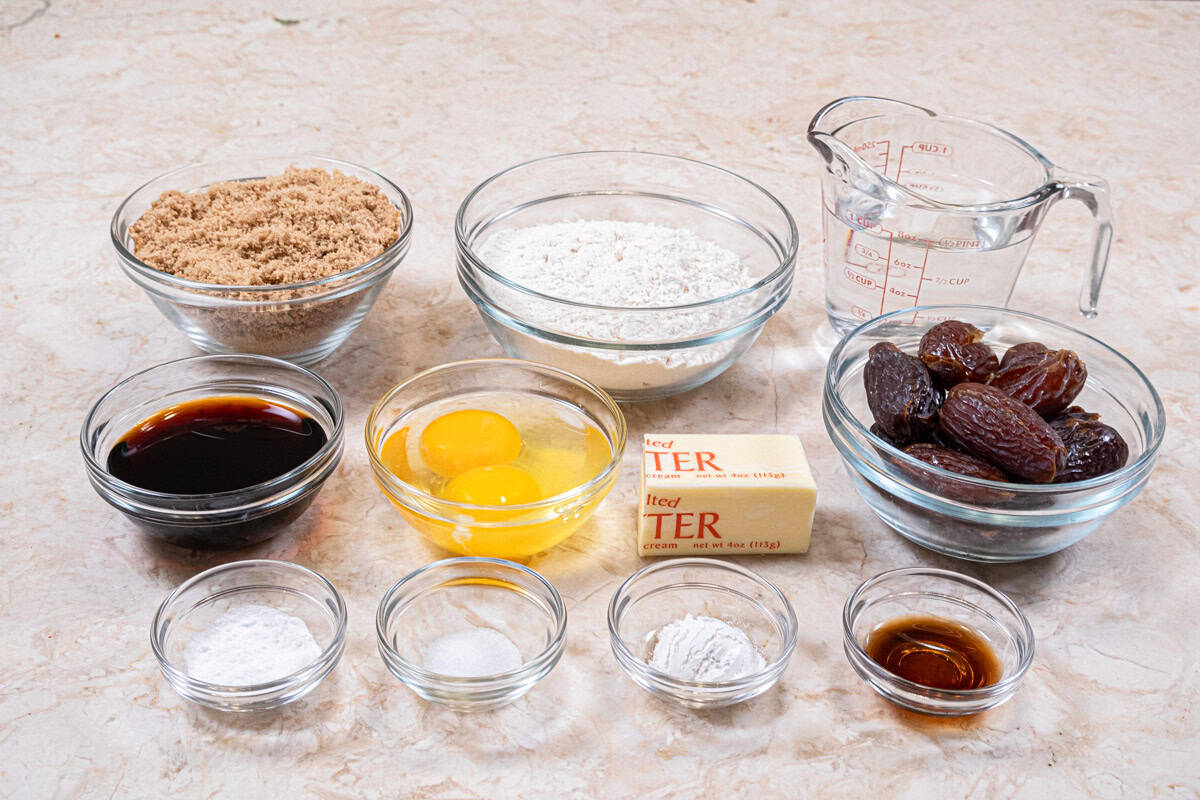
FRONT ROW: Baking powder, salt, baking soda, vanilla
MIDDLE ROW: Kahlua, eggs, unsalted butter, medjool dates
BACK ROW: Brown sugar, all-purpose flour, water

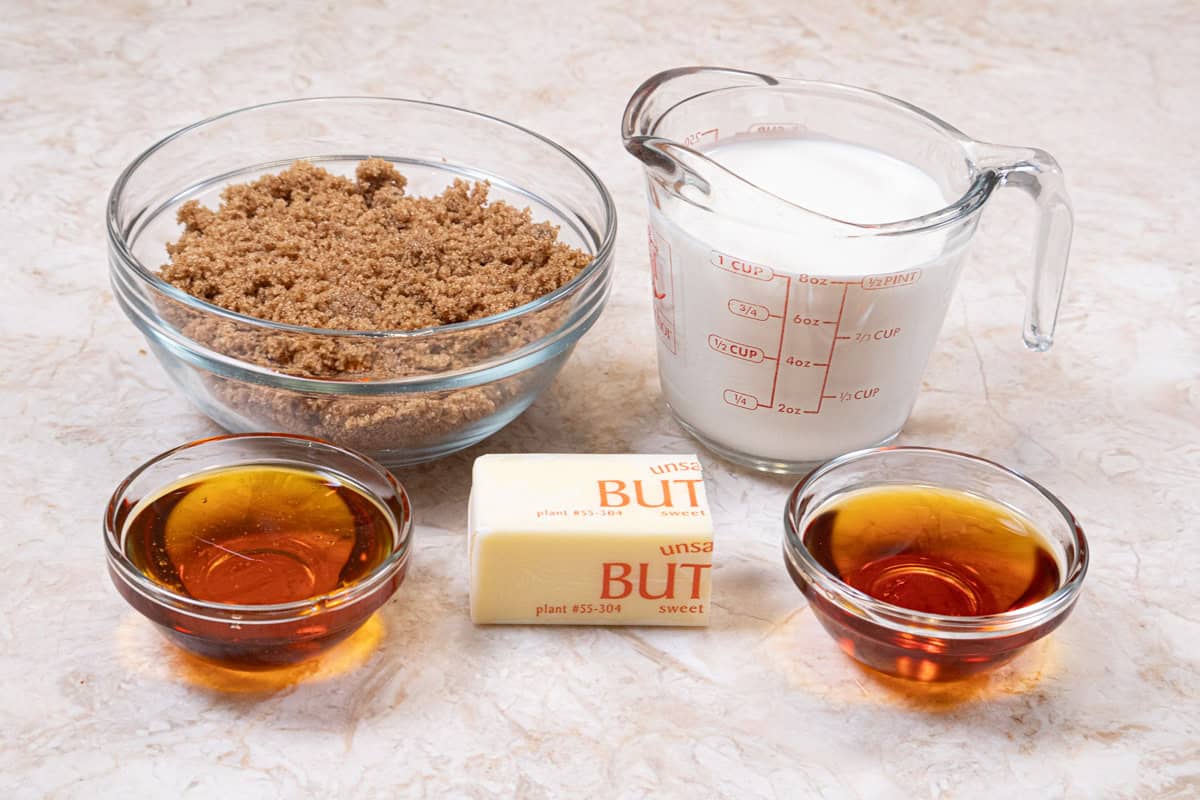
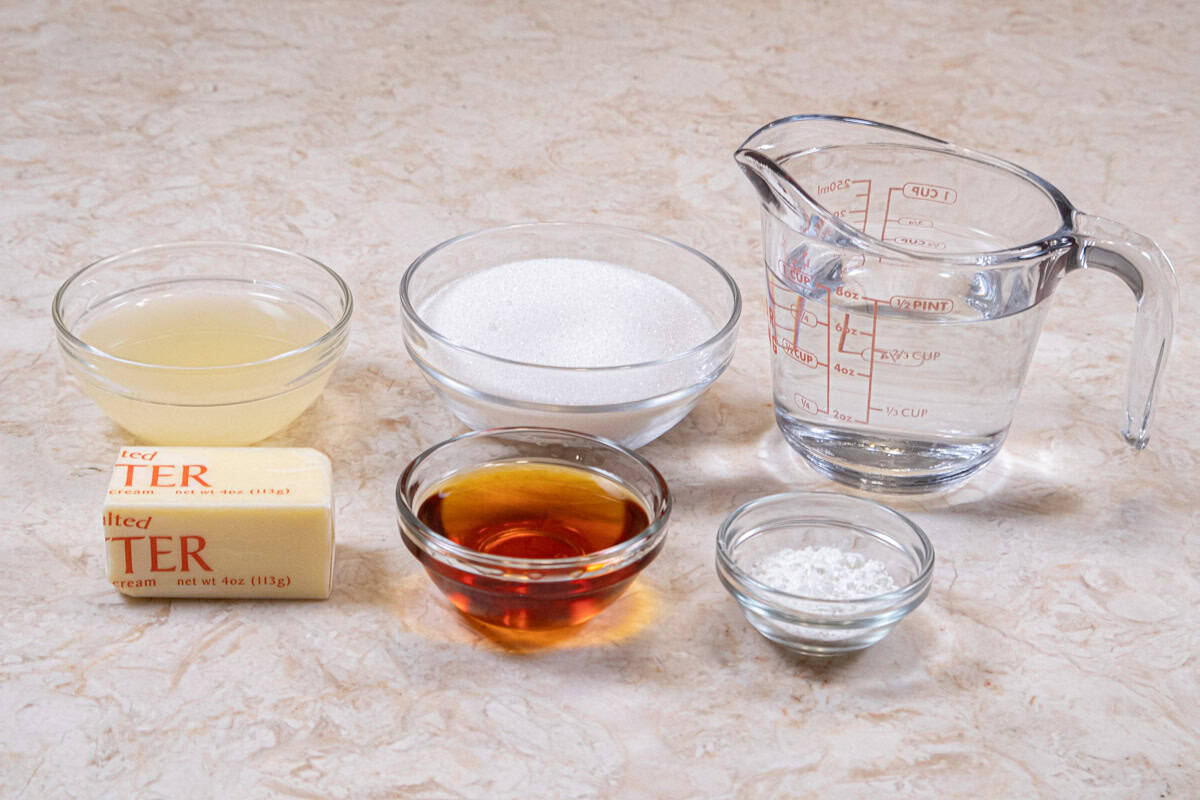
FRONT ROW: Golden Syrup (or honey or clear corn syrup), unsalted butter, dark rum ( such as Meyer's)
BACK ROW: Dark brown sugar, heavy cream

FRONT ROW: Unsalted butter, dark rum, cornstarch
BACK ROW: Lemon juice, granulated sugar, water
Be sure to see the recipe card below for the full ingredients and instructions.

Step 1. Spray six jumbo muffin cups or 6 ounce ramekins or a 12 well muffin pan for smaller puddings with a non-stick baking release. Set aside. Place the dates, Kahlua, and water in a medium size saucepan with high sides as this will boil up quite high. Bring to a boil. Step 2. Remove from the heat and heat and add the baking soda. The liquid will rise up quickly and then subside. Step 3. Place the dates and liquid in the bowl of a food processor. Step 4. Process until pureed. Cool.

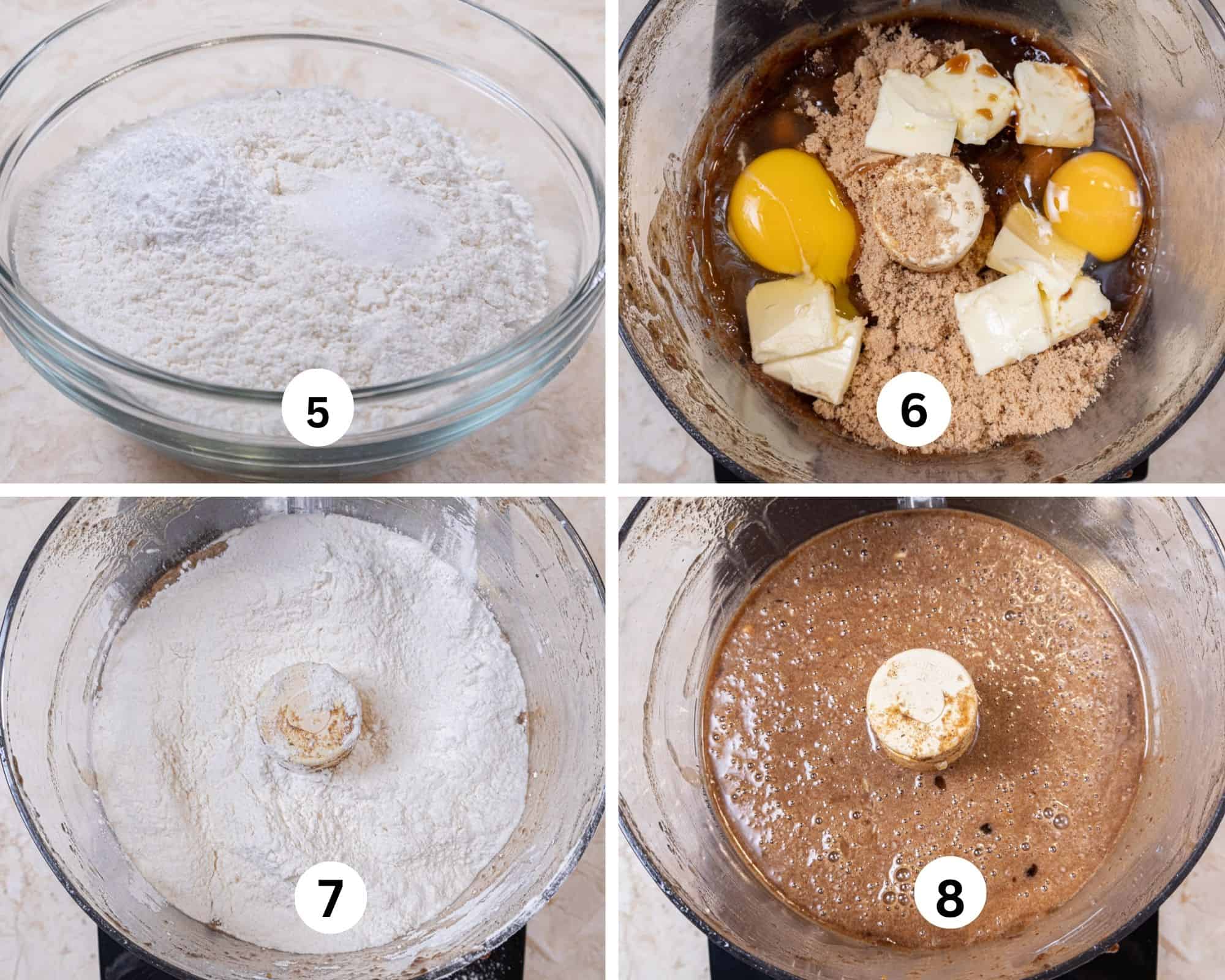
Step 5. Add the baking powder and salt to the flour and whisk. Set aside. Step 6. Add the butter, eggs, brown sugar and butter to the processor bowl. Process until smooth. Step 7. Add the flour. Step 8. Pulse quickly 3 or 4 times just to mix the flour in. Do not over mix. Divide the mixture between the molds, using about ½ cup less 1 tablespoons per mold or 140 grams. Bake as directed.

Step 9. The puddings have domed and need to be flattened. Step 10. I found the best way to do this is to use a 1 cup measure about the size of the top of the molds. Step 11. As soon as they come from the oven, press down hard with the cup to flatten them. Wipe the bottom of the cup each time to prevent the cake from sticking to the cup. Do it again if necessary. Step 12. Cool for about 10 to 15 minutes and turn the puddings out onto a cooling rack to cool completely.

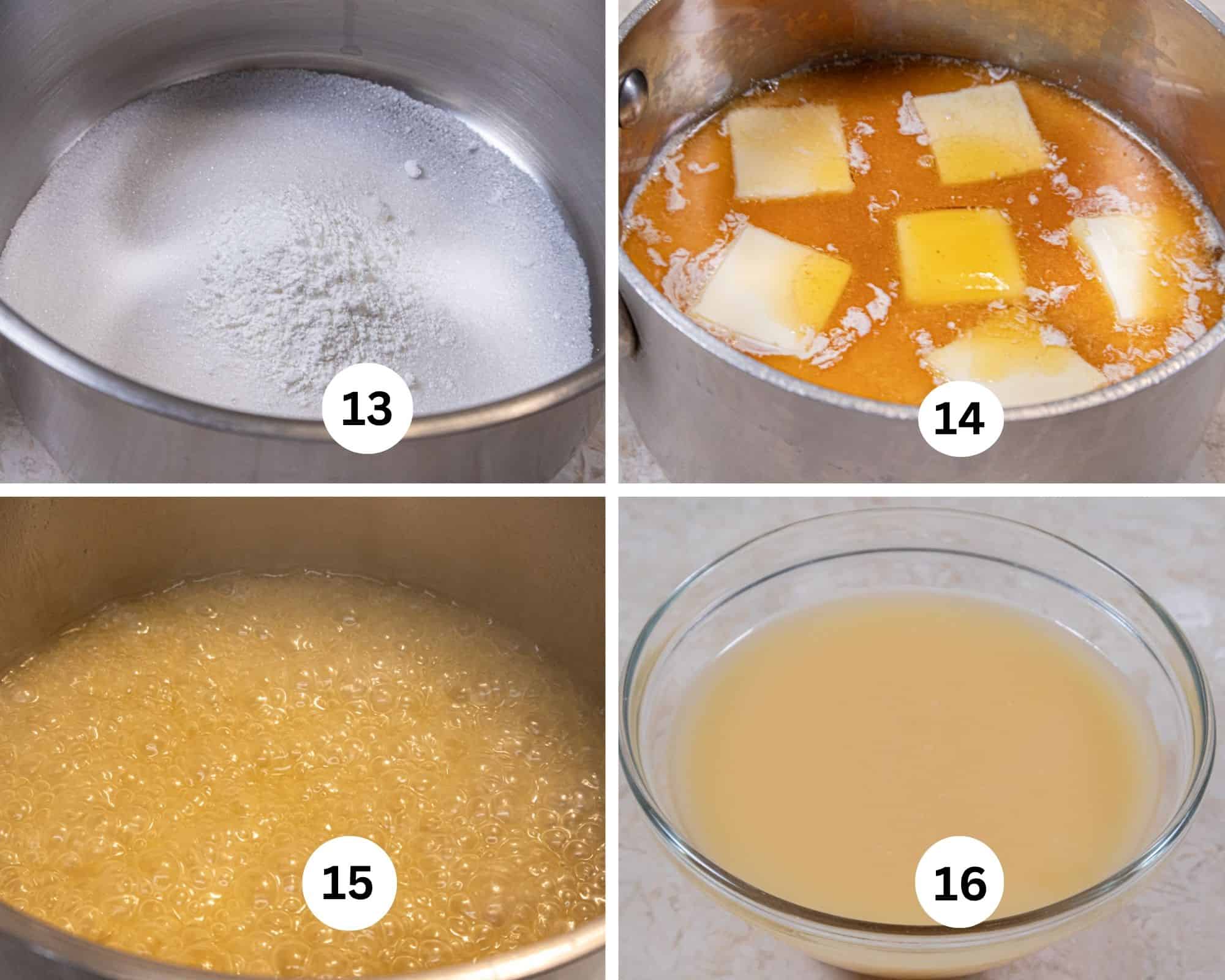
Step 13. For the lemon sauce, whisk together the flour and baking powder in a medium size saucepan. Step 14. Add the remaining ingredients. Step 15. Bring to a boil while stirring. Stop stirring and let the sauce boil hard for 1 minute. 16. Remove from the heat and pour into a bowl.

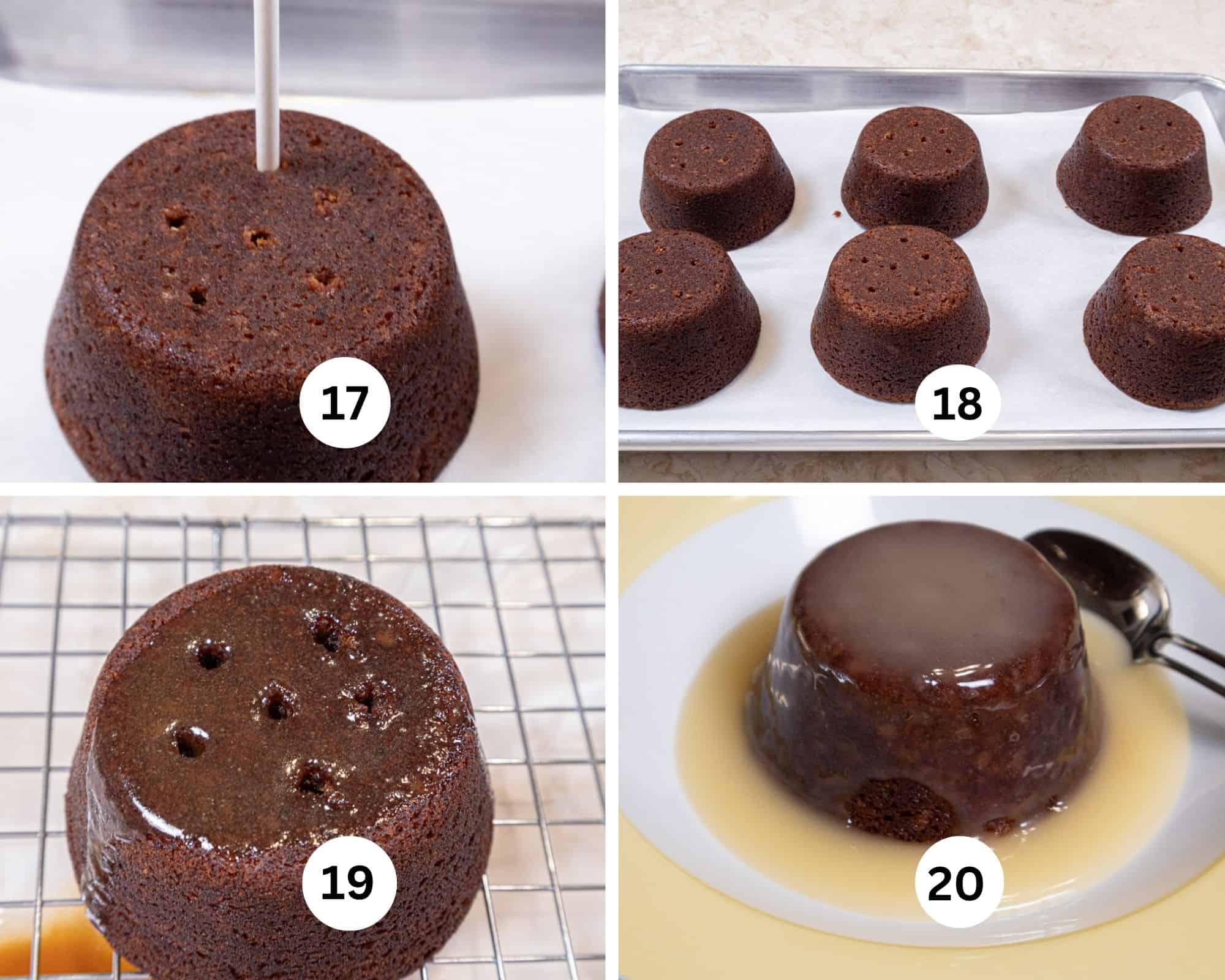
Step 17. With a skewer that is about ⅛ to ¼" thick, poke holes in the pudding. Rotate the skewer to widen the hole. Try not to go all the way through to the bottom of the puddings or the sauce will run out. Step 18. Continue until all of the puddings have been prepared. Step 19. Pour a large spoon of the lemon sauce over the top so it drips down into the holes. Let it sit for several minutes and repeat. Step 20. When serving, microwave each pudding for about 10 to 20 seconds to warm it up and then place it in a bowl and pour more sauce over it.

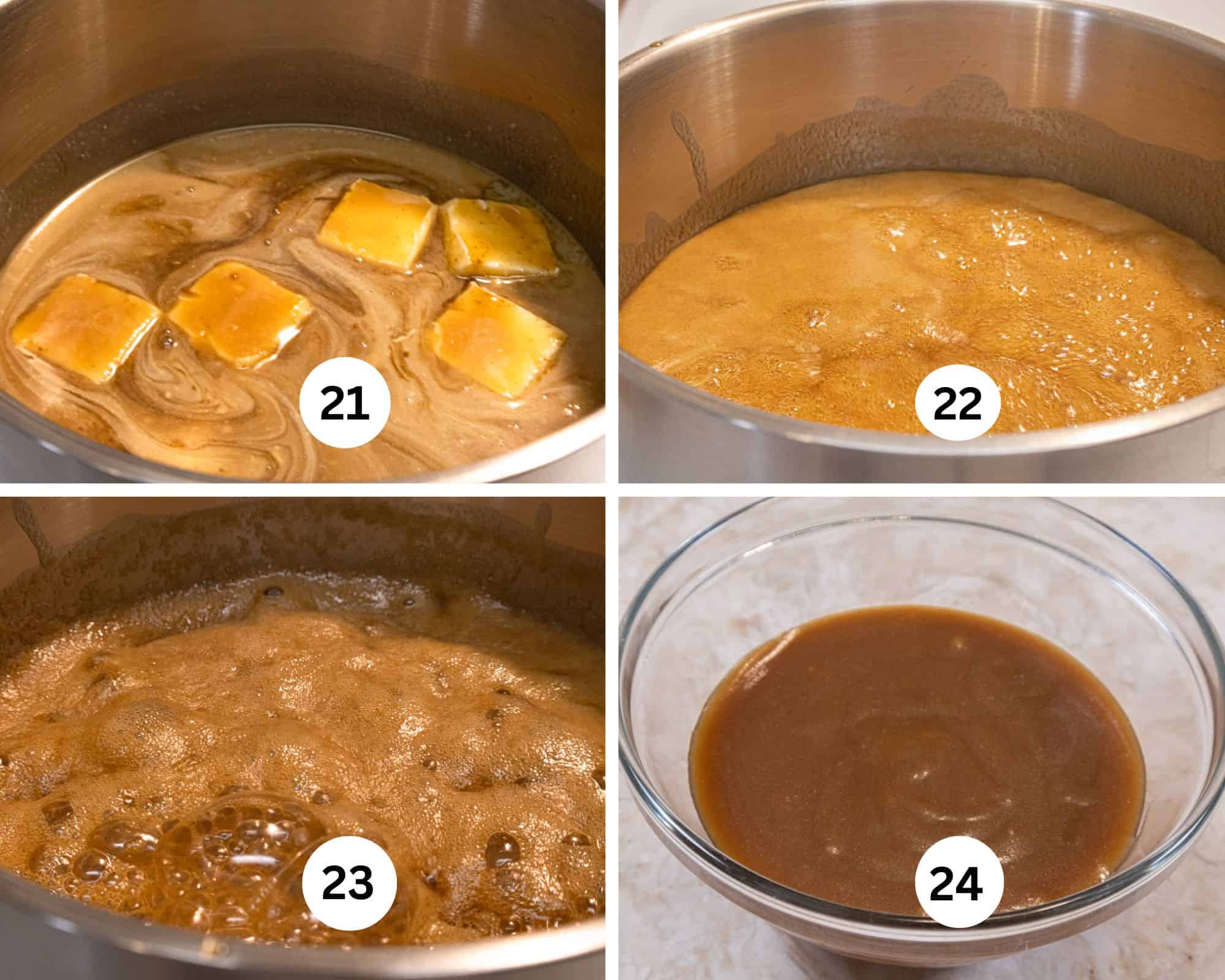
Step 21. To make the toffee sauce, place everything but the cornstarch in a medium size sauce pan. Step 22. Bring the mixture to a rolling boil. Mix the cornstarch with the water and add it to the sauce. Bring it back to a boil and boil for 1 minute. Step 24. Pour the toffee sauce into a bowl. Pour a large spoonful over the prepared puddings and follow the instructions for the lemon sauce.
According to Wikipedia, "The pudding was invented in 1907 by the landlady of the Gait Inn in Millington, East Riding of Yorkshire, but was popularised in the 1970s by Francis Coulson and Robert Lee, who developed and served it at the Sharrow Bay Country House Hotel in Cumbria.[4][5]"
Because the English refer to desserts as puddings. They are not what Americans call puddings.
Dates are very fibrous. The baking soda softens the dates and break down the fibers allowing the dates to make a smooth paste. It also reacts with the acidic nature of the dates and brown sugar as well as aiding it the cake rising.

A lot of work goes into each of my recipes and my only ask is that if you like the recipe or even the looks of it, please leave me a star rating to help me rank better. It’s important and I appreciate it and I appreciate you.
Modified: · Published: by Helen S Fletcher · This post may contain affiliate links · 8 Comments
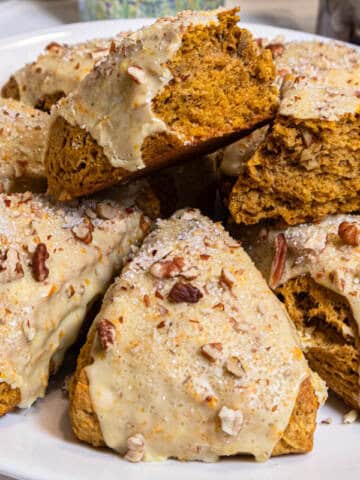
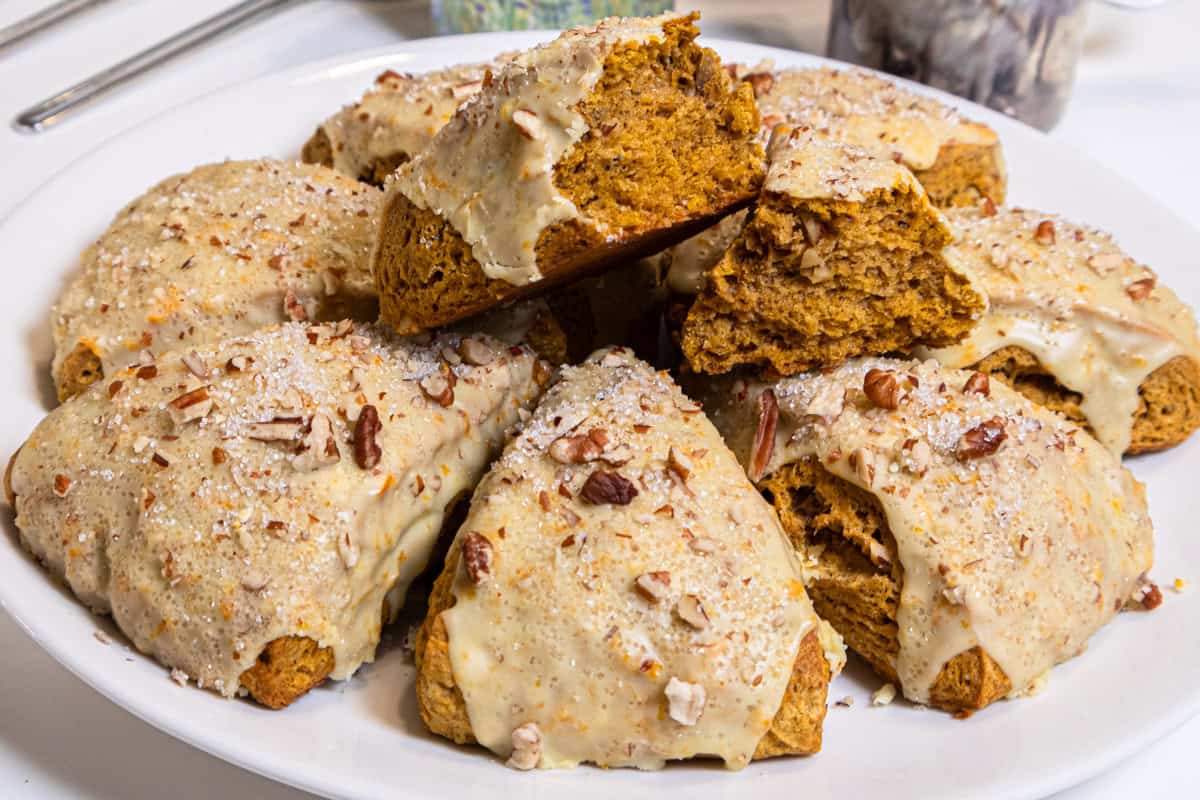
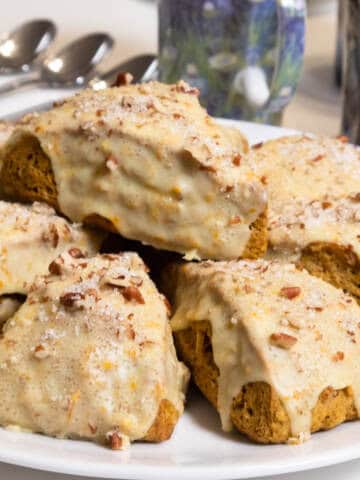
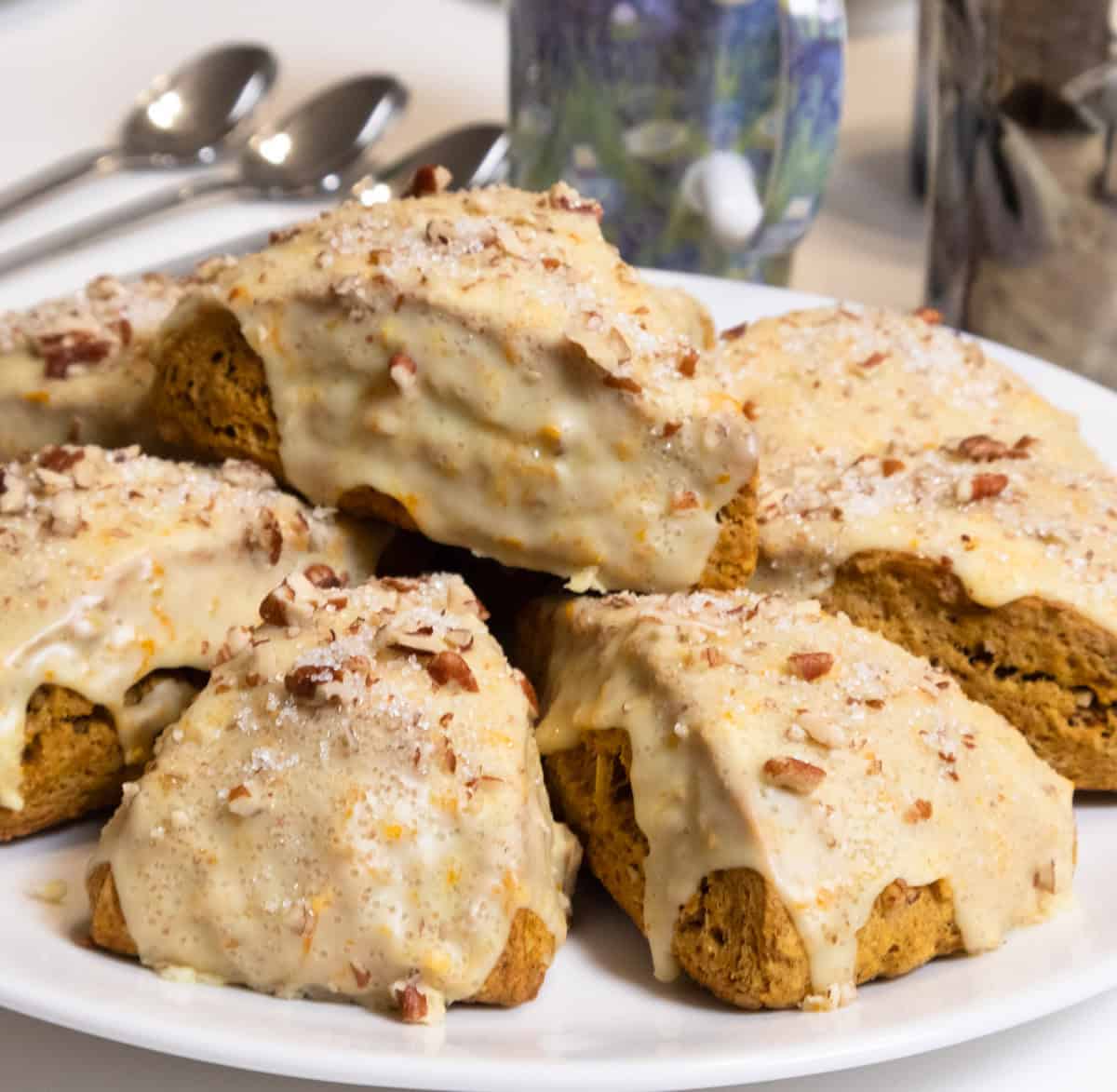
These Simple Pumpkin Pecan Scones are perfect for breakfast, brunch or snack. Quickly made with tons of warm spices and toasted pecans, these are finished with an orange glaze and pecans and sanding sugar for a bit of crunch.

One of the best things about these scones is they are more cake like and moist. While good the day they are made, they're good the second day too! Want fresh scones for breakfast? Simply freeze these, unbaked, bake and finish. Or, freeze the completed to make things even easier for a breakfast treat.
Looking for more Thanksgiving morning recipe ideas? Check out Recipes for a Stress-Free Thanksgiving Morning.
[feast_advanced_jump_to]Emphatically, NO!! When I research a recipe I want to make, I read as much as I can and over and over people think they are hard. As you will see in this recipe, in just a couple of steps in the processor and you're on your way to a delicious treat.
I know how irritating it is to use a portion of a product and be stuck with the rest. What are you supposed to do with it? Well I have some really tasty ideas to get you started. You can actually make several of these out of the remaining puree.

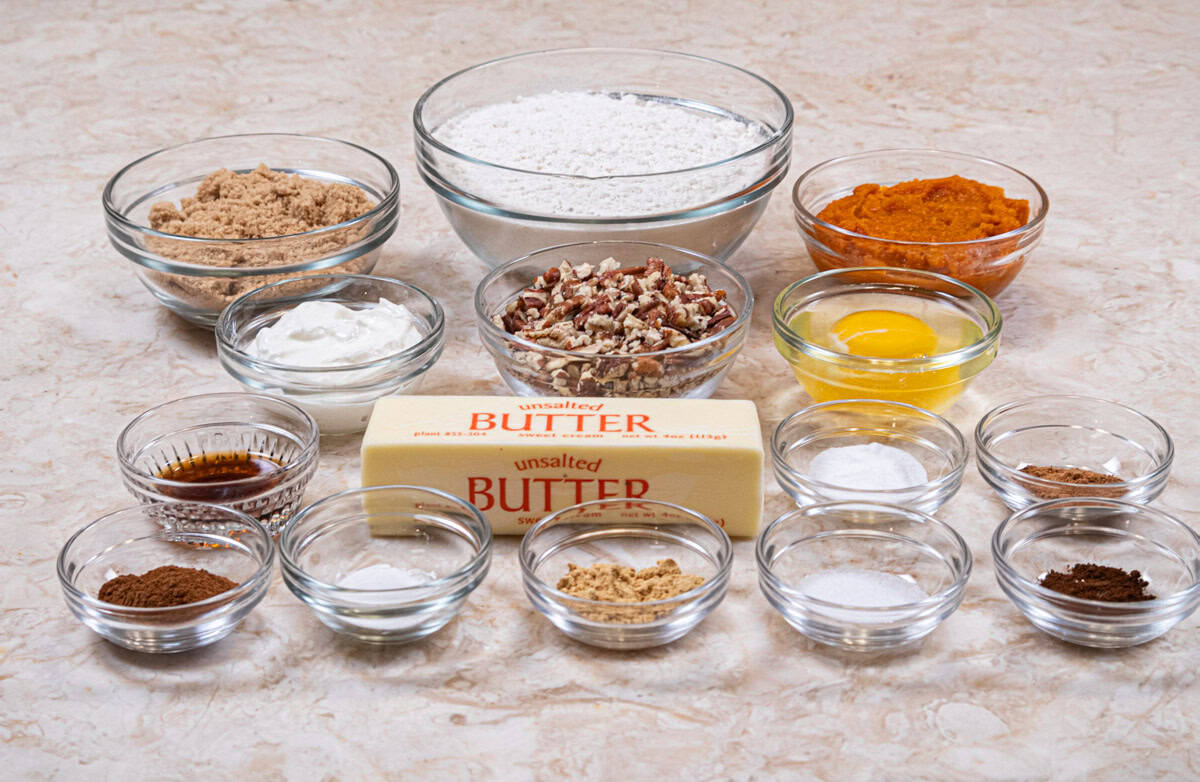
FRONT ROW: Cinnamon, baking soda, ginger, salt and cloves
SECOND ROW: Vanilla extract, unsalted butter, baking powder, nutmeg
THIRD ROW: Sour cream, toasted pecans, egg
BACK ROW: Brown sugar, all-purpose flour, pumpkin puree

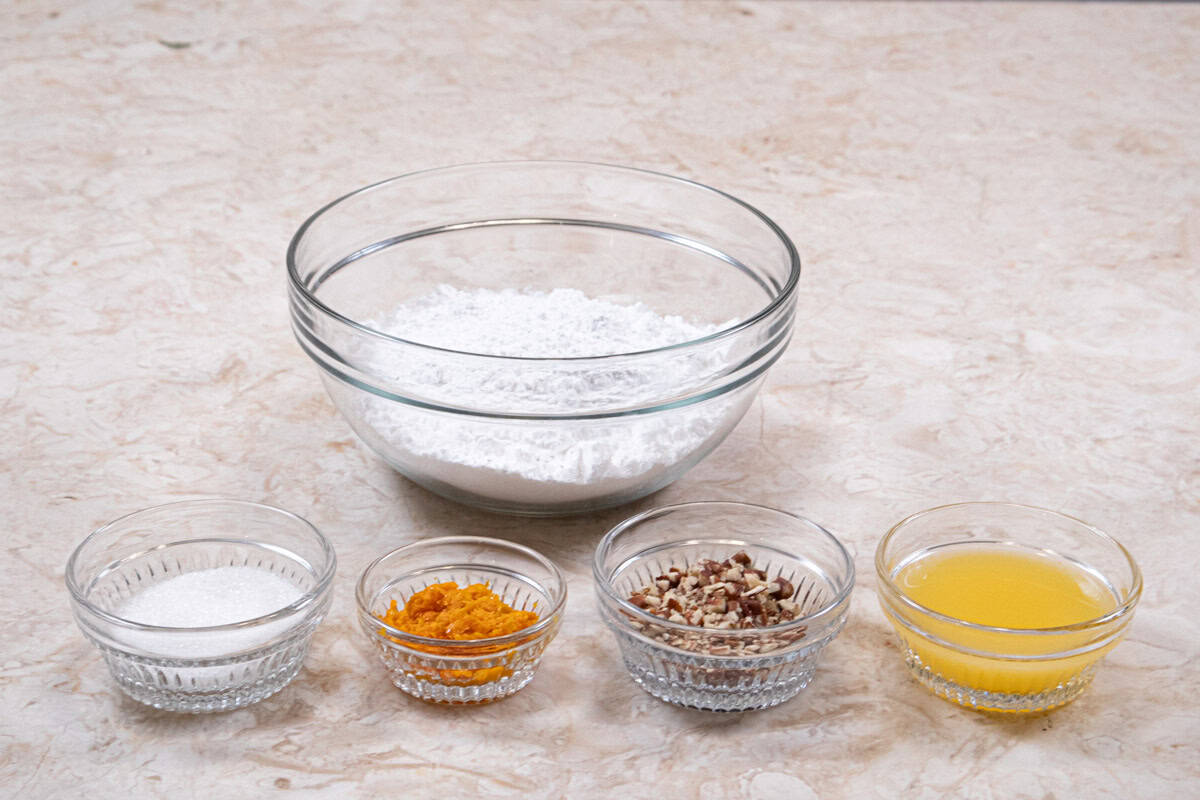
FRONT ROW: Sanding sugar, orange zest, toasted pecans, orange juice
BACK ROW: Powdered sugar
Be sure to see the recipe card below for the full ingredients & instructions.
Chop the nuts - see my post Chopping Nuts - A Quicker Way. Cut the butter into small pieces and freeze it rock hard.

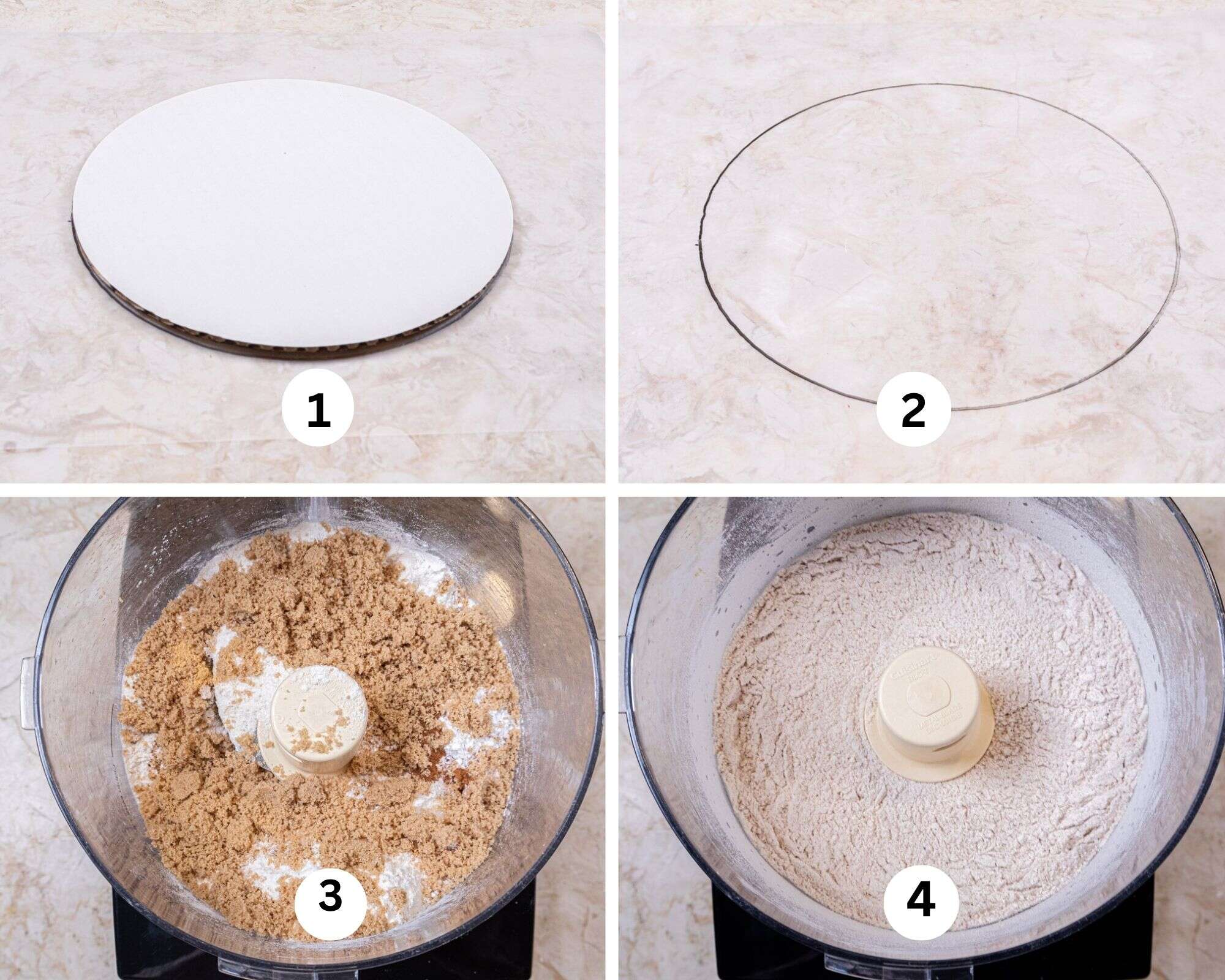
Step 1. Draw around an 8" cardboard cake round or a plate on a piece of waxed or parchment paper. Step 2. Remove the round and set aside. Step 3. Place the all-purpose flour, spices, baking powder, baking soda, and brown sugar in the bowl of a food processor. Step 4. Process briefly until mixed.

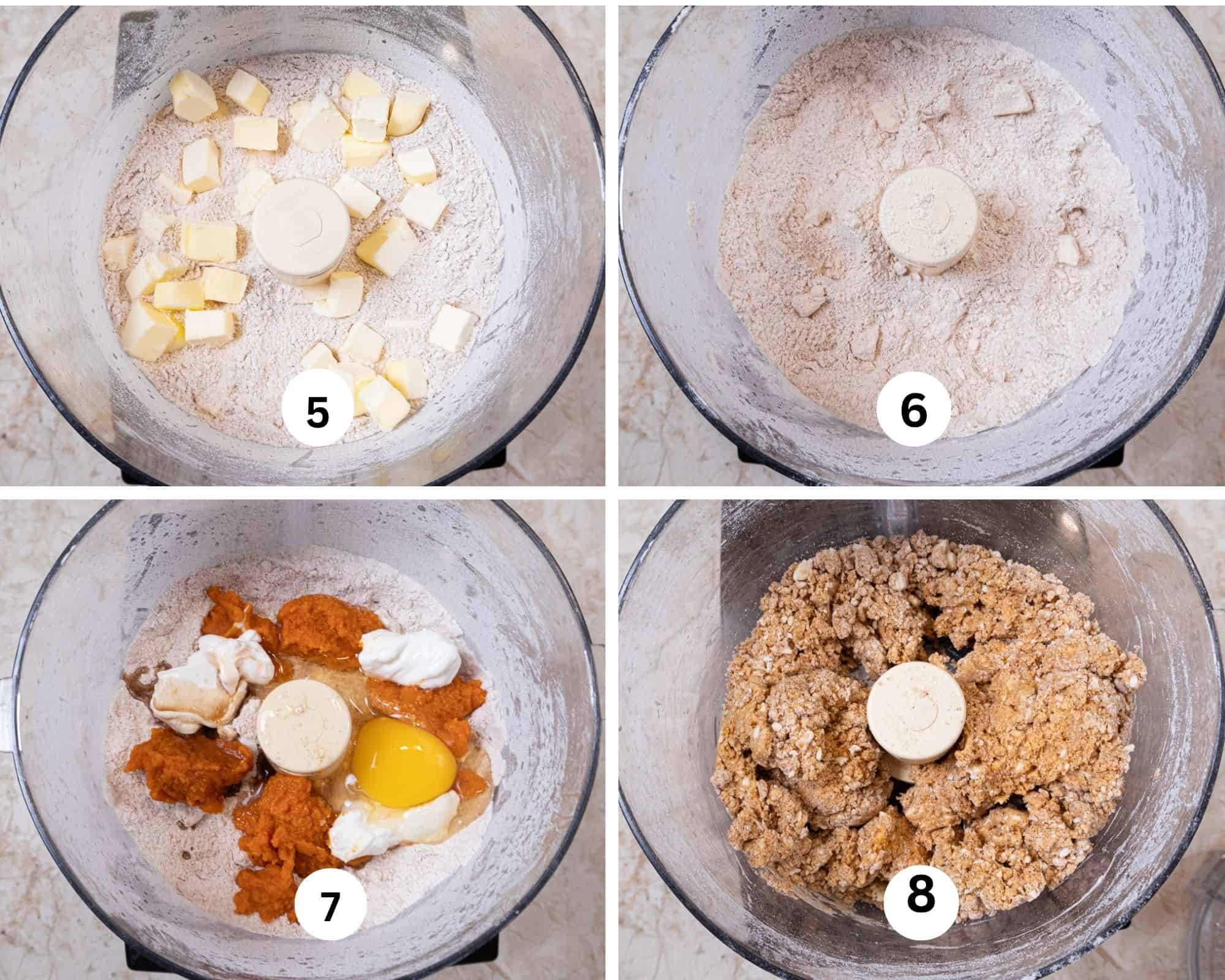
Step 5. Distribute the cut up frozen butter over the flour mixture. Step 6. Process very briefly, leaving some of the butter in larger pieces. Step 7. Add the pumpkin puree, sour cream, egg and vanilla to the bowl. Step 8. Pulse in the ingredients to form a shaggy batter.

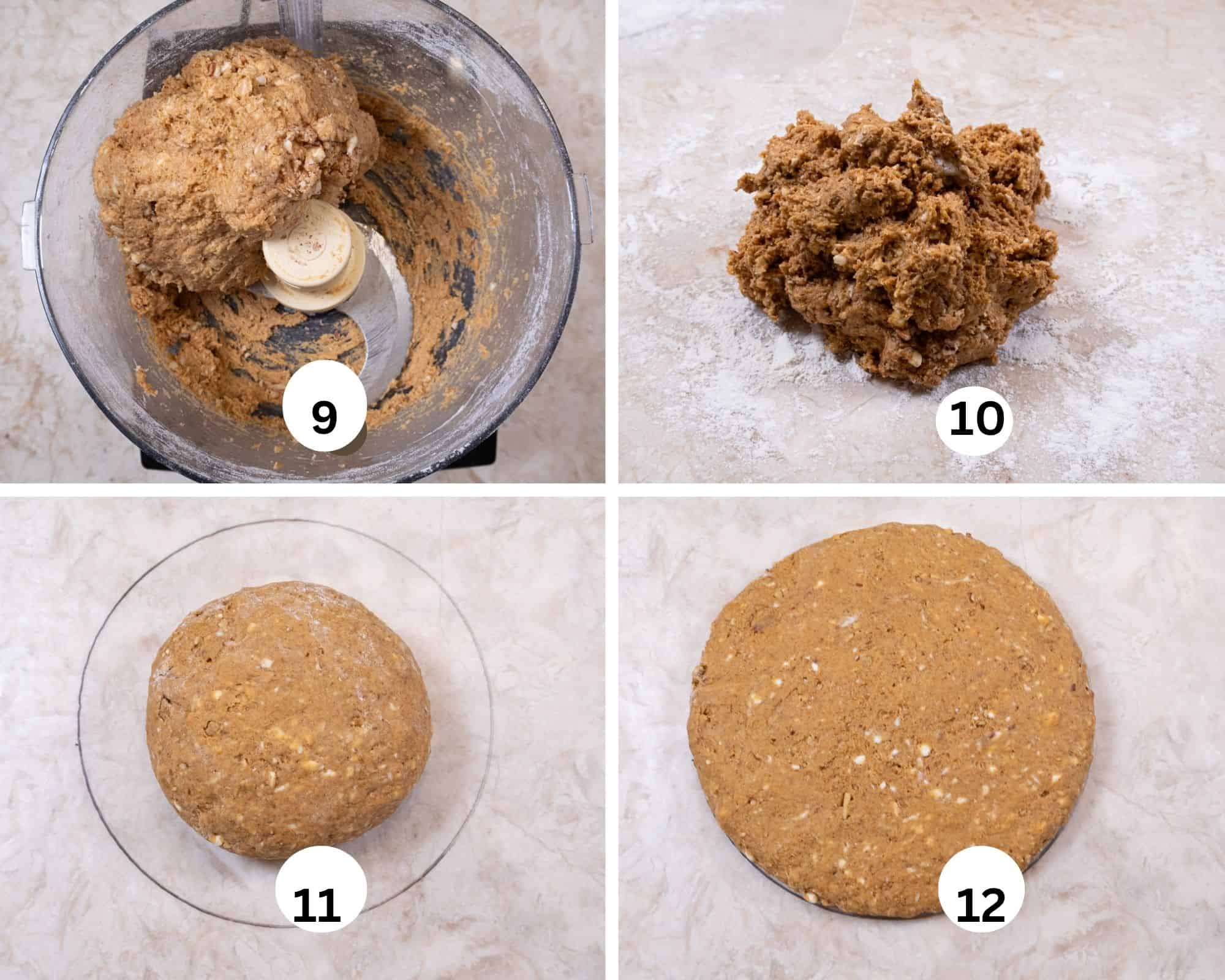
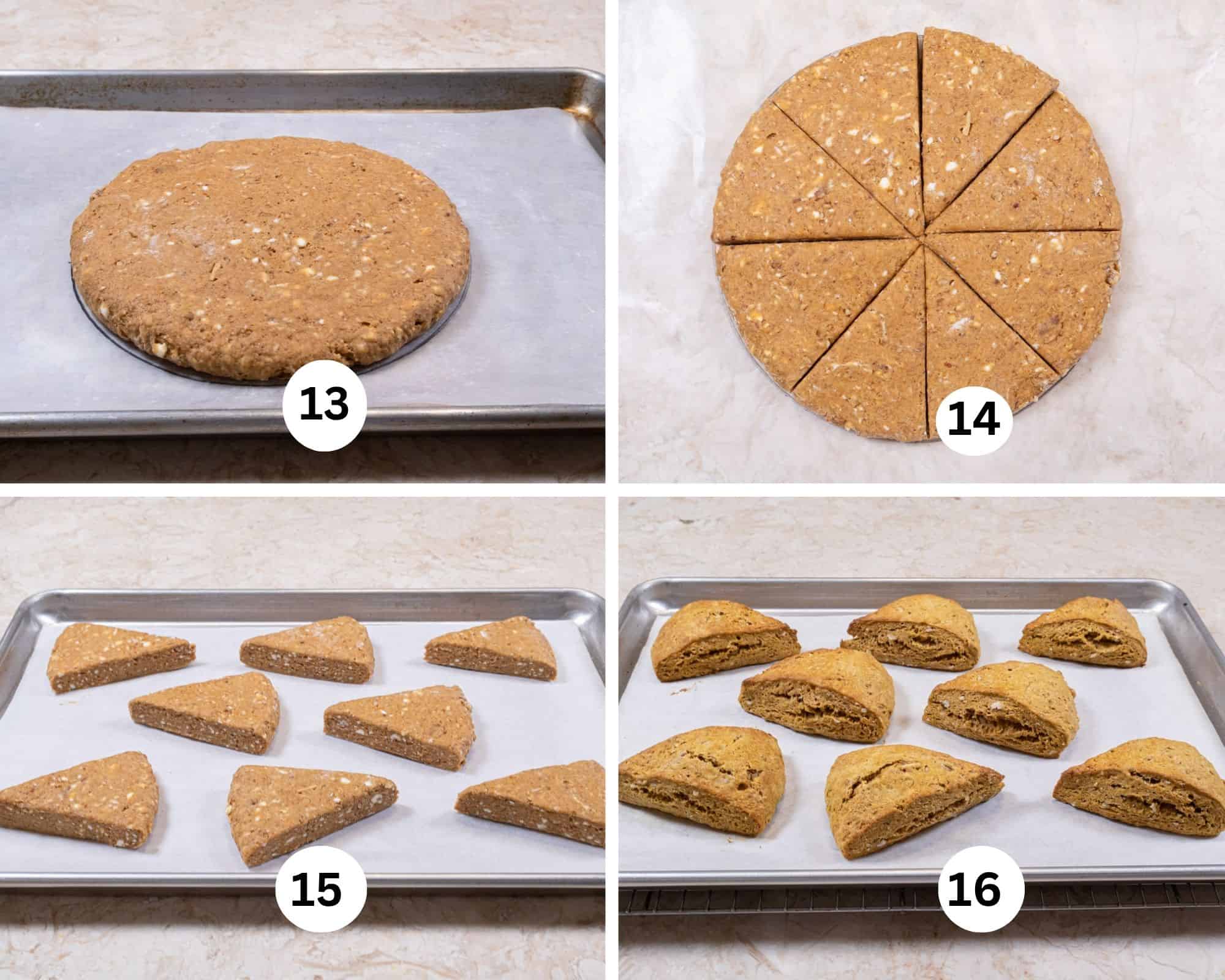
Step 9. Add the pecans and process very briefly to mix the dough. Step 10. Turn the dough out onto a lightly floured surface. Step 11. Knead briefly to make a smooth ball. Place the ball inside the circle drawn on waxed or parchment paper. Step 12. Pat the dough out evenly to the edges of the circle.

Step 13. Place the paper on a baking sheet and freeze for 20 to 30 minutes or until the edges are just frozen but it is not hard throughout. This will make it much easier to cut cleanly. Step 14. Cut the circle of dough into 8 pieces. Step 15. Place them on a parchment lined baking sheet. Step 16. Immediately bake as called for. Cool completely before glazing.

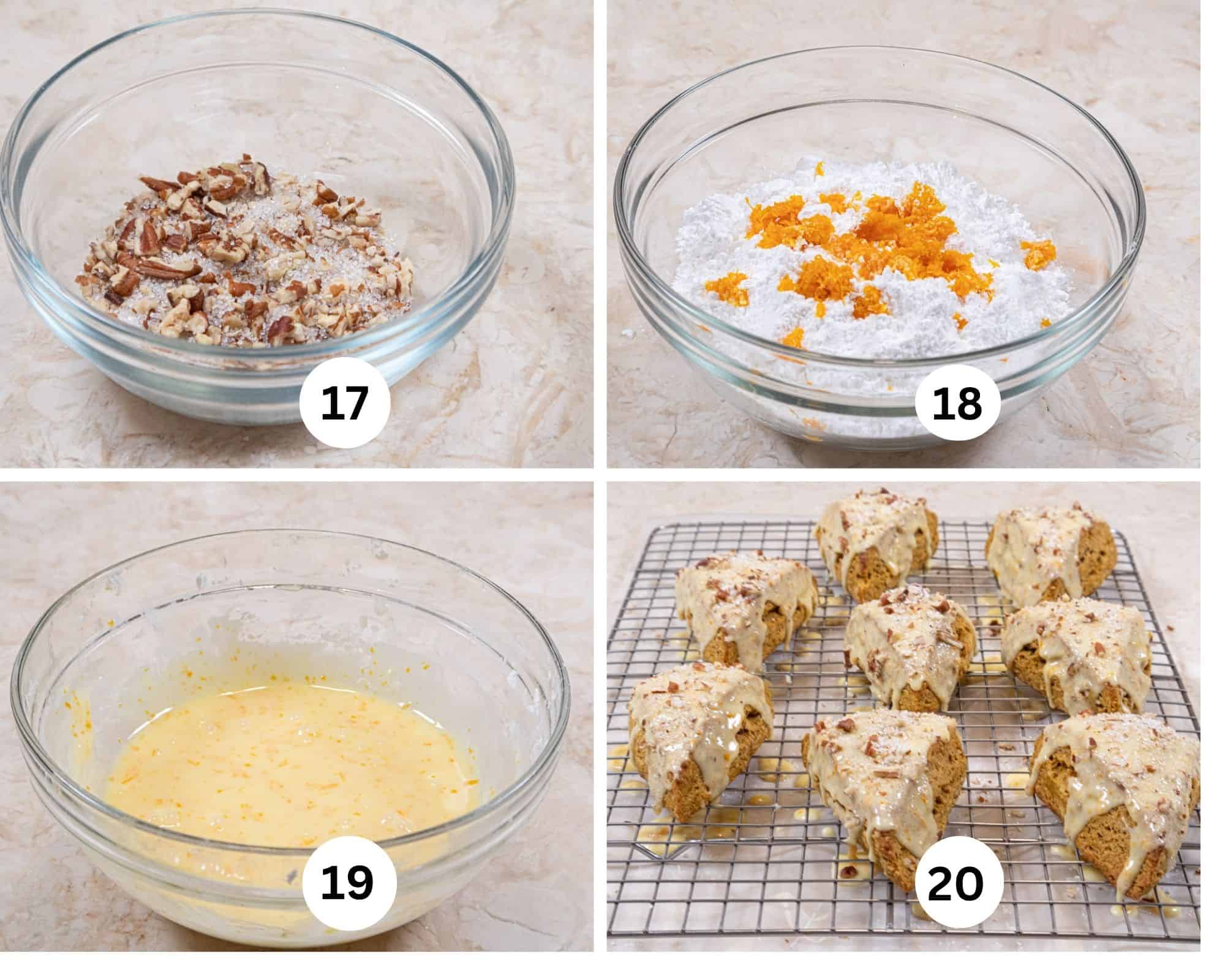
Step 17. Mix the reserved toasted pecans and the sanding sugar in a small bowl. Set aside. Step 18. Add the orange zest to the powdered sugar in a medium bowl. Step 19. Add 2 tablespoons of orange juice to the bowl and stir. If the glaze is too loose, add a bit more orange juice a teaspoon at a time. Step 20. Place a cooling rack over waxed or parchment paper. Spread the cooled, baked scones out on the rack. Using a large serving spoon scoop up a spoonful and pour it over the center of the scone lengthwise. Spread it over the scone and let it run over the sides. Glaze a couple at a time and immediately sprinkle with the pecan/sugar mixture. Repeat until they are all glazed. Let the glaze dry completely. Store in a covered container if not serving right away or freeze.
Scones most likely originated from Scotland. The first print reference dates back to 1513 and is from a Scottish poet.
It depends upon where you live. In England and the former or current related countries, they are most usually eaten at "tea" which is around four o'clock in the afternoon. They are usually served with clotted cream and jam. In the US they are eaten for breakfast, brunch and as a snack since we don't do "tea".
English scones are pretty straight forward without a lot of embellishments although they may contain raisins or currants. In America we use more butter, and a lot more add ins of all kinds.
The baked and glazed scones can be held under a cover for a day or two. They are best within 2 days.
They can also be frozen unbaked. Just add a bit more time when baking. In addition, they can be baked, glazed and finished then frozen until hard. Wrap them individually in foil and place in freezer proof bags. Thaw at room temperature. The glaze will initially be wet but will dry as they thaw out.

A lot of work goes into each of my recipes and my only ask is that if you like the recipe or even the looks of it, please leave me a star rating to help me rank better. It’s important and I appreciate it and I appreciate you.
Modified: · Published: by Helen S Fletcher · This post may contain affiliate links · 19 Comments
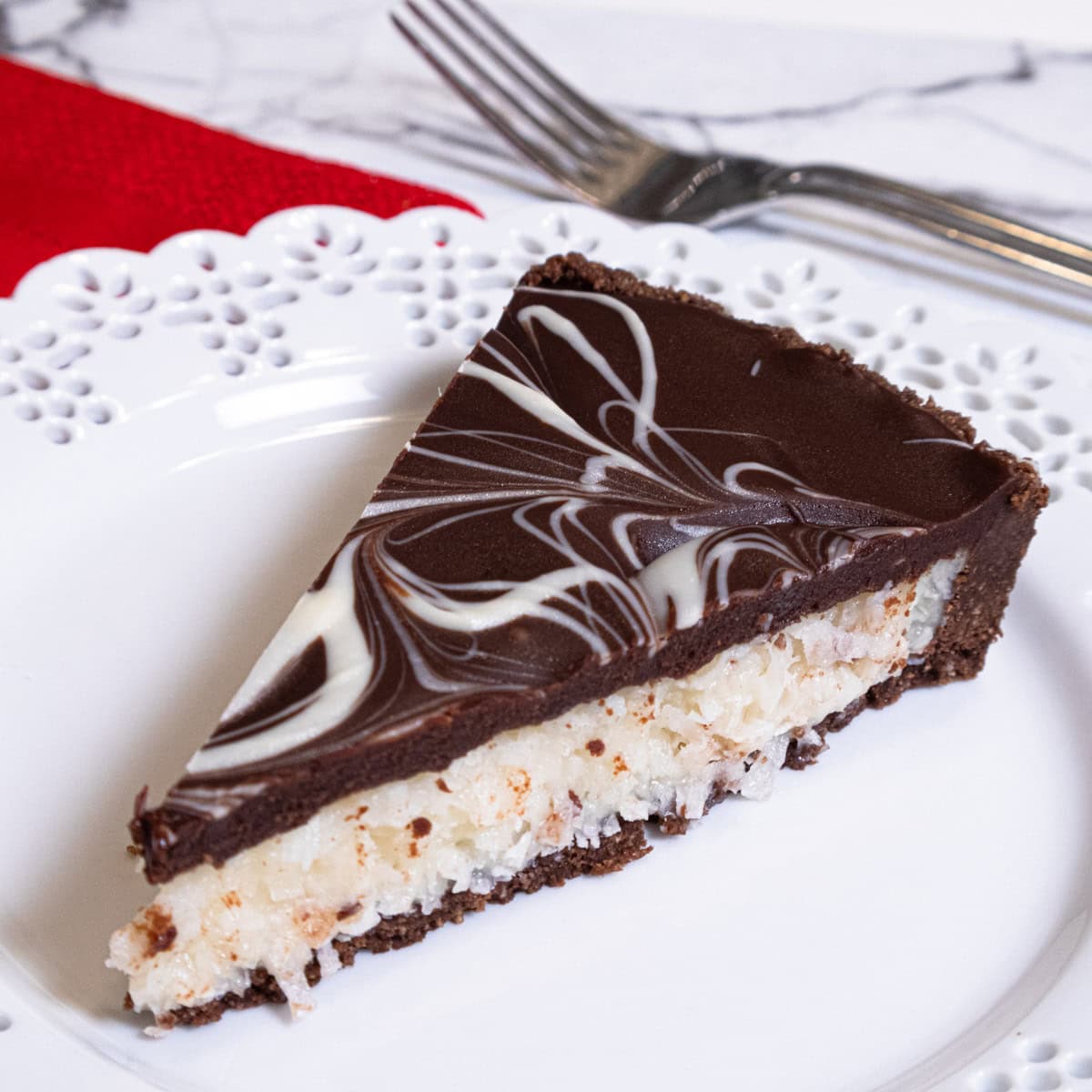
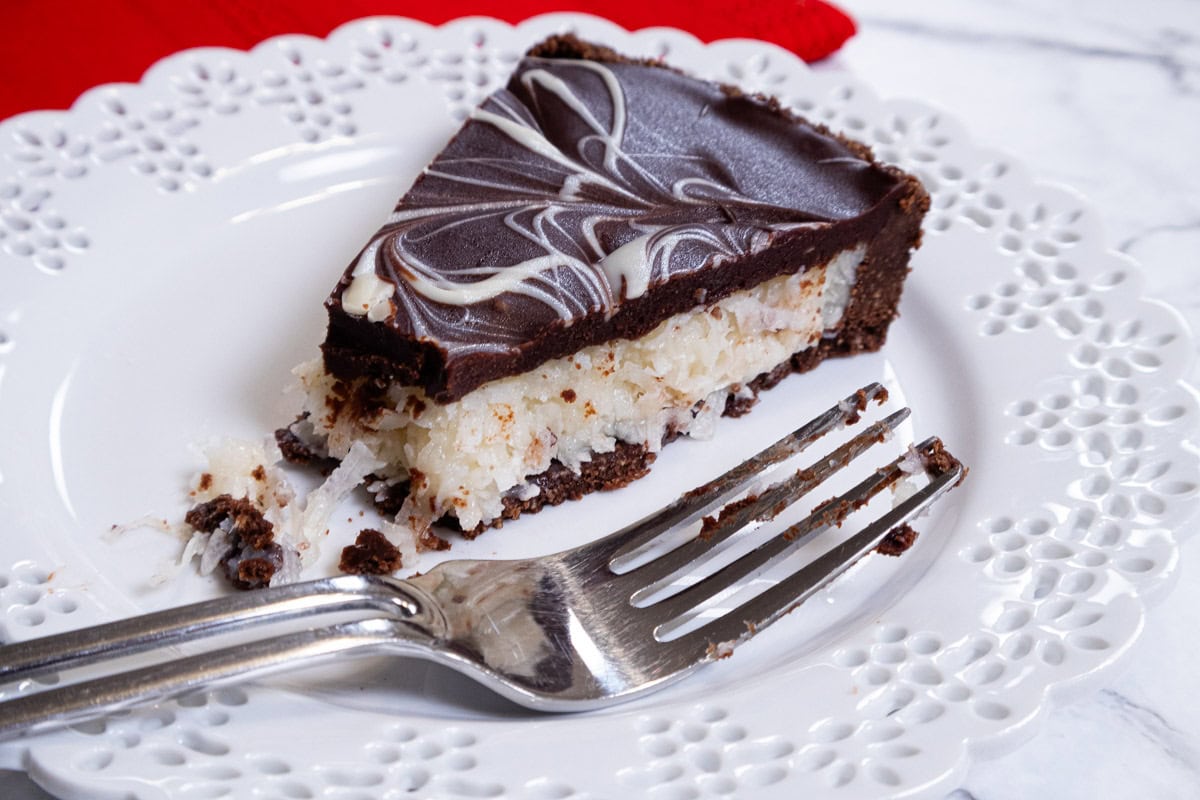
The only way to adequately describe this Chocolate Coconut Tart is to think Mounds Bars. This unusual tart comprises a sublime mixture of cream of coconut, white chocolate, a touch of sour cream and a lot of coconut in a chocolate crust. You'll especially like the no bake aspect of making this.

While completely optional, the white chocolate swirl on top adds visual appeal. Easy to make, easier to eat!
If you love tarts, you'll also love this Chocolate Cranberry Curd Tart and my Strawberry Crumb Tart. And for more no-bake recipes, check out No Oven? No Problem!

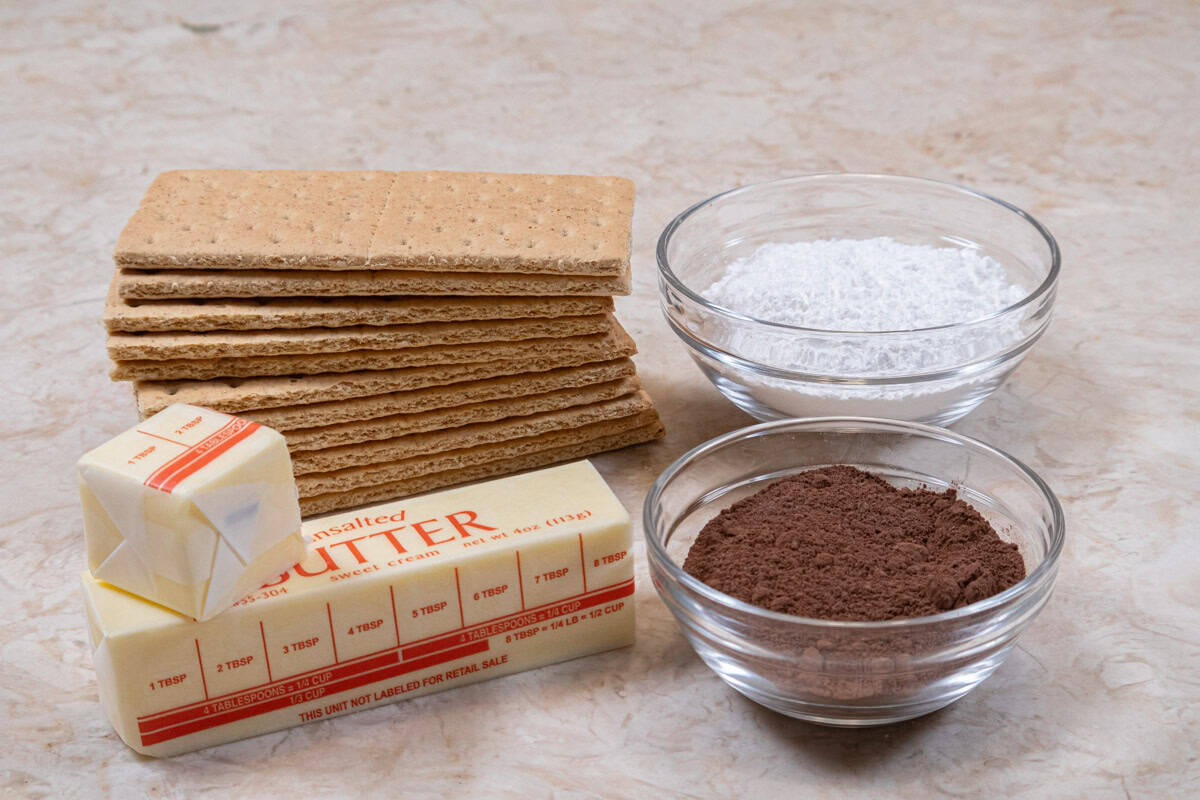
FRONT ROW: Unsalted butter, cocoa powder (either natural or Dutch)
BACK ROW: Graham Crackers, powdered sugar

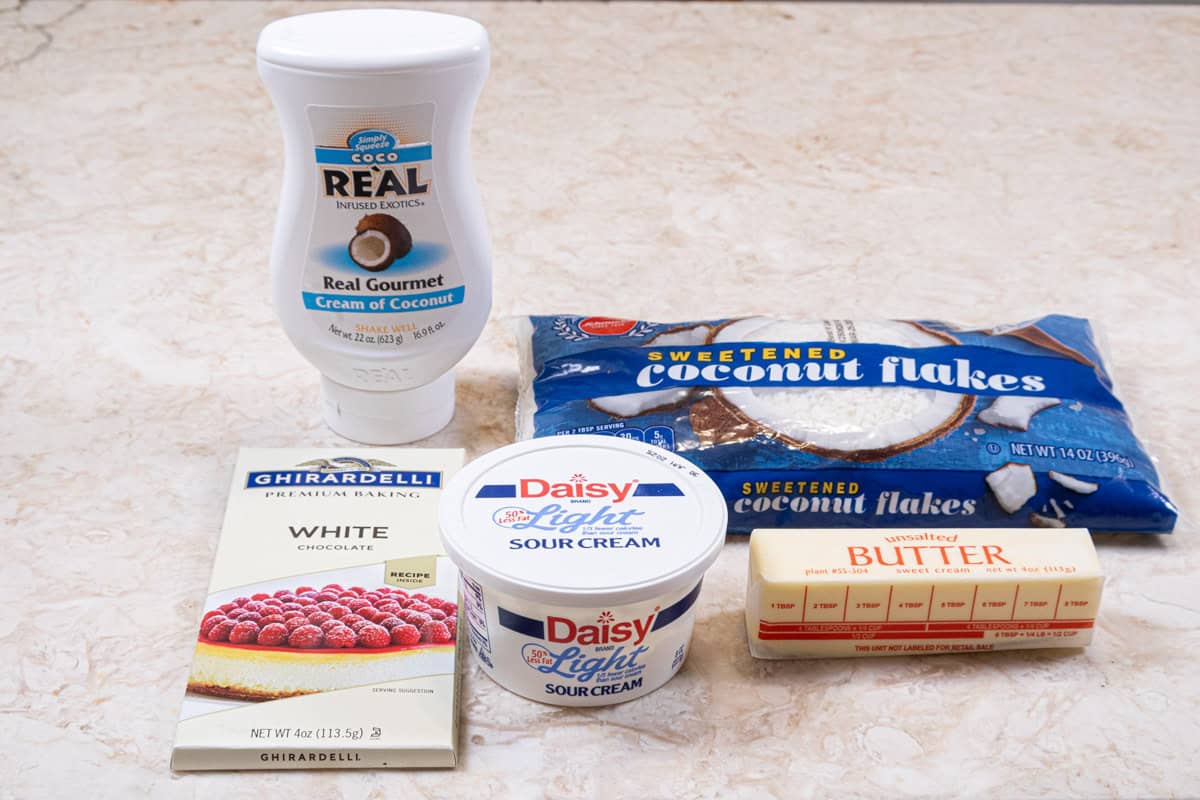
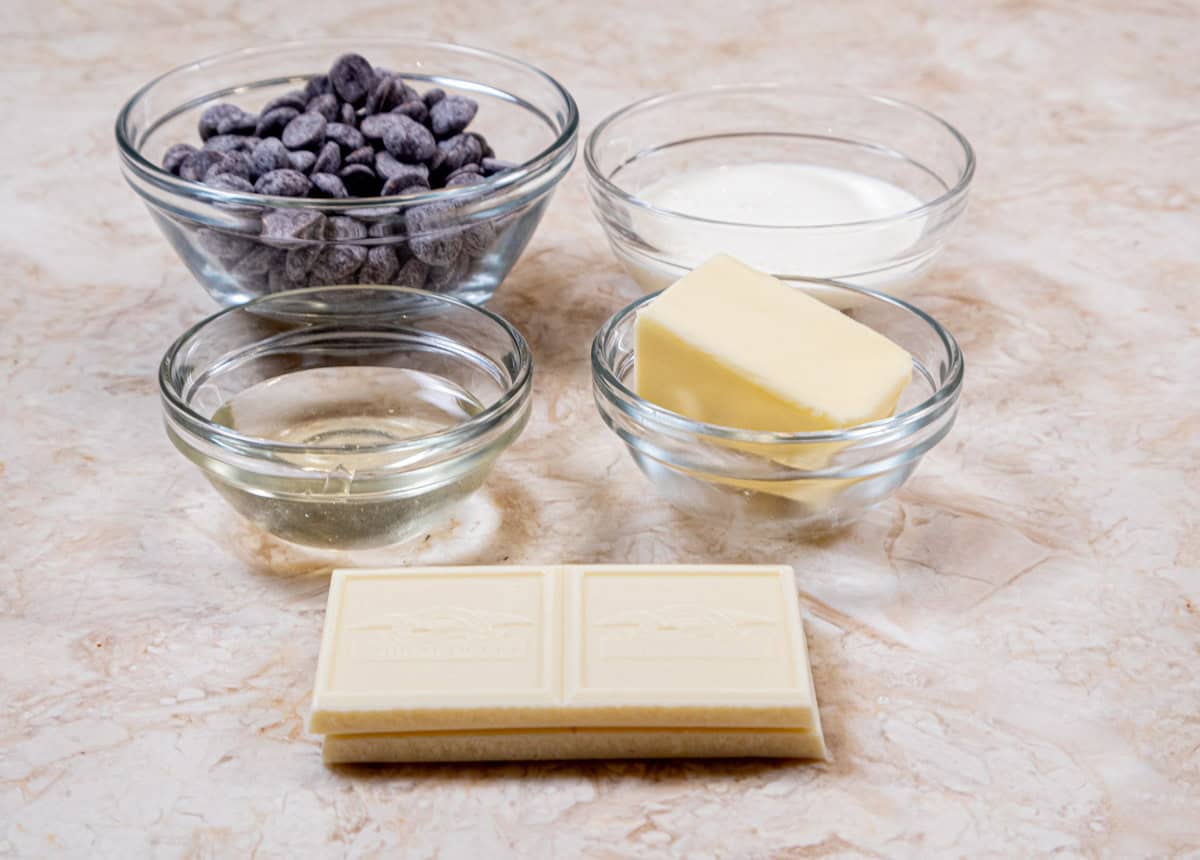
FRONT ROW: White chocolate, sour cream, unsalted butter
BACK ROW: Cream of Coconut, sweetened coconut

FRONT ROW: White Chocolate
MIDDLE ROW: Corn syrup, unsalted butter
BACK ROW: Semisweet Chocolate, heavy cream

Be sure to see the recipe card below for the full ingredients & instructions.

Step 1. Place the dry ingredients - graham crackers, cocoa and powdered sugar in the bowl of a food processor. Step 2. Process until uniform fine crumbs form. Step 3. Remove the crumbs to a medium size bowl and add ½ cup of the melted butter. Step 4. Toss with a fork until all of the crumbs are coated. Pick up a few and press them between your fingers. If they don't stick together well, add the remaining butter 1 tablespoon at a time. Retest to see if they need the last tablespoon.

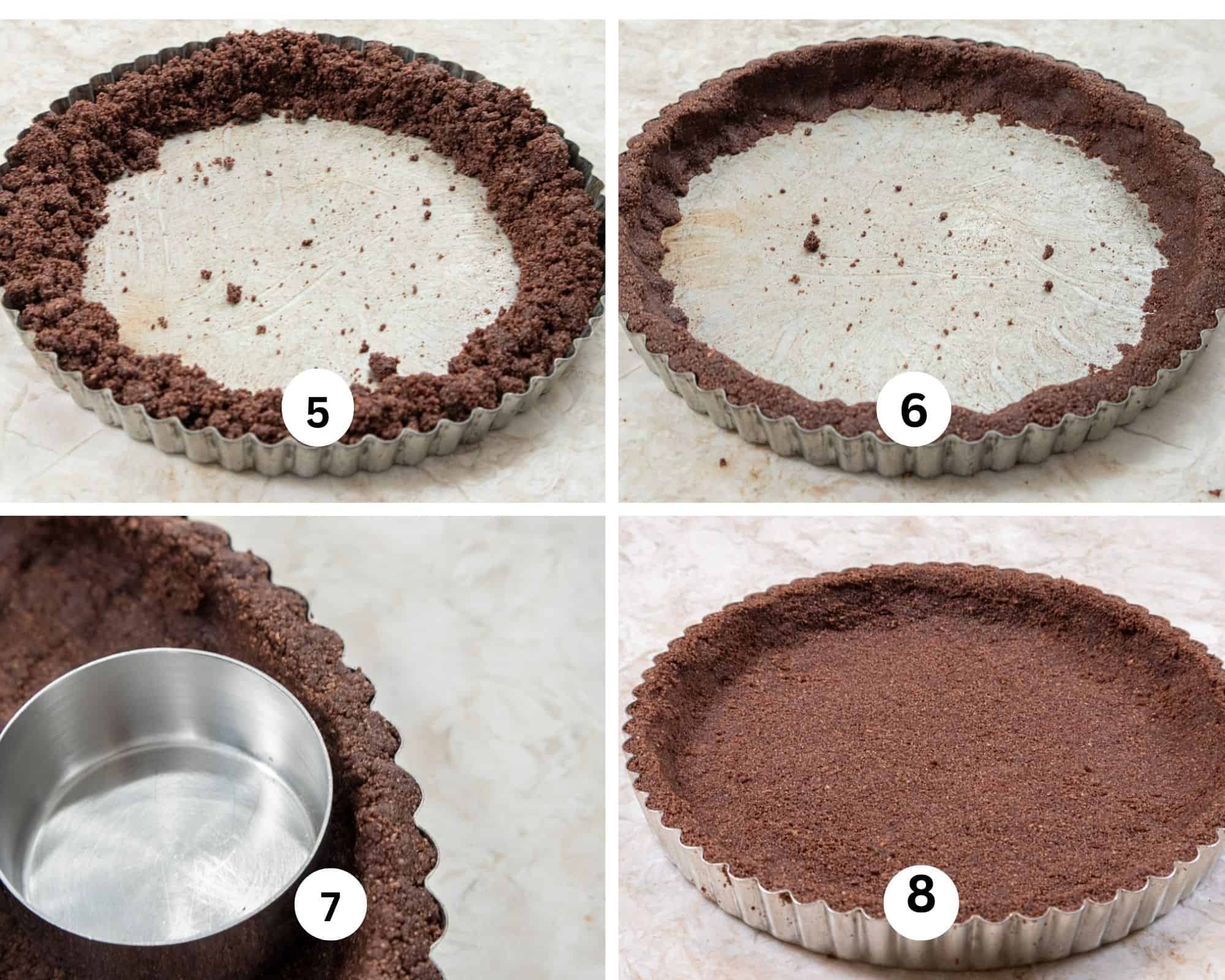
Step 5. Place the called for amount of crumbs evenly around the rim of the tart pan. Step 6. Press them firmly into the sides of the pan Step 7. Place the remaining crumbs evenly on the bottom of the pan With your hand or a measuring cup, press them firmly into the bottom and along the sides of the pan. Step 8. Refrigerate the finished crust while the filling is being made.

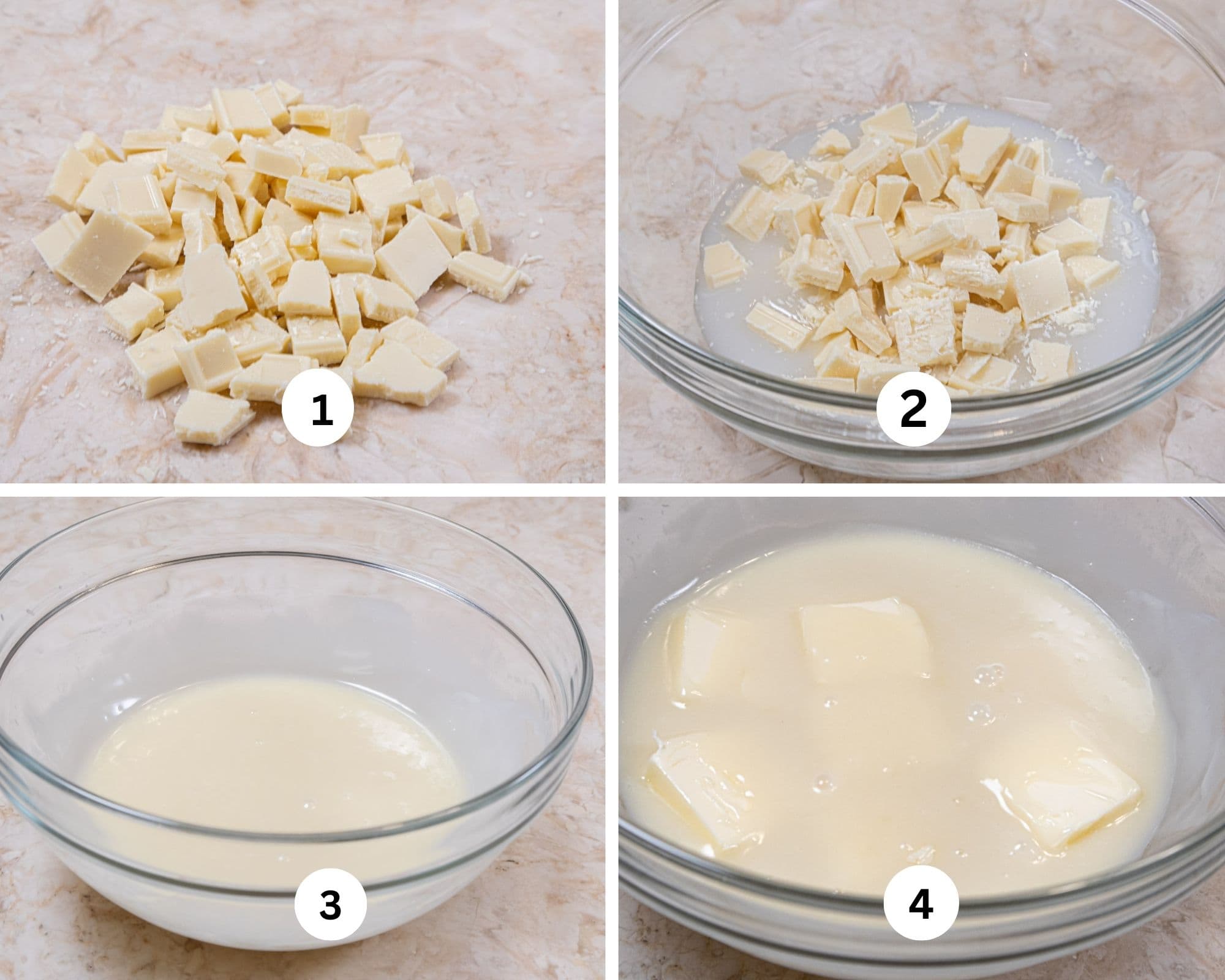
Step 1. Coarsely chop the white chocolate to make it easier to melt. Step 2. Place it in a medium size bowl with the cream of coconut. Microwave at ½ power for about a 1 to 1 ½ minutes. Be careful to start on the low side as white chocolate burns very, very easily. Alternatively, make a double boiler by placing the bowl over a saucepan filled with a couple of inches of water. Bring the water to a bare simmer - no more. Do not let the water touch the bottom of the bowl. Step 3. Whisk to smooth out the chocolate. If it isn't smooth, heat again very briefly. It is easier to control in a double boiler. Step 4. Add the butter.

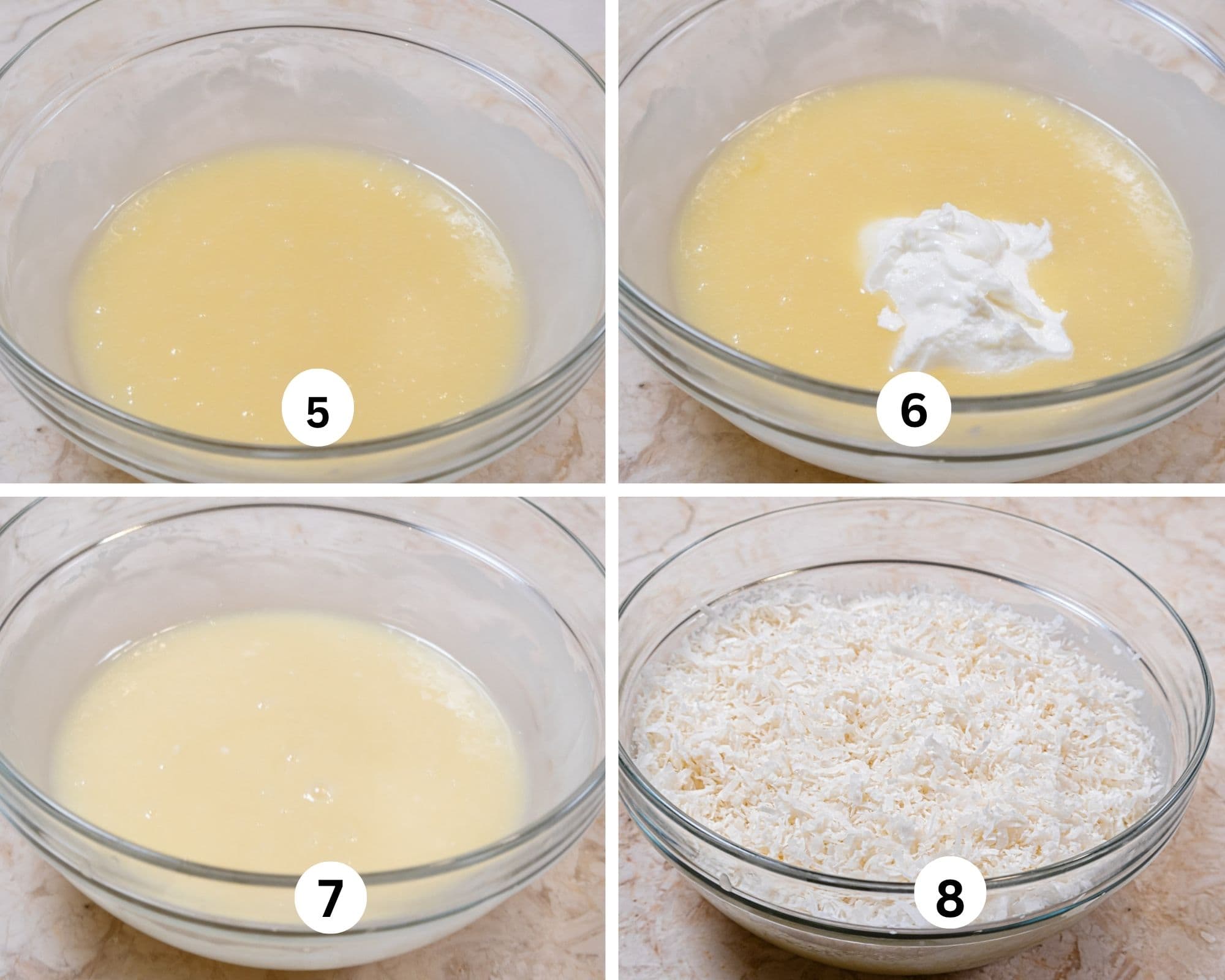
Step 5. Whisk in the butter. If the mixture is too cool, reheat briefly - just enough to melt the butter. Step 6. Add the sour cream. Step 7. Whisk it in. Step 8. Add all of the coconut.

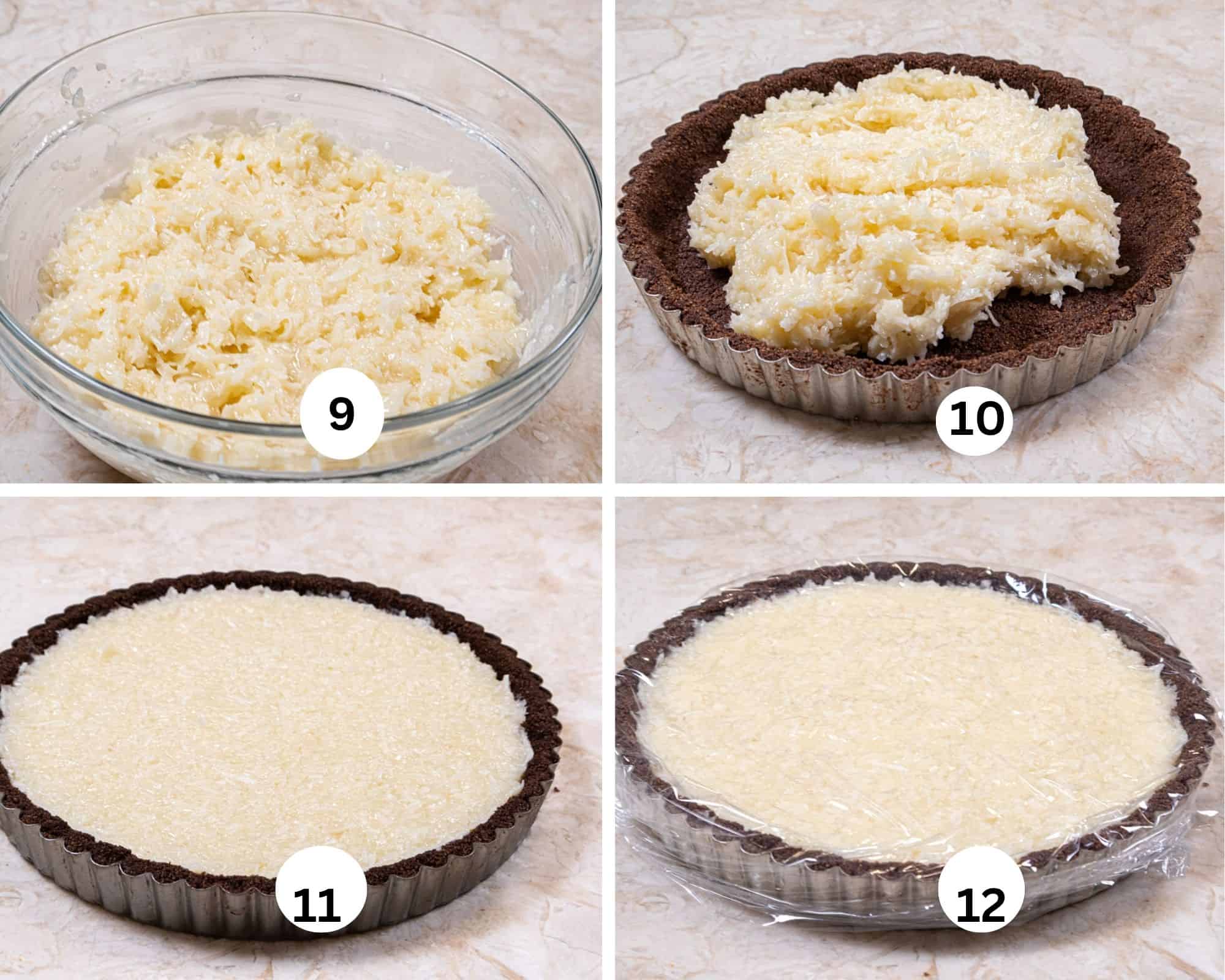
Step 9. Stir the mixture to coat all of the coconut. Step 10. Remove the crust from the fridge and spoon the filling into the chocolate shell. Step 11. Smooth the top. Step 12. Cover it with plastic wrap and place it in the refrigerator for 4 hours or overnight to firm up.

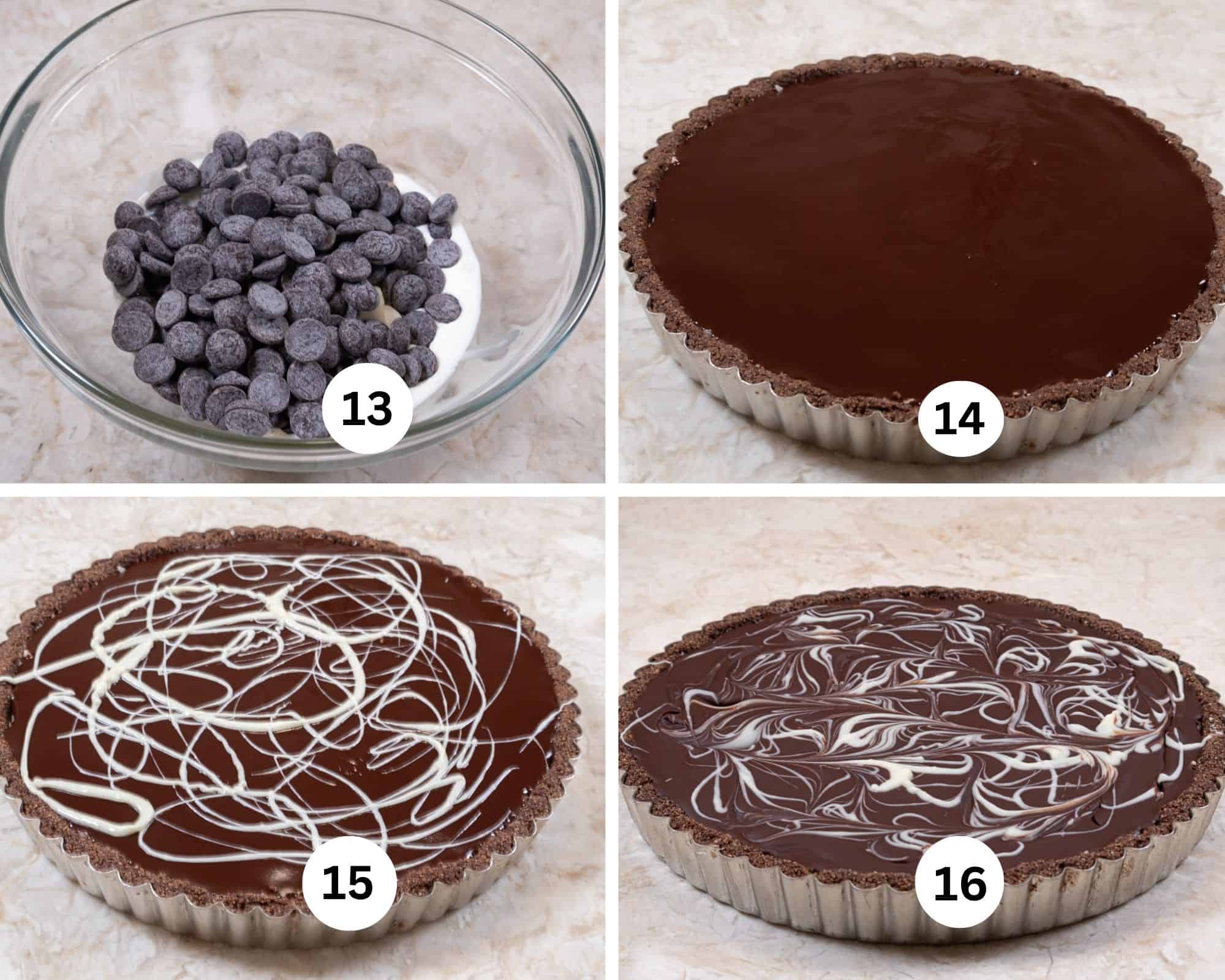
Step 13. Place the cream, corn syrup, butter and chocolate in a medium size bowl. Heat at half power for 20 t0 30 seconds to melt the chocolate or place over a double boiler. Whisk to smooth out. It should be pourable but not runny. Step 14. Pour the ganache over the tart and level it with a small offset spatula or by picking it up and carefully tilting in each direction to let the ganache run to the edge of the filling. Do not go over the edge of the crust. Step 15. Melt the 2 ounces of white chocolate very carefully at half power in the microwave, starting at abut 10 to 15 seconds. Do not over heat or it will burn. Dip a soup spoon into the white chocolate and wave it over the chocolate ganache in circles. Step 16. Quickly, with a toothpick or small wooden skewer, marbleize the white chocolate by dragging the toothpick through the white chocolate in a random pattern. The dark chocolate needs to be unset to do this. Refrigerate.
Desiccated coconut, shredded and flaked. Desiccated coconut involves finely grating coconut meat and drying it until only 3% moisture remains. It is very dry and usually unsweetened. Shredded coconut is fresh or dried. Fresh has a higher moisture content but drier versions last longer. Last, Coconut Flakes are larger and fatter than shredded. They can be sweetened which are most often used for baking and decorating or unsweetened.
Despite having the word nut at the end, coconut is a type of fruit known as a drupe.
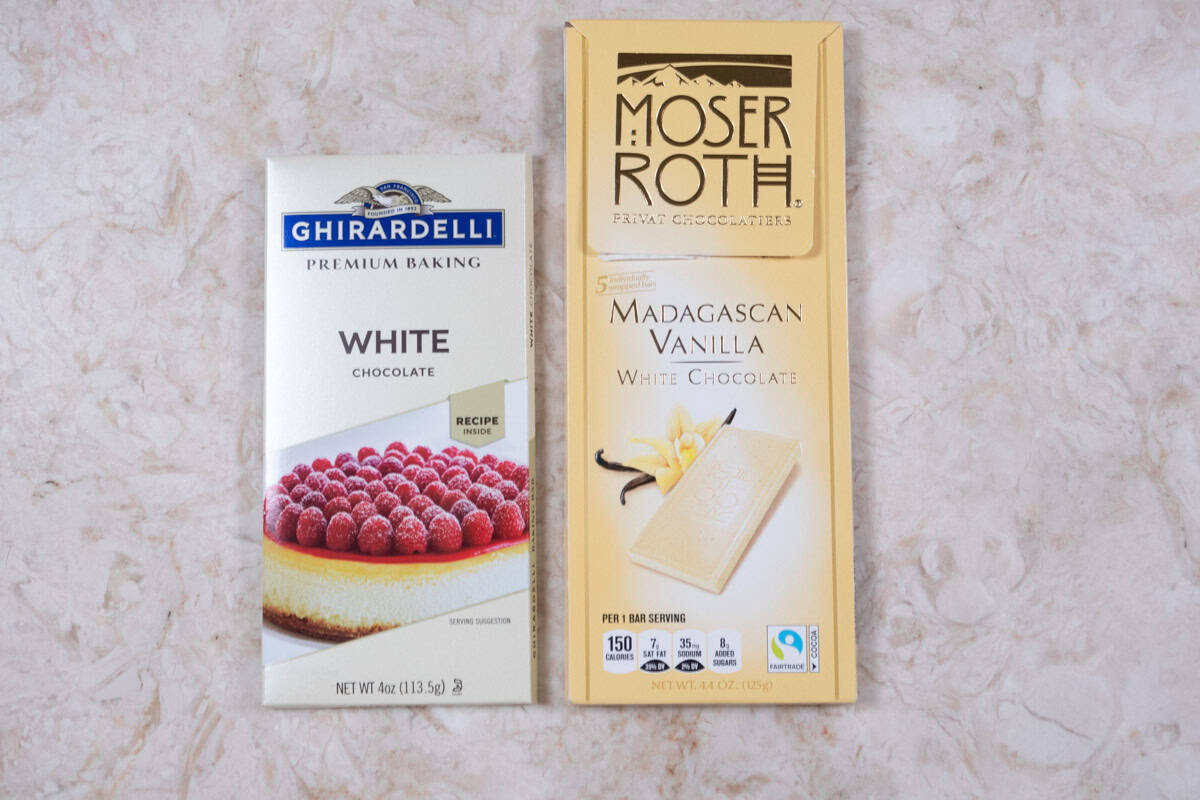
White chocolate isn't chocolate at all but it is made from cocoa butter, milk solids and sugar. It contains no cocoa solids which make chocolate dark. When buying white chocolate check to make sure cocoa butter is listed in the ingredients. If it isn't then it isn't real white chocolate.

A lot of work goes into each of my recipes and my only ask is that if you like the recipe or even the looks of it, please leave me a star rating to help me rank better. It’s important and I appreciate it and I appreciate you.
Modified: · Published: by Helen S Fletcher · This post may contain affiliate links · 9 Comments
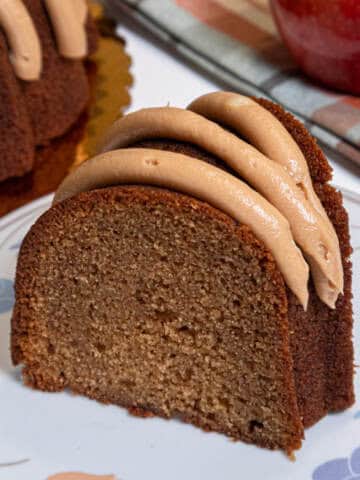
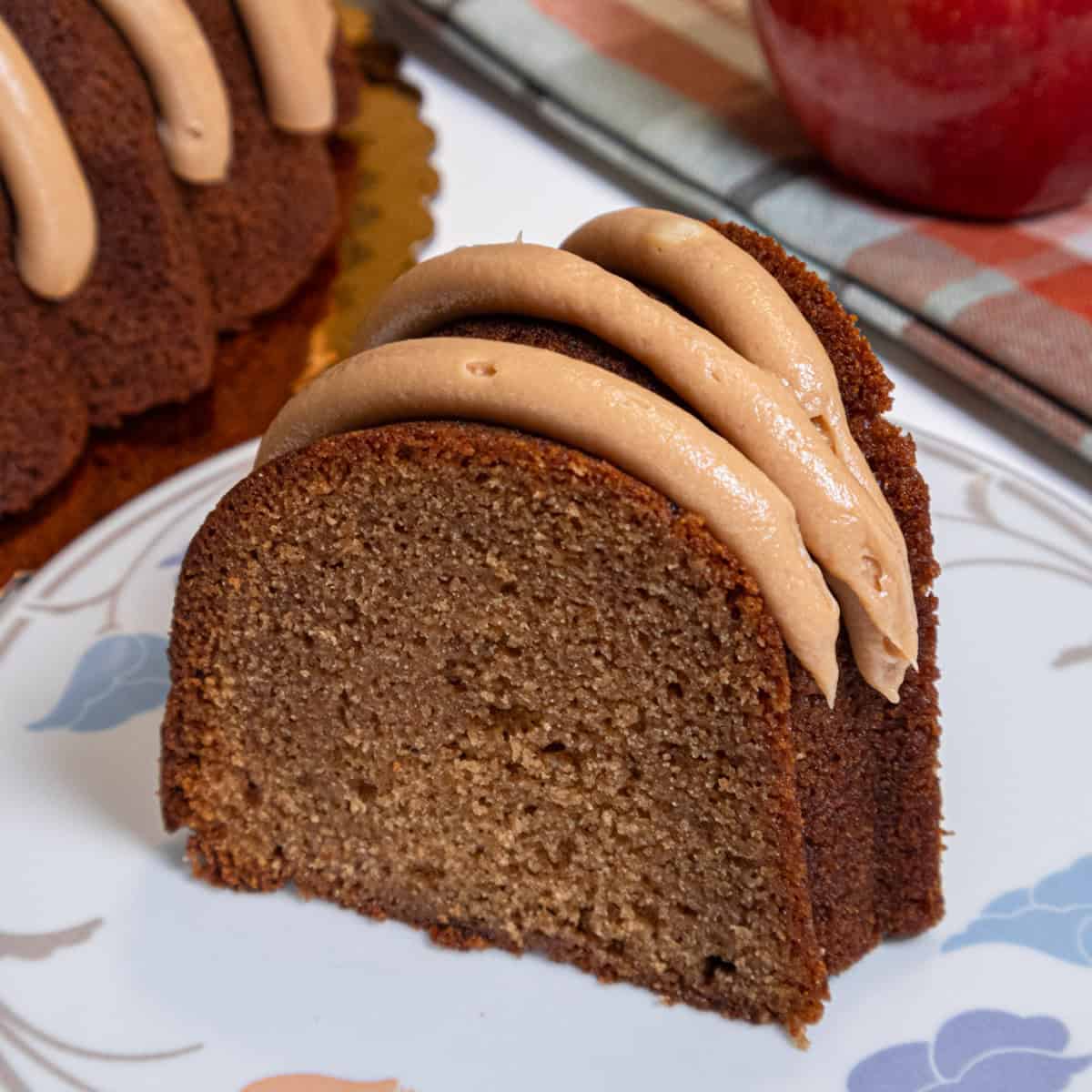
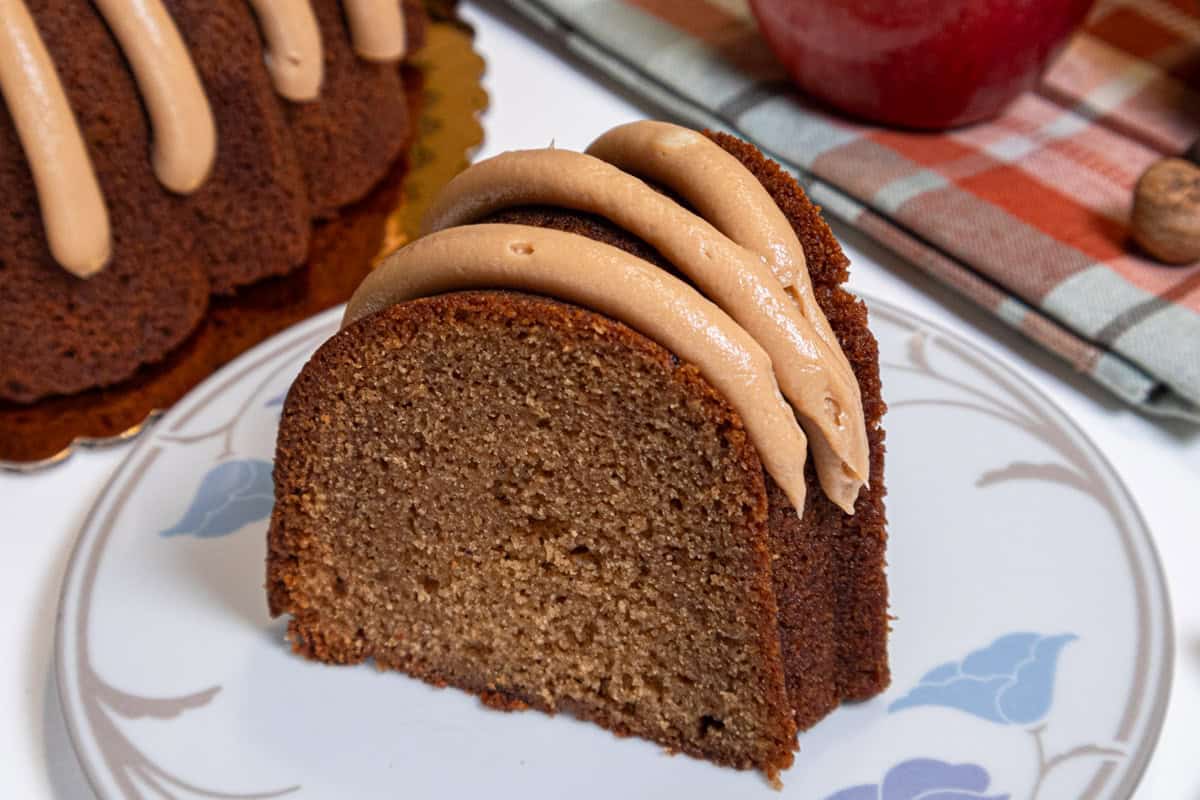
What if I were to tell you this Apple Spice Bundt Cake is as easy to make as falling off a log? What's more it has no apples to peel, core and slice and features a secret ingredient. Finished with a Caramel Cream Cheese Frosting, this cake is filled with the warm spices of fall and is sure to be your newest fall cake.

This cake is so easy to make it will go together in about 20 minutes after you measure the ingredients.
Other cakes I suggest are: Poppyseed Cake with Orange Curd and White Chocolate Buttercream, Chocolate Raspberry Marzipan Gateau, Lemon Rum Bundt Cake, Double Chocolate Mousse Cake and the, Amaretto Truffle Torte. If you are looking for more fall baking ideas, check out Fill Your Home With Autumn Baking.
Apple Butter!! This is not to be confused with applesauce. Apple butter is made during the fall and is often offered then and retired until the next year. Apples are very slowly cooked with sugar and spices until they are dark, sweet, thick and very much apple! It makes the perfect addition to a simple bundt cake and takes it from good to outstanding.
The second surprise is the Caramel Cream Cheese Frosting. Homemade caramel (it's very easy so don't be intimidated!) is teamed with cream cheese for an intense tasting finish to this special cake. That's it. No additional powdered sugar or butter. It's all in the caramel.
This combination is often used in cakes to insure flavor from the butter and oil to keep the cake moist give it a longer shelf life.

FRONT ROW: Unsalted butter, vanilla, corn syrup
BACK ROW: Water, granulated sugar, heavy cream

FRONT ROW: Salt, ginger, baking soda, cloves, cinnamon
SECOND ROW: Nutmeg, baking powder, unsalted butter, vanilla
THIRD ROW: Eggs, brown sugar, granulated sugar
BACK ROW: All-purpose flour, canola or vegetable oil, apple butter

LEFT TO RIGHT: Caramel and Cream Cheese
Be sure to see the recipe card below for the full ingredients & instructions.
Heat the cream in a microwave or on the stove until steamy hot but not boiling. Set aside. For more information on making caramel, please see my post, Caramel, a Building Block of Pastry.

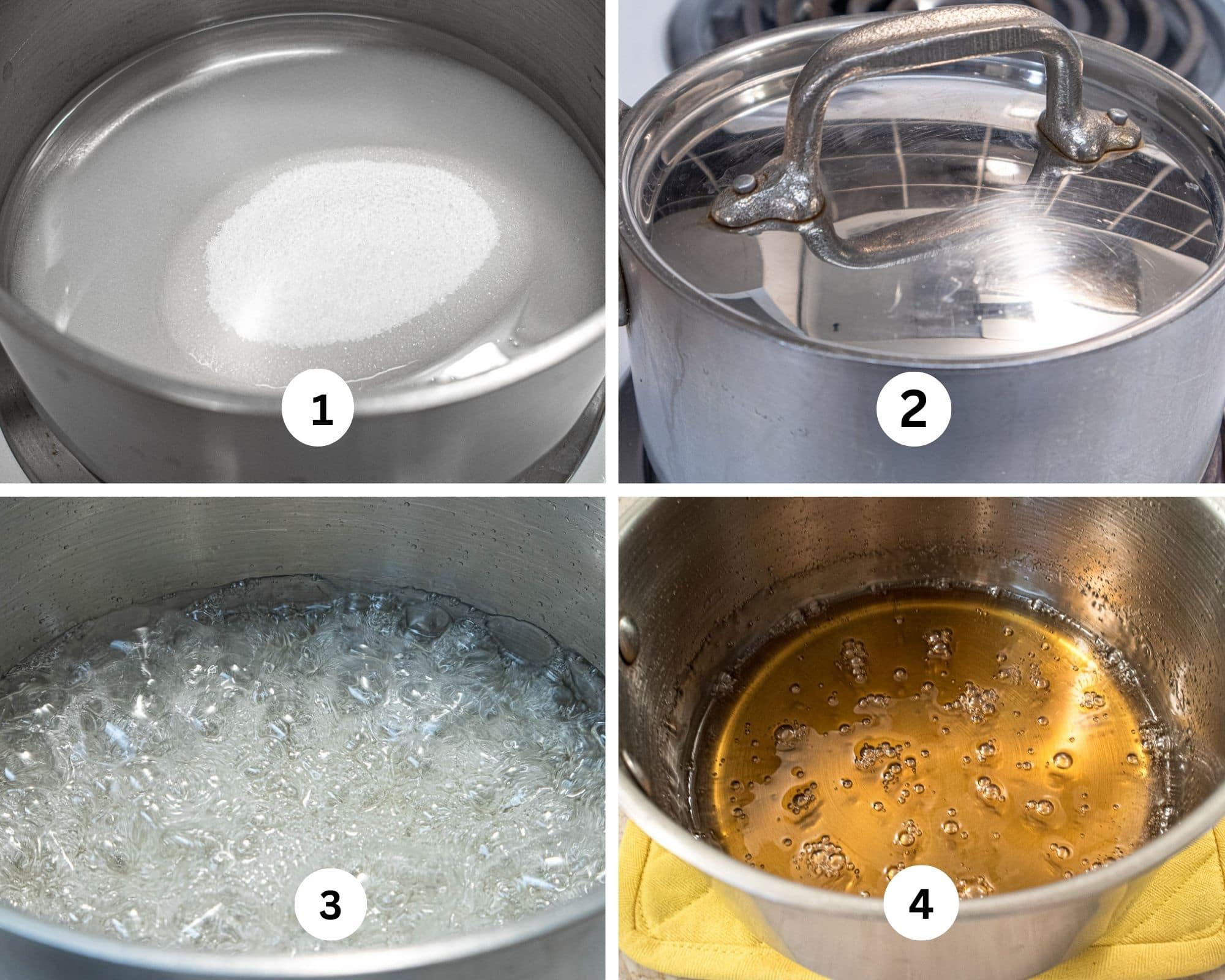
Step 1. Stir the water, corn syrup and sugar in a medium saucepan over medium high heat. Bring it to a boil. Step 2. Cover the pan tightly for 3 minutes or brush down the sides of the pan with cold water to remove any sugar crystals that could cause the caramel to granulate after cooling. Step 3. Bring the mixture to a rolling boil. Step 4. Boil it until it reaches a medium golden color.

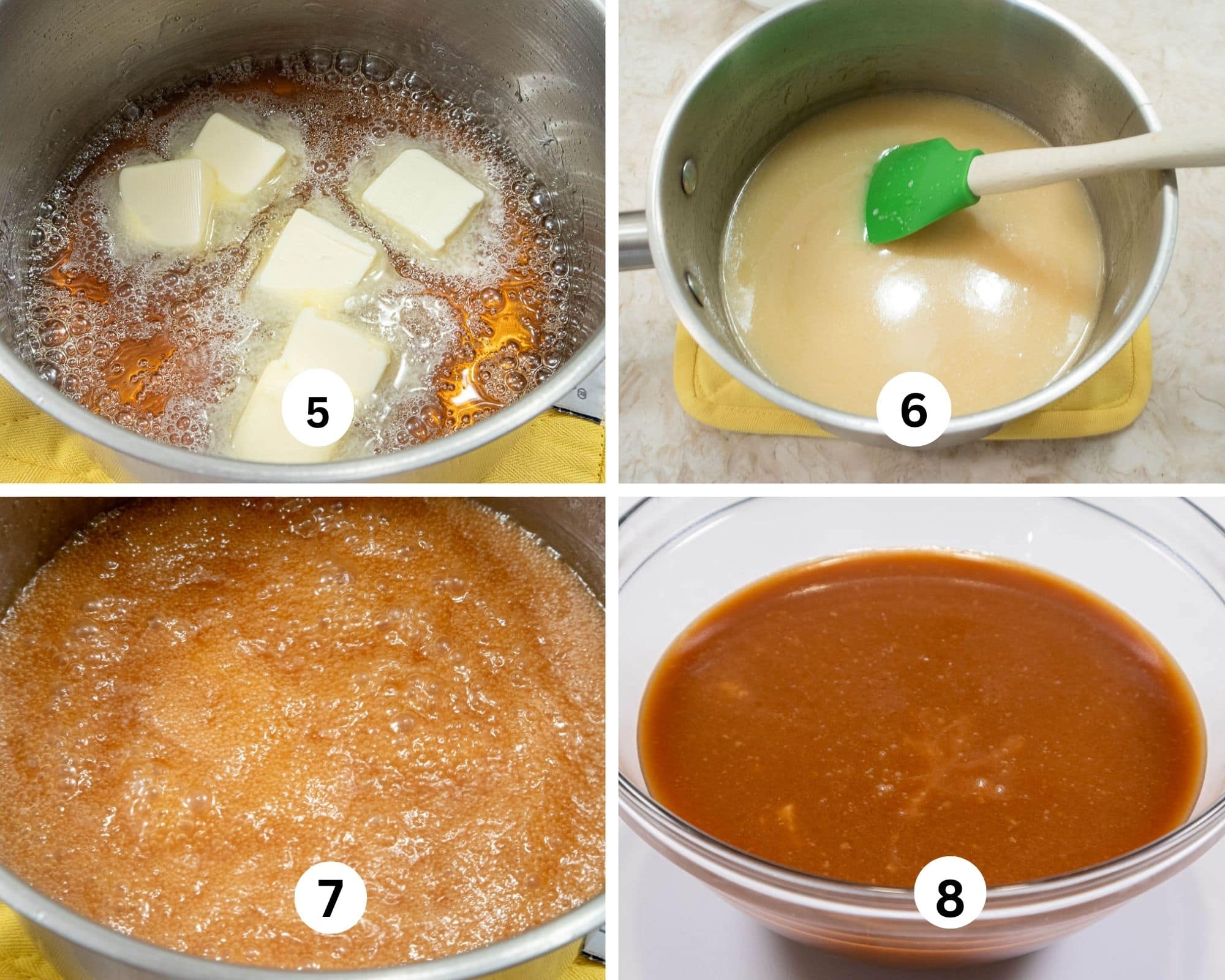
Step 5. Remove the pan from the heat and stir in the butter until it is melted. Step 6. Add the hot cream and stir it in. If it wasn't hot enough and it lumps somewhat, that's fine. It will be corrected in the next step. Step 7. Return to the heat and bring it back to a boil until the temperature reaches 228°F. Remove from the heat immediately and pour it into a bowl to cool or if in a hurry, pour it into a rimmed sheet pan where it can spread out.

Step 1. Place the flour, spices, salt, baking powder and baking soda in a medium bowl. Step 2. Whisk them together and set aside. Step 3. Place the brown and granulated sugar, the softened butter and oil in the bowl of a mixer fitted with a paddle attachment. Step 4. Mix on low to bring together and then raise to medium. Mix to combine, scraping often, especially on the bottom.

Step 5. Add the eggs and vanilla to the batter and mix to combine. Step 6. Add half the apples butter and beat until combined. Step 7. Add half the flour. Step 8. Beat in on low, scraping often. Repeat with the remaining apple butter and flour.

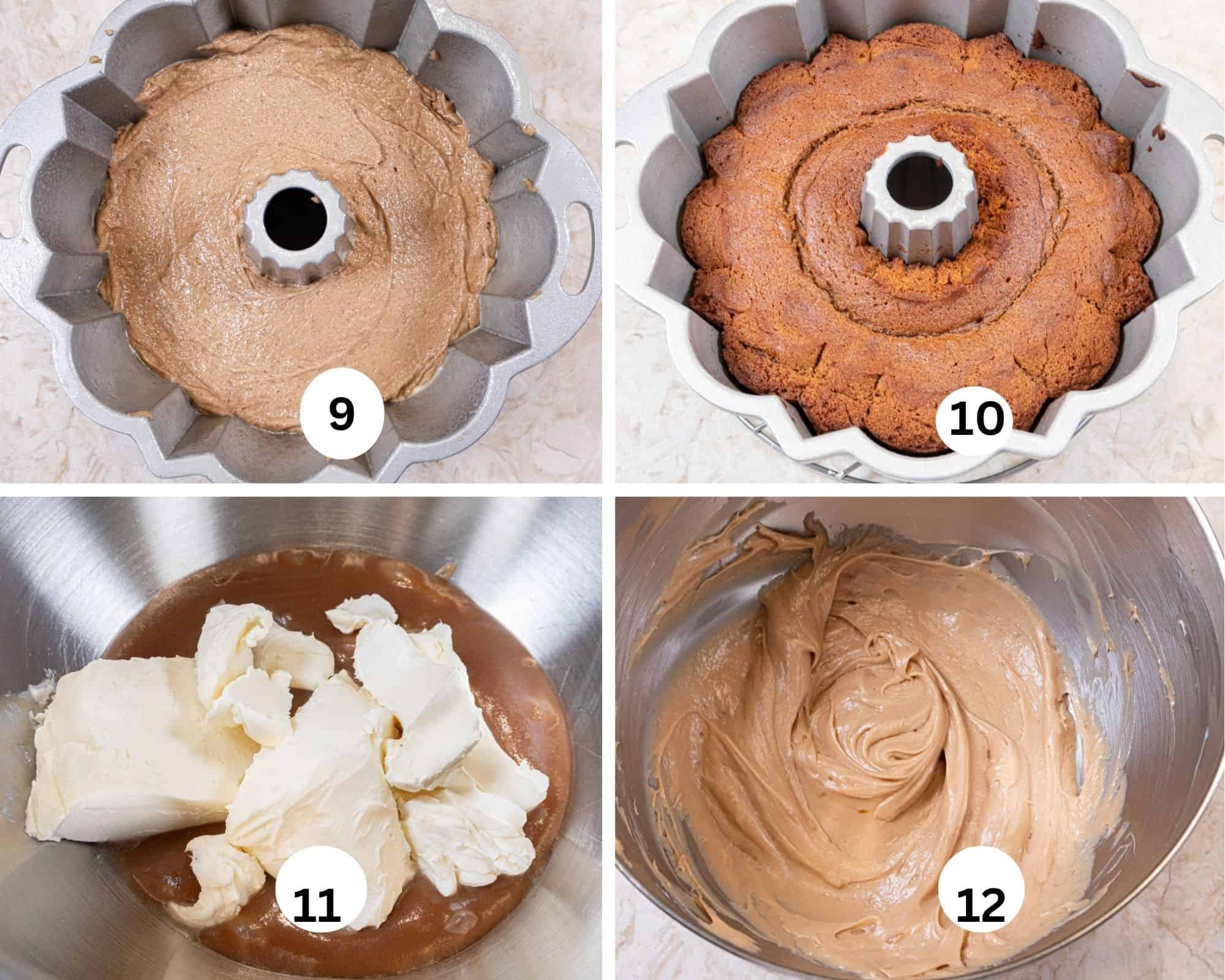
Step 9. Spray the bundt pan well with a non-stick baking spray. Dollop the batter evenly into the bundt pan and smooth it out. Step 10. Bake as called for. Step 11. Place the room temperature caramel and cream cheese in the bowl of a mixer. Step 12. Beat on low to mix and then raise to medium or medium high and beat until smooth and completely combined. Scrape often to ensure an even frosting.

Step 13. Cool the cake in its pan for about 20 minutes. Turn it out onto a rack to cool completely, then transfer to a serving dish or cardboard round. Step 14. Place a ½" plain tip in a piping bag and pipe frosting between the lines starting about 2" above the bottom as shown. Step 15. Pipe the frosting up the side of the bake in the natural divide, then up and over the top into the hole. Step 16. After all of these have been piped, go back and pipe in the same manner between the already piped lines as seen in the this photo. Alternatively, omit the frosting and dust with powdered sugar.
They are easy to make, require no filling and no fancy finishes.
There used to be one design, but in ensuing years, there are many different designs including seasonal ones. Just make sure the cup size is correct for the recipe being made.
There are different sizes so it's important to check to make sure the pan you have will hold enough batter. The traditional Nordic Bundt pan holds 12 cups. However, the pan should only be filled to ⅔ to ¾ full with cake batter to allow it to rise without going over the edge of the pan.

A lot of work goes into each of my recipes and my only ask is that if you like the recipe or even the looks of it, please leave me a star rating to help me rank better. It’s important and I appreciate it and I appreciate you.
Modified: · Published: by Helen S Fletcher · This post may contain affiliate links · 5 Comments
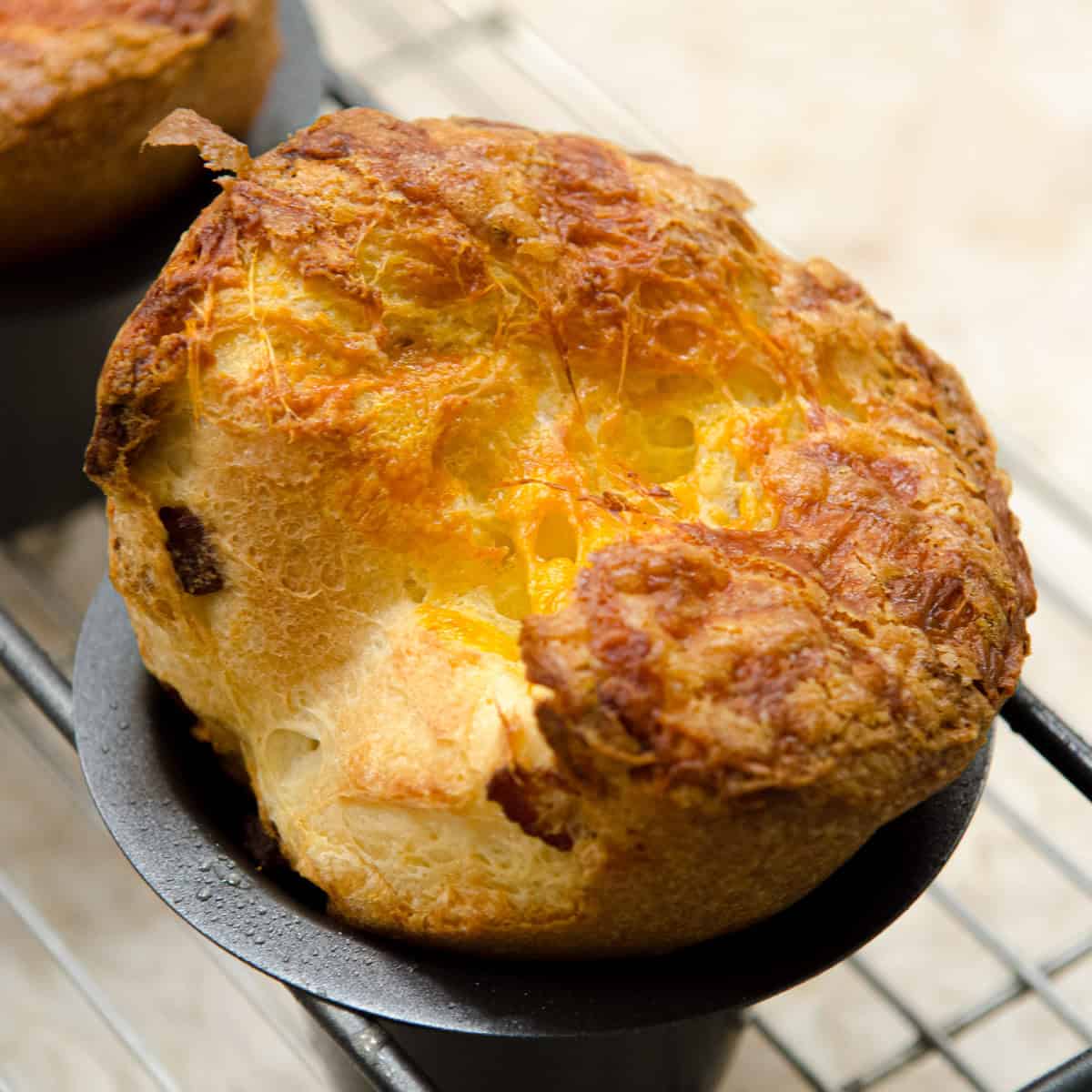
This Cheddar Bacon Popovers Recipe will be the easiest you will ever make. There is easy and then there is POPOVER EASY! Think about this. All of the ingredients, except the cheese and bacon go into a processor or blender and that's pretty much it. Process or blend, portion out the bacon, pour the batter over, sprinkle with cheese and in the oven they go.

With its cheesy top and bits of bacon, this is the perfect accompaniment to almost anything or just for a snack. The bacon and cheese really come through.
Often compared to Yorkshire pudding and crepes, popovers can be plain, enhanced as I did or add parmesan cheese, basil and oregano for an Italian version, or lemon and feta for a Greek version.
Other quick breads I think you'll enjoy are: Buttermilk Flatbreads, Cream Biscuits, Cinnamon Filled Buttermilk Scones, and Traditional Irish Soda Bread. For more incredible bread inspiration, check out Unforgettable Breads to Bake and Share

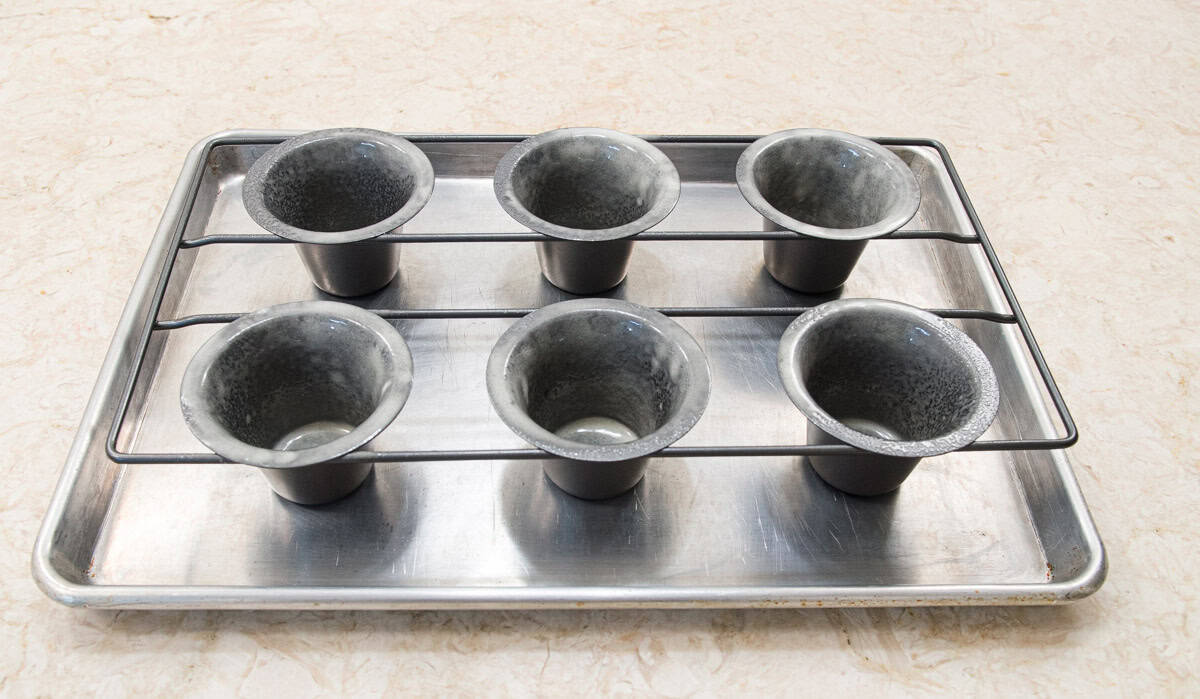
This is the traditional popover pan. There are 6 cups attached between rails so the heat can get around them evenly. It is easier and safer to put them on a half sheet pan to move them in and out of the oven. The cups are tapered at the bottom to encourage the "popover".
Do you have to bake in these? No, the popovers can be made in muffin cups but they don't have the same look but are just as good.
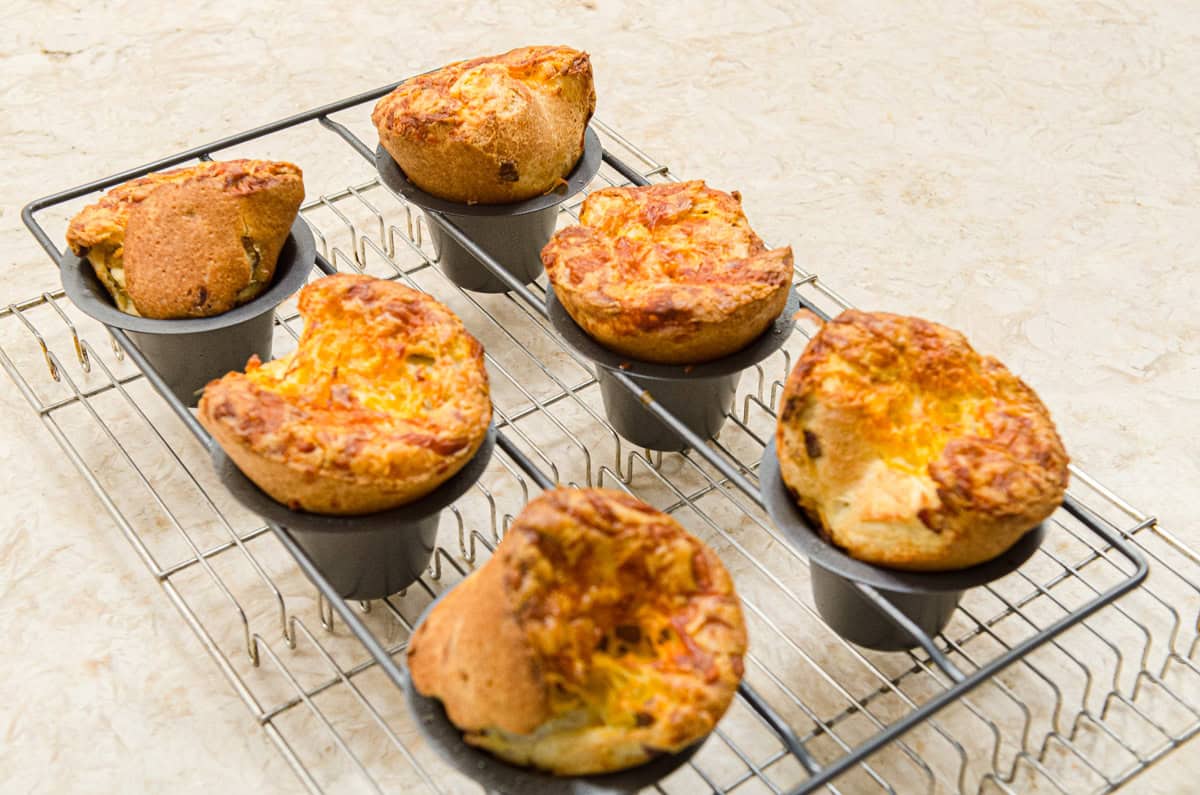
Because it can literally turn over in the pan while baking. You can see it here on the front and back left side.

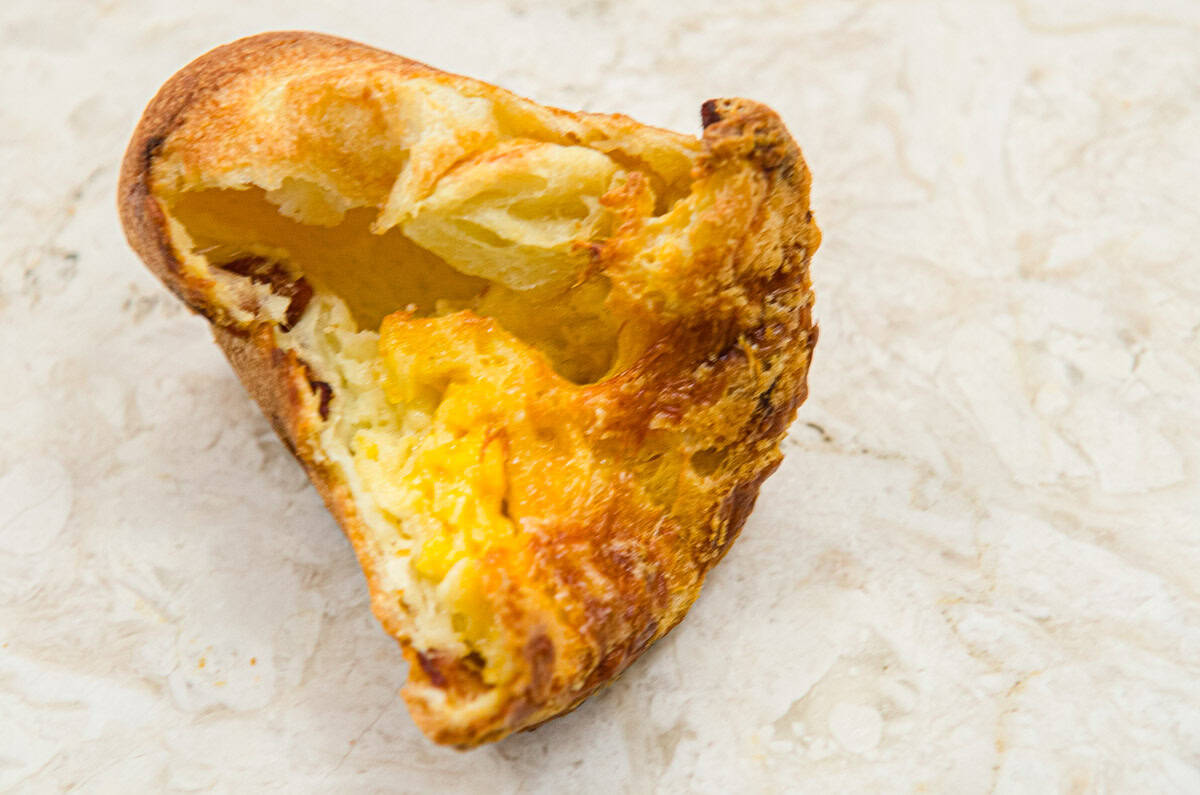
I'm not sure who came up with the description that includes the custardy inside. What is inside is unbaked dough! The definition of custard is a mixture of milk, sugar and eggs as its base where the eggs act as the thickener. It has a smooth, creamy texture with no flour in site.
The doughy inside comes from either overfilling the popover cups or underbaking the popover or both. Very little batter goes into the cup which is why it is so amazing that they rise so high. The dough inside is also the reason so many recipes call for rushing to the table before they deflate. The uncooked dough inside retains heat and steam which quickly deflates the popovers and they become soft and soggy.
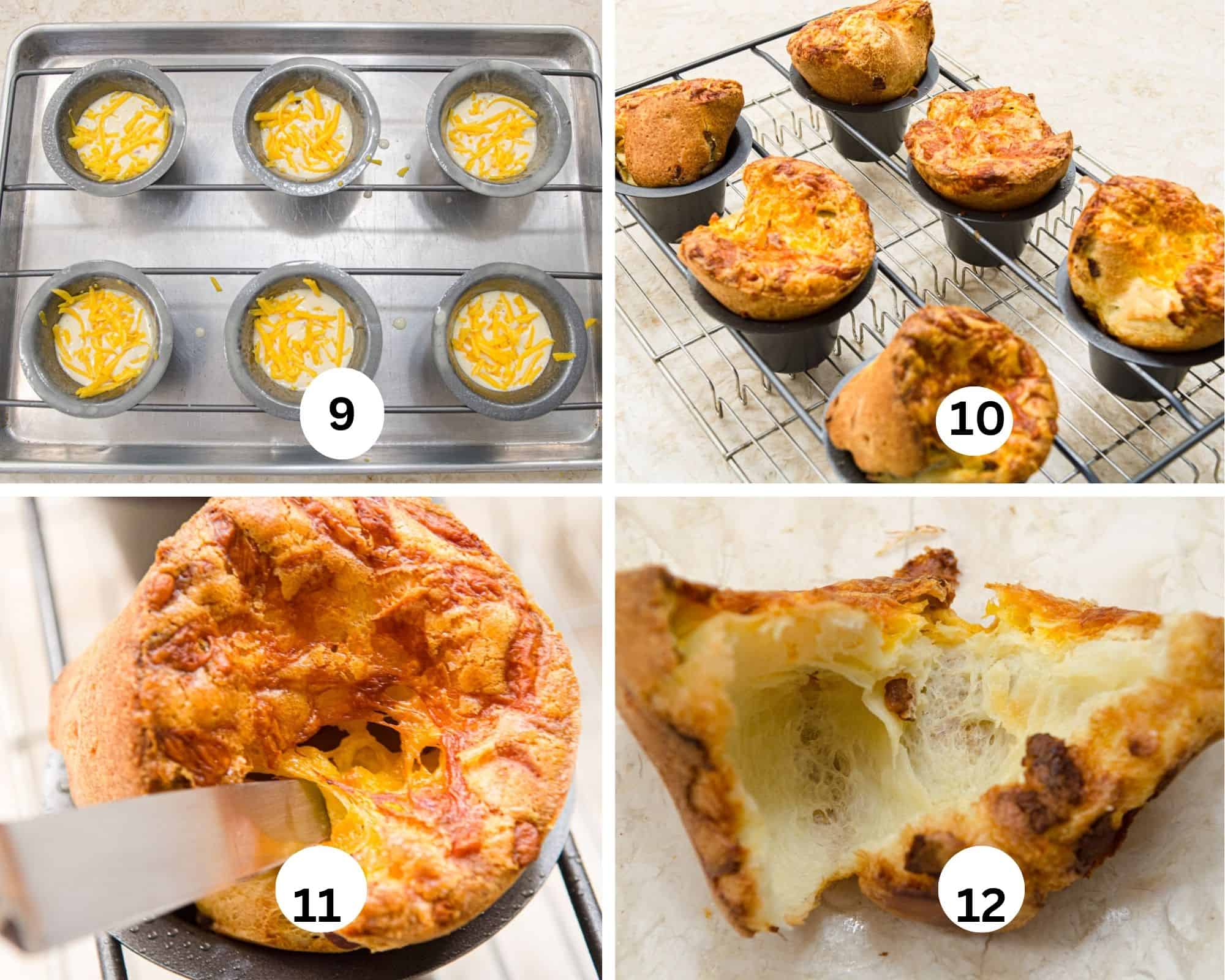
But the bottom line is there is no custard in a popover. My popovers are a crispy outside surrounding a hole in the middle. You can see it here along with the bacon and the cheese. There is no need to rush them to the table because they don't deflate. They stay crisp.


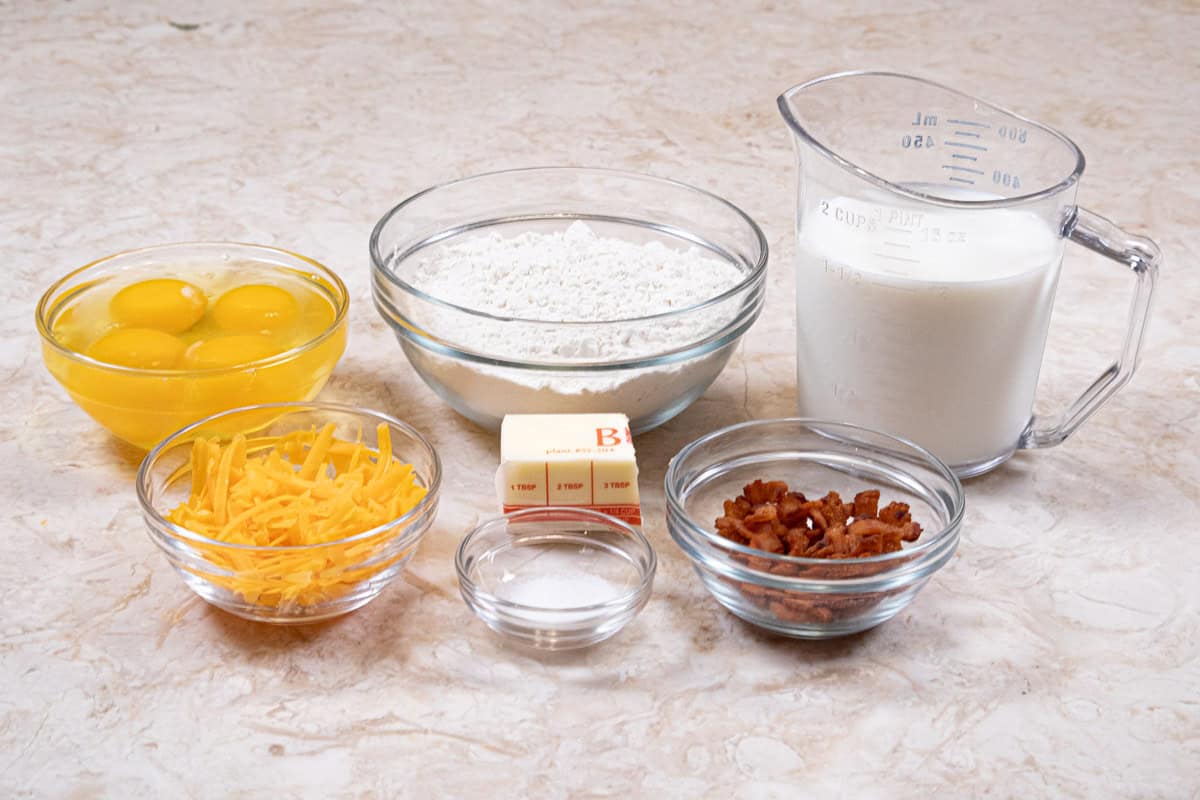
FRONT ROW: Cheddar cheese, salt, cooked bacon
BACK ROW: Eggs, bread flour, 2% milk
Bread flour is used for its strength. It will hold the popover up while they get set in the oven. It also makes a crisper crust that stays that way.
2% milk or a combination of whole milk and water is important to the end result of the the popovers. I give you the choice in the recipe.
While I give you a weight for the bacon, it depends upon the bacon. Some render out more fat than others.
The eggs are size large.
Be sure to see the recipe card below for the full ingredients & instructions.

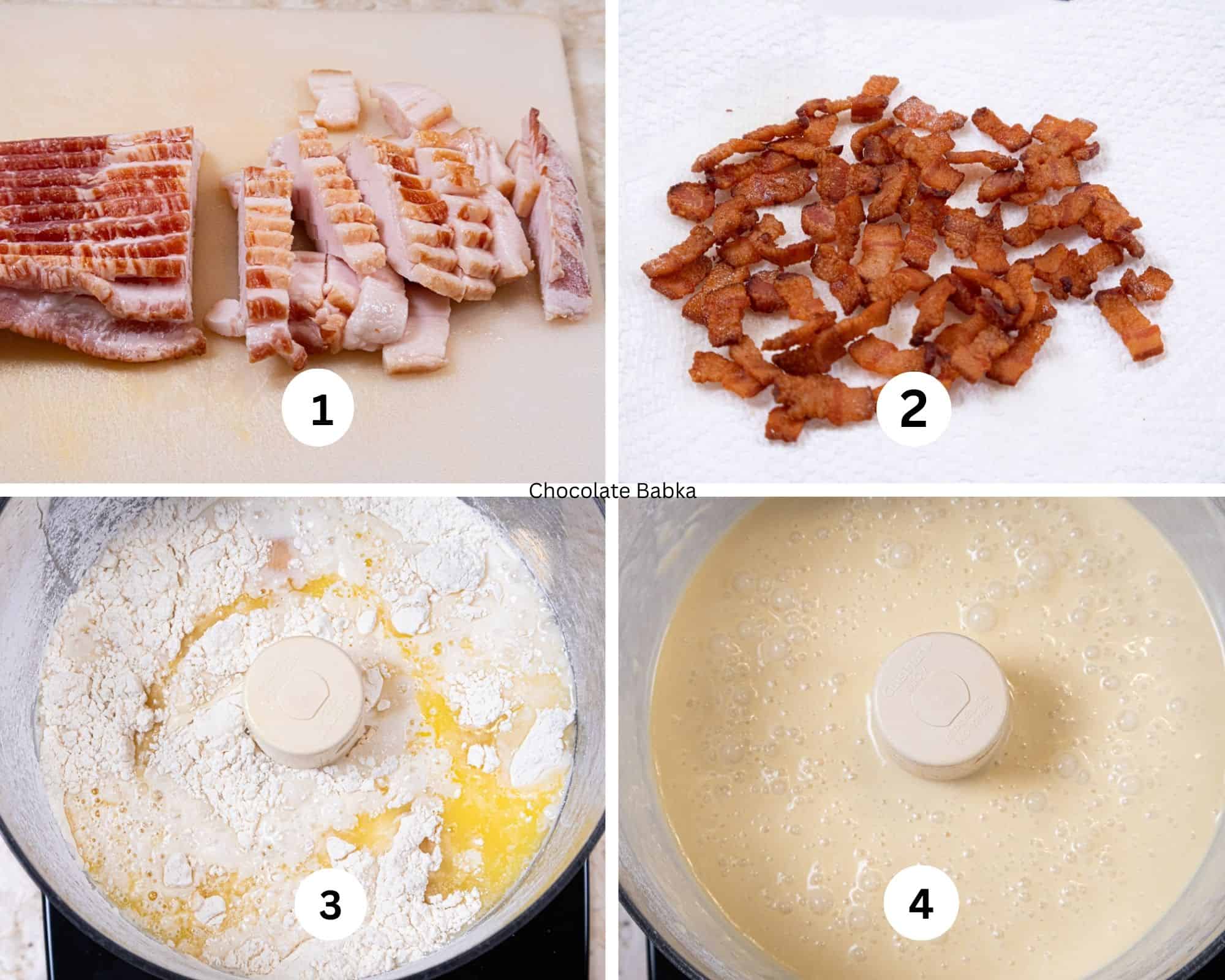
Step 1. I have found the easiest way to cut the bacon for this is the just slice it vertically. Step 2. Place the slices in a frying pan and fry it over low to medium heat until they are crisp and the fat is rendered out. The bacon will separate out into individual pieces as it fries. Step 3. Place the eggs, 2% milk or the milk and water, melted butter, bread flour and salt in the bowl of a processor or blender. Step 4. Process or blend until smooth.

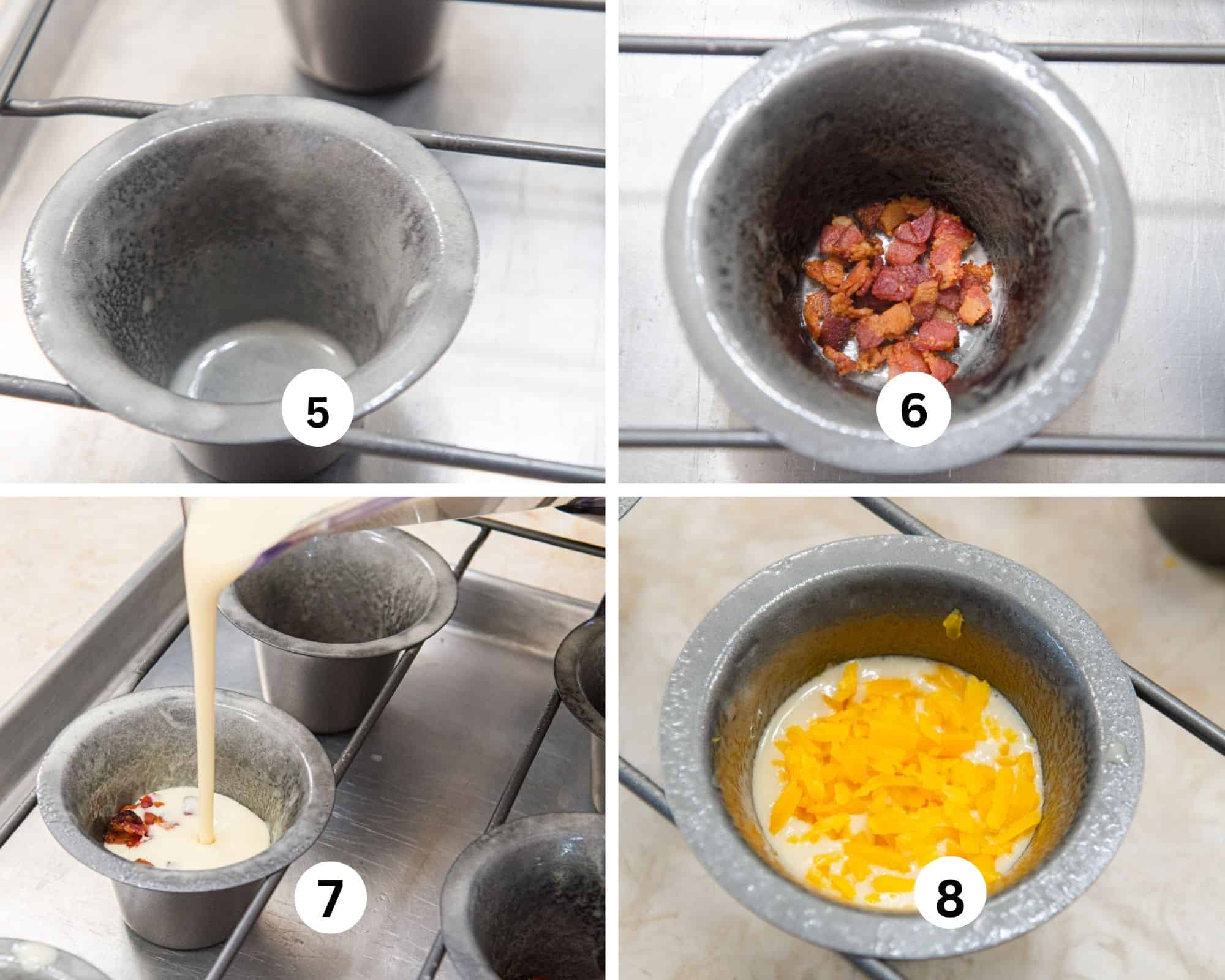
Step 5. Spray the cups and lips of the cups very well with a non-stick baking release. Step 6. Place 1/12 of the bacon in each cup. Step 7. Pour ¼ cup batter over the bacon. Step 8. Top with 1/12 of the grated cheese.

Step 9. Place the rack of popover pans on a half sheet pan. Step 10. Bake as called for. You can see some of them have popped over. Step 11. Immediately, upon taking the popovers out of the oven, slit the top to release any steam inside. Step 12. One of the popovers opened up. This is how they should look. They should not be doughy inside.
There are four ways products rise. They are yeast, chemical leaveners like baking powder and baking soda, air (think angel food cake) and steam (think choux paste for cream puffs and popovers).
Yes, the batter needs to the very thin and pourable. That is one reason 2% milk is better than whole milk in this recipe because it is thinner. Water can be used to dilute the whole milk.
It is important to heat the popovers quickly so the steam can push them up. Too low a temperature will result in popovers that are not as high and crisp and may end up doughy inside.

A lot of work goes into each of my recipes and my only ask is that if you like the recipe or even the looks of it, please leave me a star rating to help me rank better. It’s important and I appreciate it and I appreciate you.
Modified: · Published: by Helen S Fletcher · This post may contain affiliate links · 5 Comments
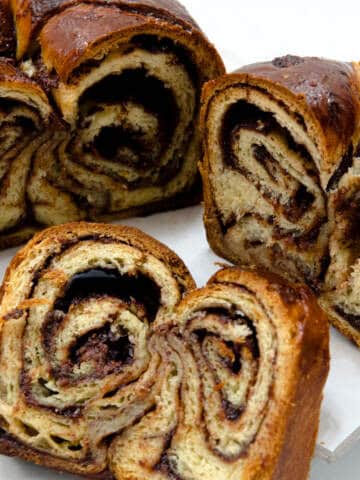
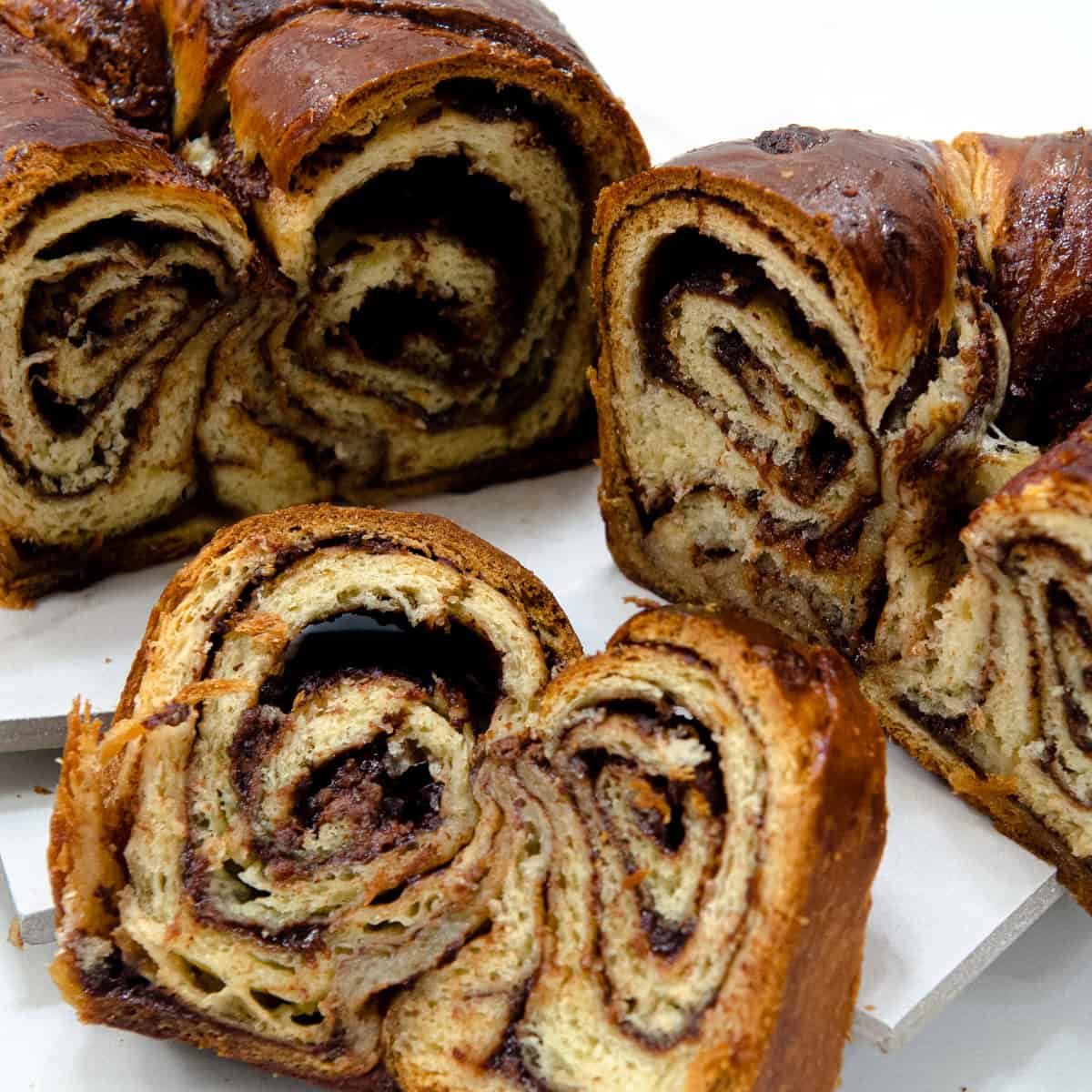
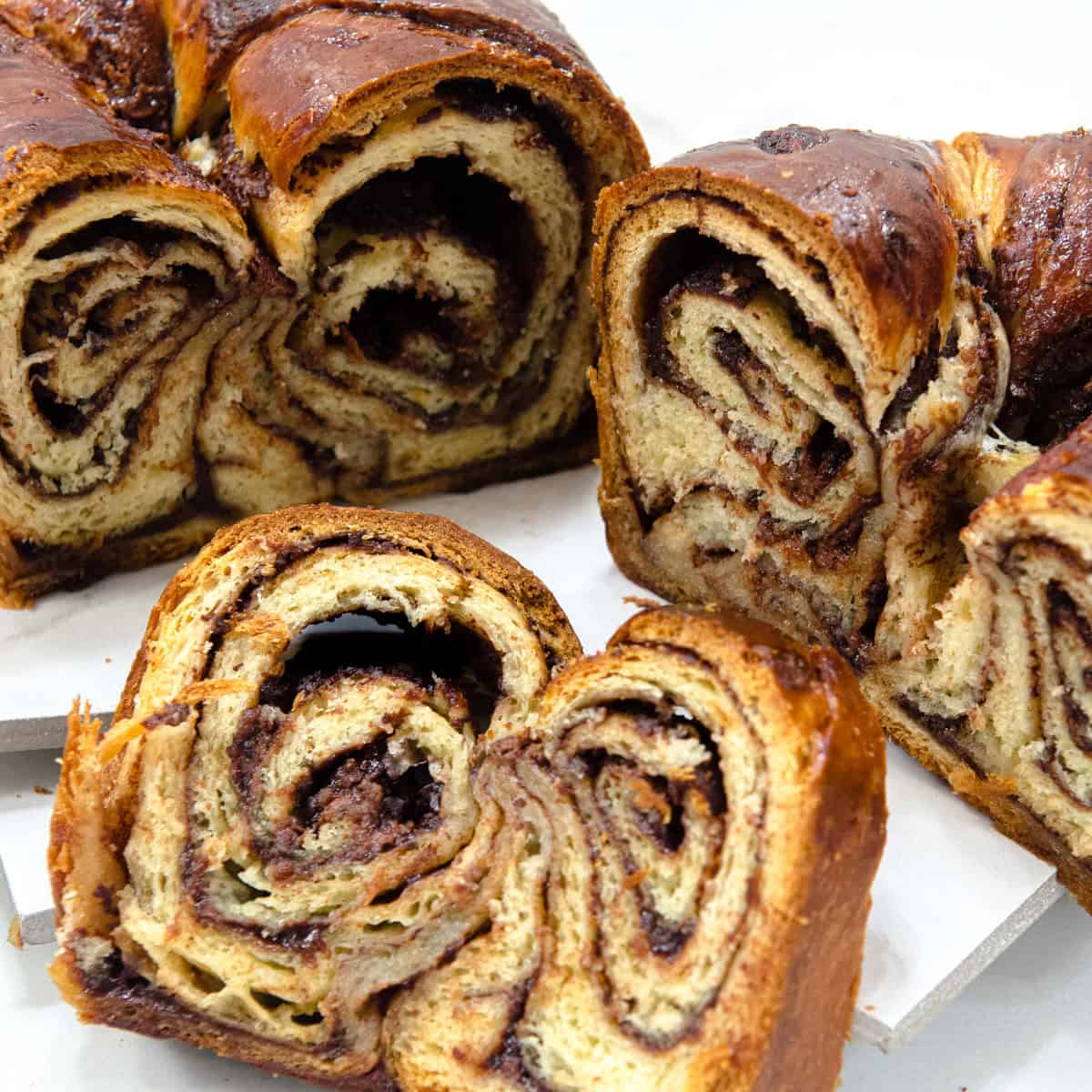
My Chocolate Babka Recipe is a visually stunning sweet bread that has a couple of tips to help you shape this marvelous filled yeast dough. For the chocolate filling, I simply used Nutella to highlight the sweet dough for an unparalleled treat that is easier to make than it looks. It's very straight forward to make and easy to twist using a much easier technique than most recipes. So if you're thinking twice about making this, let me assure you, you can make this!

Babka is a sweet bread from old world Poland and Ukraine and while many recipes fill it with cinnamon sugar, when the new world took a look at it the filling quickly changed to chocolate or almost anything.
Other sweet breads I love are: Lemon Sugar Buns, Orange Macadamia Rolls Recipe, Brandied Chocolate Cherry Almond Garmisch, and my Best Cinnamon Rolls with Cinnamon Crunch Topping (think Panera's Cinnamon Crunch Bagel topping). For more baking inspiration, check out Kick-Start Your Holiday Spirit: Cookies & Breads to Bake Now.
Everything is the answer! The dough is enriched with butter, eggs, and sugar providing an easy to roll out dough which is filled with Nutella. I used my mothers enriched yeast dough from European Nut Roll with Three Fillings.
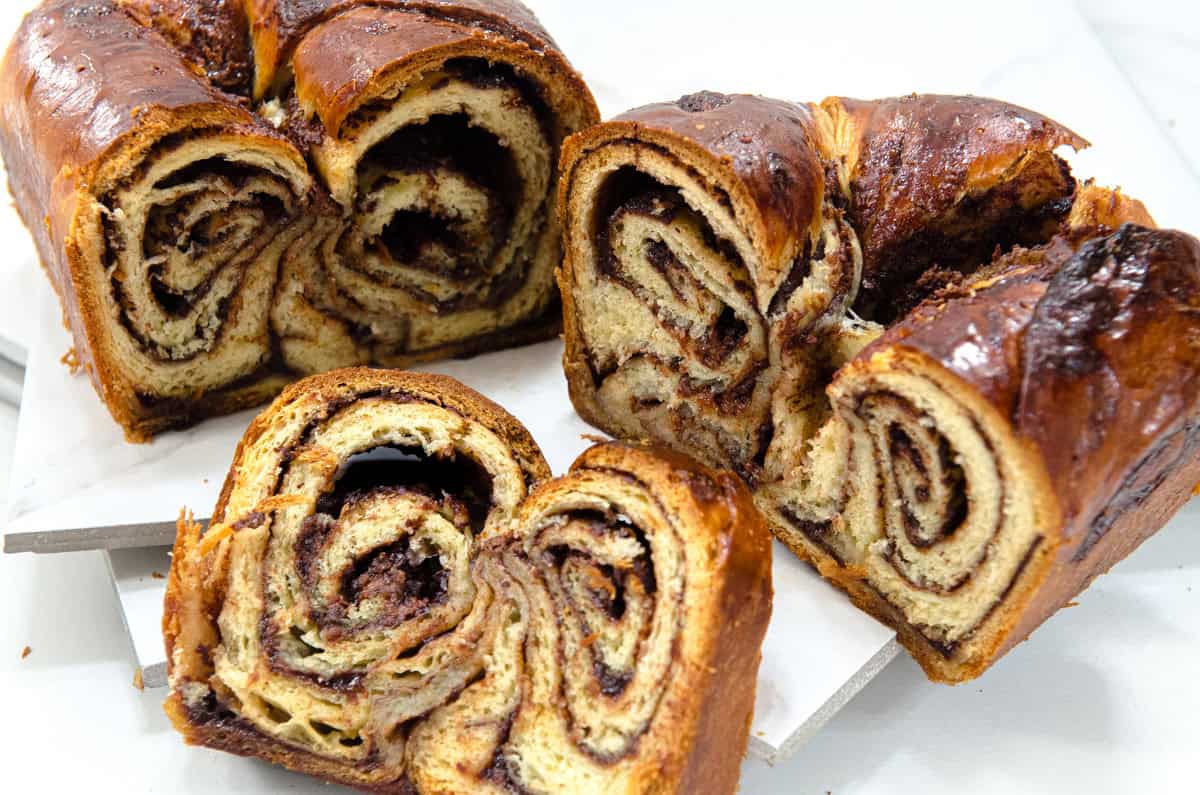
Babka is recognizable from it's distinctive swirly inside made by rolling the dough as if making cinnamon rolls then twisting it to further shape it inside. It can be finished with a crumb coating or a shiny, simple sweet glaze. I chose the glaze for a beautiful finish that enhances the Babka.
The basic steps are to make the dough, let it rise then chill overnight to make it a snap to roll out with no spring back. It is then filled, rolled tightly like a cinnamon roll dough but there the difference stops. Most recipes call for the dough to be slit from top to bottom and then twisted. I did this the first time and there is no way to adequately describe the mess it makes. There was chocolate all over the table, my hands, and me. So much so, I almost gave up at that point.
Since I'm not easily defeated in the kitchen, I went back and researched some more. I found a recipe for Chocolate Babka from Martha Stewart where I found the perfect method for shaping and swirling the dough without the mess Unfortunately, when I went to her site to link it, it is no longer there. I am sharing this method with you.

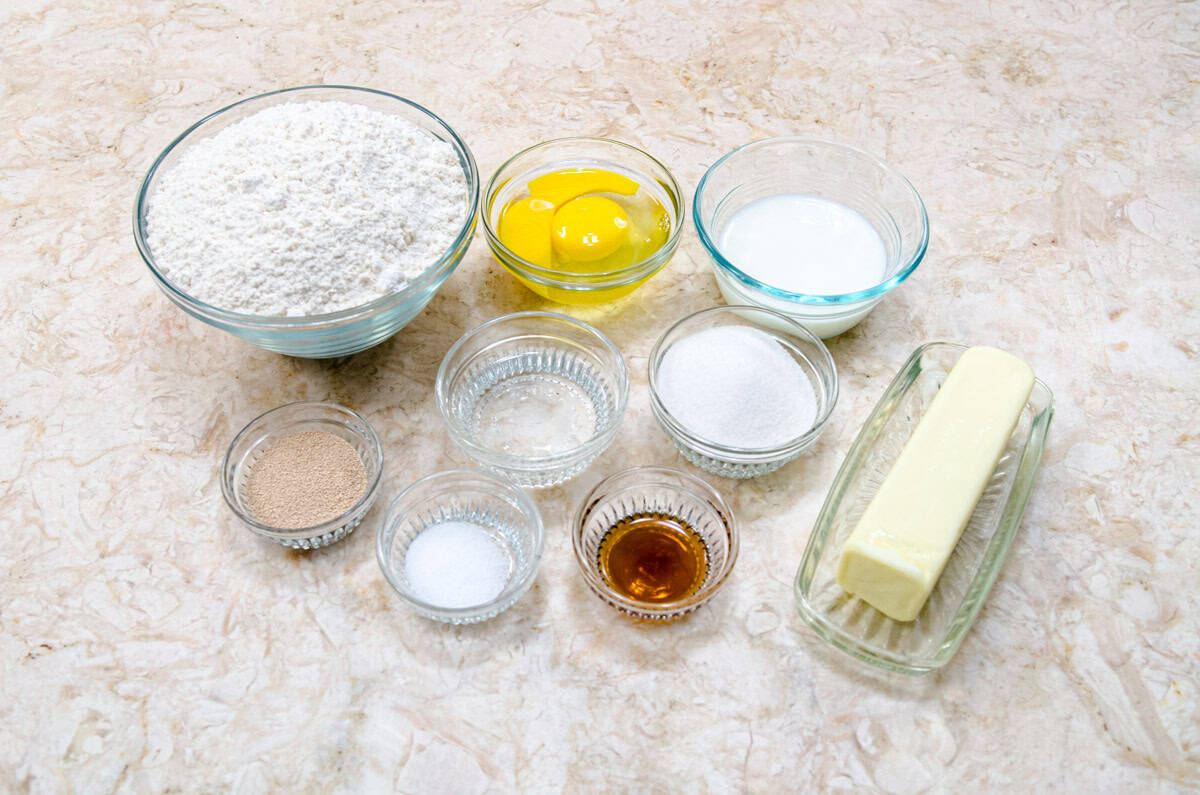
COUNTERCLOCKWISE FROM TOP LEFT: Bread flour, egg + egg yolk, milk, unsalted butter, vanilla, salt, yeast.
IN MIDDLE: Water, granulate sugar

FRONT ROW (egg wash): Cream, egg yolk
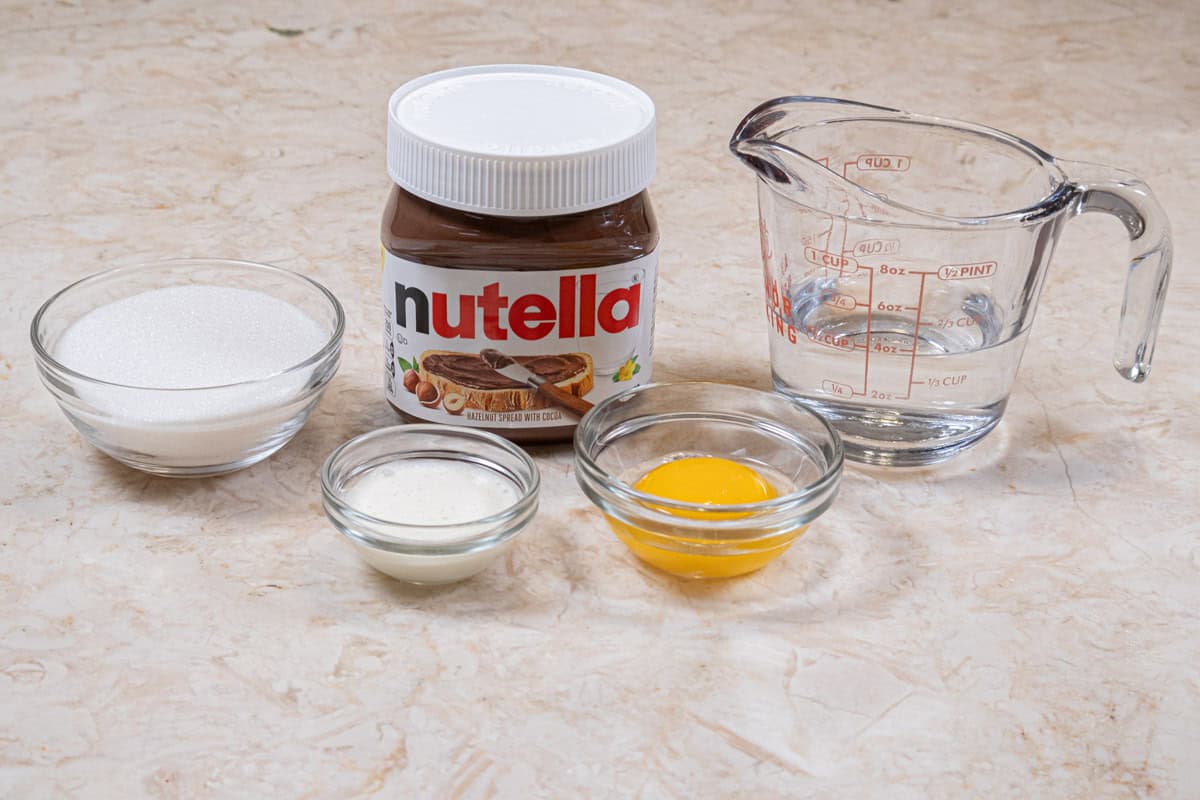
BACK ROW: Granulated sugar, Nutella, Water (sugar & water for the simple syrup, Nutella for the filling
Be sure to see the recipe card below for the full ingredients and instructions.

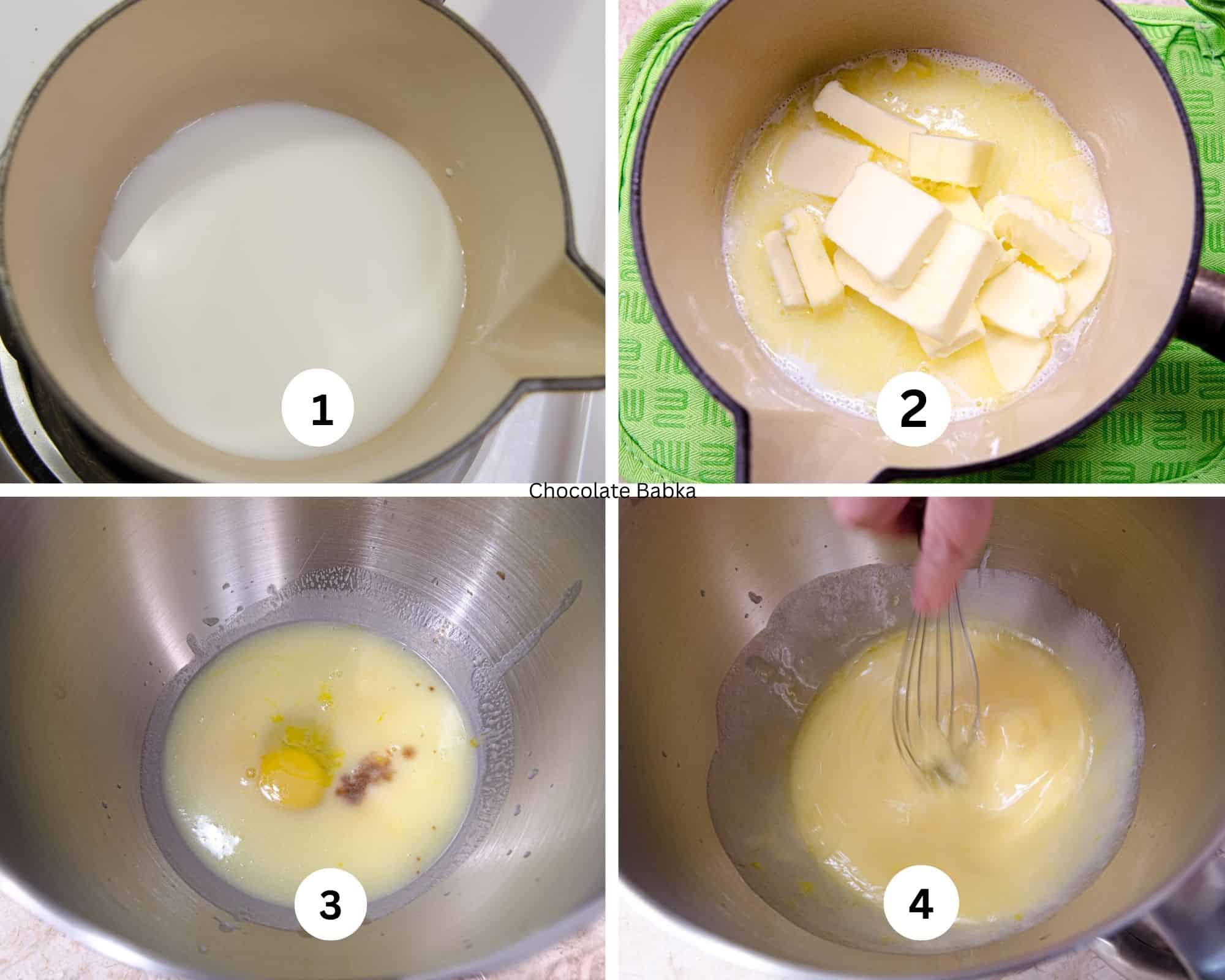
Step 1. Stir the yeast into the water and set aside. Heat the milk to simmering. Step 2. Add the butter, sugar and salt. Stir to melt the butter. If all of it doesn't melt, reheat briefly. Step 5. Pour into the bowl of a mixer. Step 4. Whisk together and cool to lukewarm. Whisk in the water and yeast.

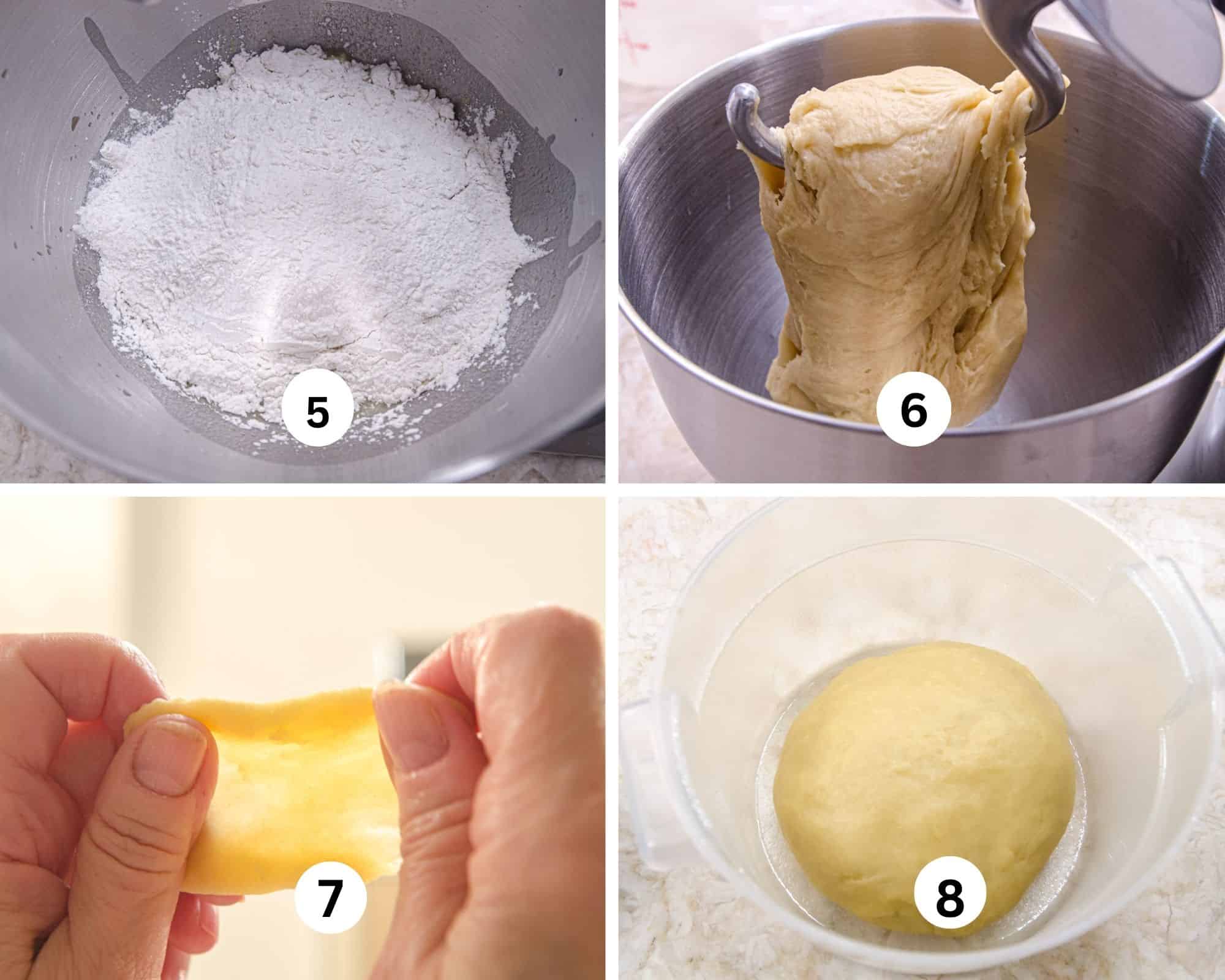
Step 5. Add the flour all at once to the mixing bowl. Step 6. Fit the mixer with a dough hook if available. Mix on low until it comes together and then on whatever speed your mixer suggests for yeast doughs. Beat until it cleans the side of the bowl. Step 7. Take a small piece of dough and stretch it between your fingers. If you can see through it the dough is finished. This is called a windowpane test. If the dough breaks and will not stretch, then beat it for a couple of more minutes. Repeat the windowpane test. Step 8. For the first rise, place the finished dough in a container at least twice as big that has been sprayed with a non-stick baking release. Cover the dough and mark the top with the time. Allow the dough to rise until doubled in bulk. This can be a slow riser due to the enrichment of egg, sugar and butter. Deflate the dough and refrigerate overnight to make it easier to roll the next day. It can be refrigerated up to 3 days before using.

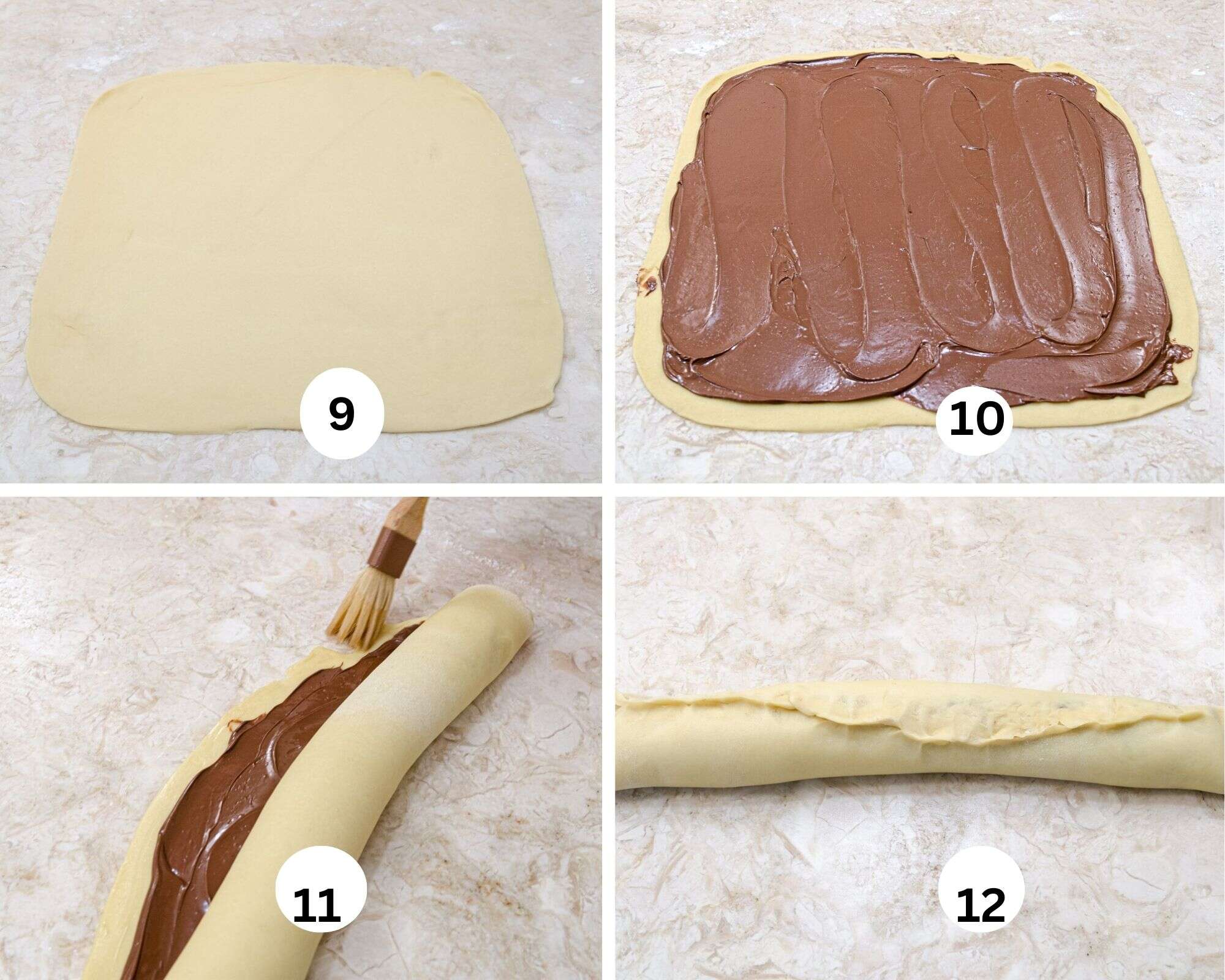
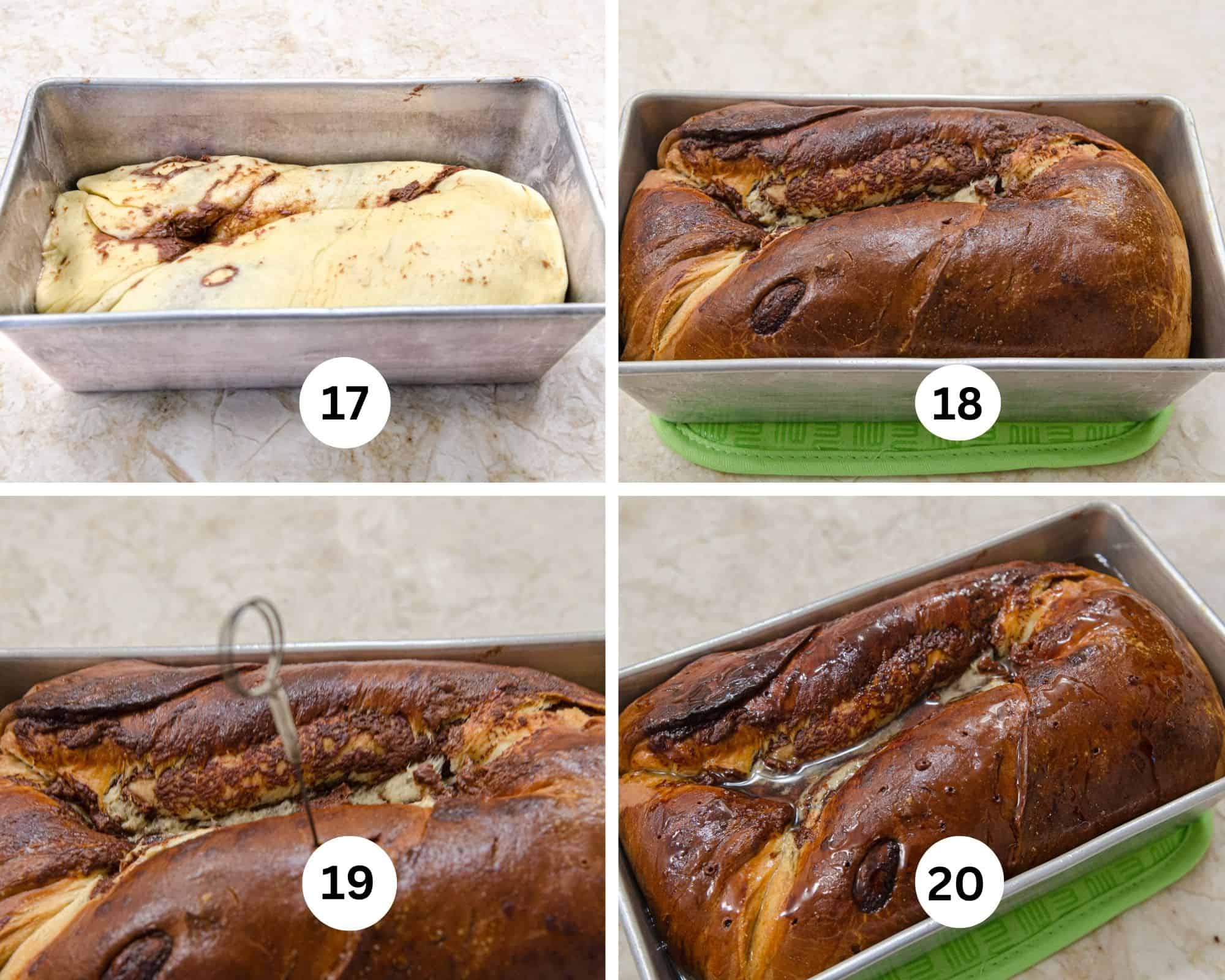
Step 9. Remove the dough from the fridge. Spray a 9x5" pan with a non-stick baking release. Roll the dough into an 18" x 24" rectangle on a lightly floured surface. If the dough is really soft, fold it in quarters, place it on a parchment paper lined sheet pan and put it int the freezer for a few minutes to firm up. . Step 10. Turn the dough so the 18" side is in front of you. Spread the nutella to within ½" inch of the edges of the dough. If the nutella is too stiff to spread easily, microwave it briefly to a spreadable consistency. Step 11. Roll the dough tightly. When you get to the end, wet it lightly with water. Step 12. Pinch the seam together as well as the ends to seal them.

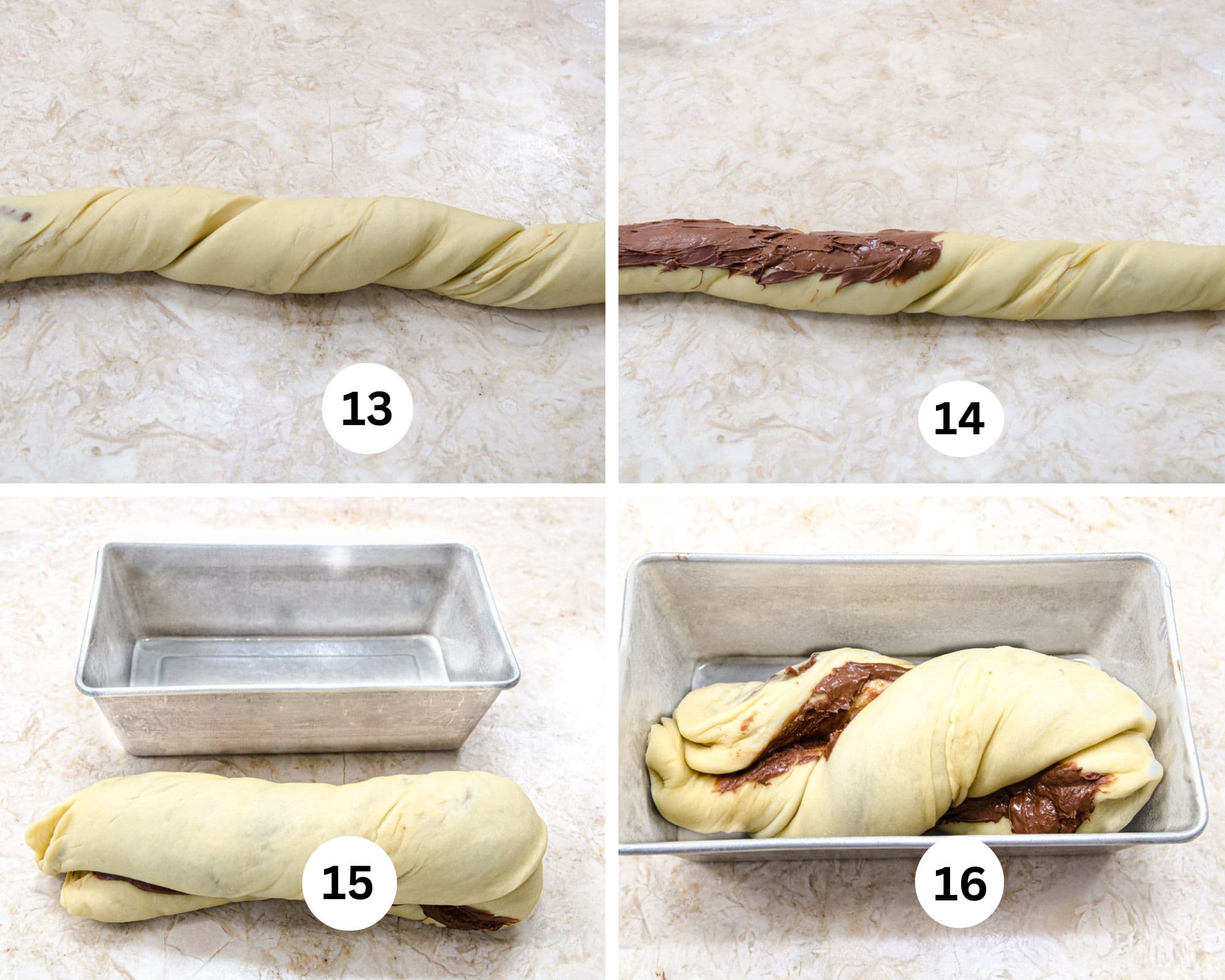
Step 13. Take the roll in each hand and twist each hand in the opposite direction. Twist has hard as possible to make them very tight. Twist a second time. Step 14. Spread the reserved 2 tablespoons nutella over half of the twist. Step 15. Fold the plain side over the nutella. Step 15. Spray a 9x5" loaf pan with a non-stick baking release. Twist the babka again as much as you can and tuck it into the prepared loaf pan. Flatten it with your hand. Cover and give it a second rise until doubled.

Step 17. When the Chocolate Babka has doubled in the pan, brush it with the egg wash. Brush it again just before it goes into the oven. Step 18. Bake it on the middle rack of the oven as directed. While the babka is baking, prepare the simple syrup. Let it simmer for 1 minutes. Step 19. Poke holes all over the babka with a cake tester. Go almost to the bottom but not through it. Step 20. Pour the prepared simple syrup mixture over the babka and let it cool. Serve or freeze.
We have the Jewish settlements in Poland and Ukraine to thank for Babka. In the 1800's the bakeries would use their traditional challah bread that is enriched with eggs and butter as a base, roll it out, fill it with cinnamon sugar or jam, roll it up and bake it in a round pan for a sweet treat.
Doughs that are enriched with eggs, butter and sugar are used. Think, challah, brioche dough or any enriched yeasted sweet dough.
Anything you fill a sweet roll with - cinnamon and sugar, poppyseed filling, cream cheese, chocolate, jams or preserves, almond paste, apricot or prune lekvar are just a few of the possibilities
The babka will last, covered at room temperature for several days. Do not refrigerate. For longer storage, bake it and soak it, then freeze it. Wrap it well and it will last for several months in the freezer. Thaw it at room temperature and freshen it in a 350°F oven. Wrap it in aluminum foil, leaving a small opening in the top and heat for about 20 minutes.

A lot of work goes into each of my recipes and my only ask is that if you like the recipe or even the looks of it, please leave me a star rating to help me rank better. It’s important and I appreciate it and I appreciate you.
Modified: · Published: by Helen S Fletcher · This post may contain affiliate links · 9 Comments
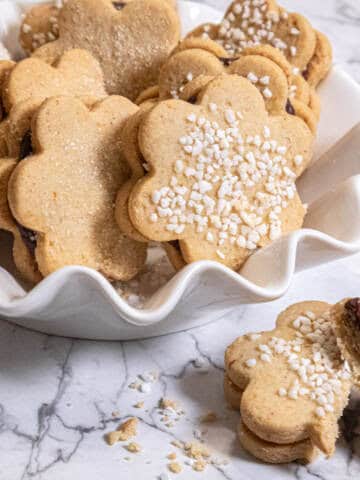
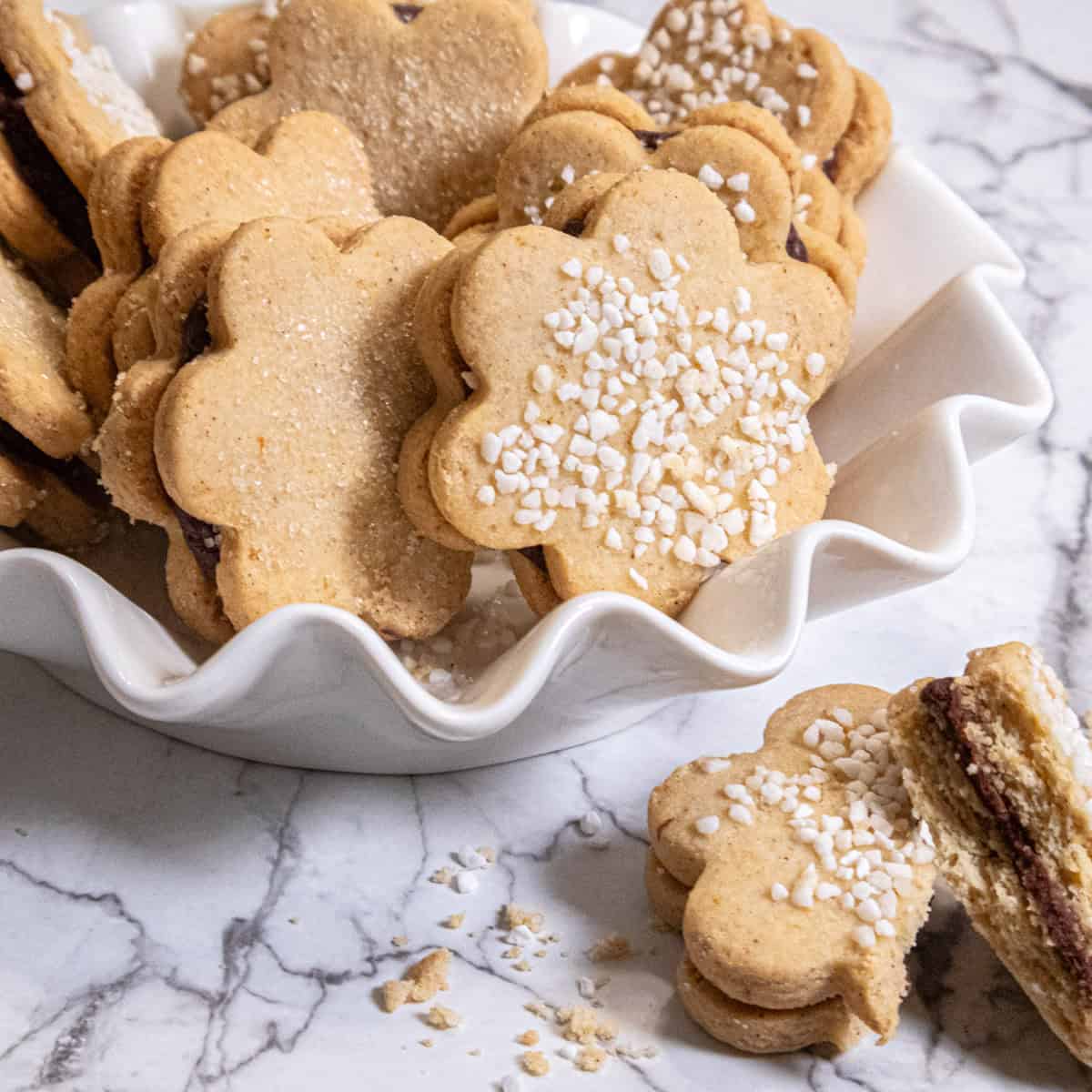
These Best Spiced Shortbread Cookies are one of the easiest and simplest to make. Three ingredients plus the two flavorings are all that is needed and I'll bet they're in you pantry and fridge already. Now imagine these are sandwiched with a chocolate sour cream ganache. This shortbread uses Chinese 5 Spice powder or cinnamon.

This is the same basic shortbread we used at the bakery. I am so in love the shortbread cookies, there is a whole chapter in my Craving Cookies cookbook. If available, European Butter is perfect for these cookies.
While I include mixing methods for both the processor and mixer, I am showing you the mixer in the instructions.
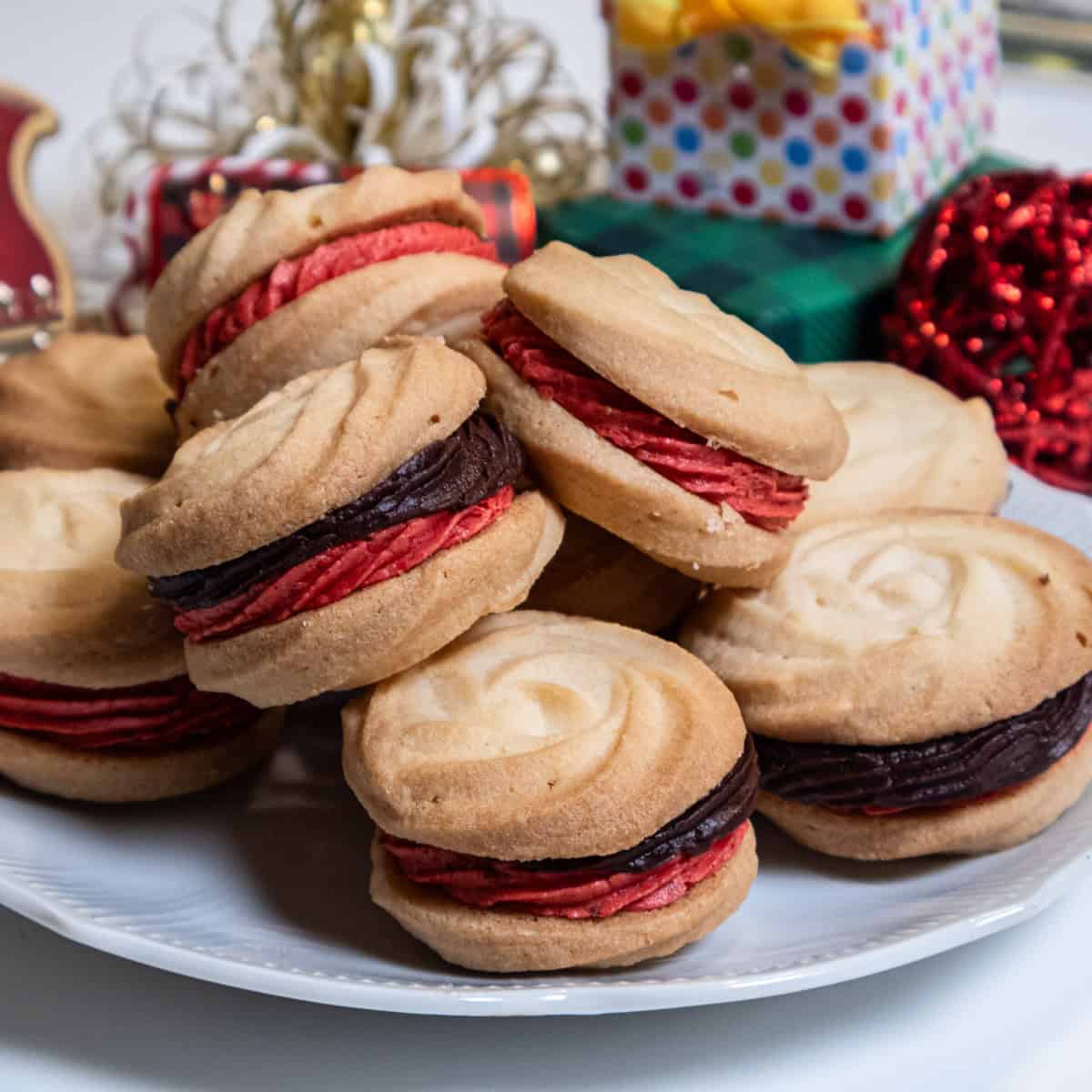
Other interesting shortbread cookies include: Viennese Whirls, Easy Decorated Shortbread Cookies, Tropical Shortbread Cookies (think coconut and macadamia nuts), Peppermint Ravioli Cookies, and everybody's favorite, the savory Cheddar Pecan Shortbreads. And lets not forget about Irresistible White Chocolate Pistachio Cookies.
Chinese 5 Spice is typically a blend of five different spices - star anise, cloves, Chinese cinnamon, Sichuan peppercorns, and fennel seeds. It is use in savory recipes as well as sweet. Star anise and fennel both taste to a greater or lesser degree like licorice.
The same amount of cinnamon can be substituted if desired.
Traditional shortbread cookies are basically made with butter, flour, and sugar, either granulated or powdered sugar. No eggs, baking powder or baking soda are used. They are tender and have a melt in your mouth texture. Having said that, additions are anything you want from nuts to citrus zest, and extracts. The dough can be used for cookies, cookie bases, and pastry crusts.
These are one of the easiest cookies to make.....and to enjoy!

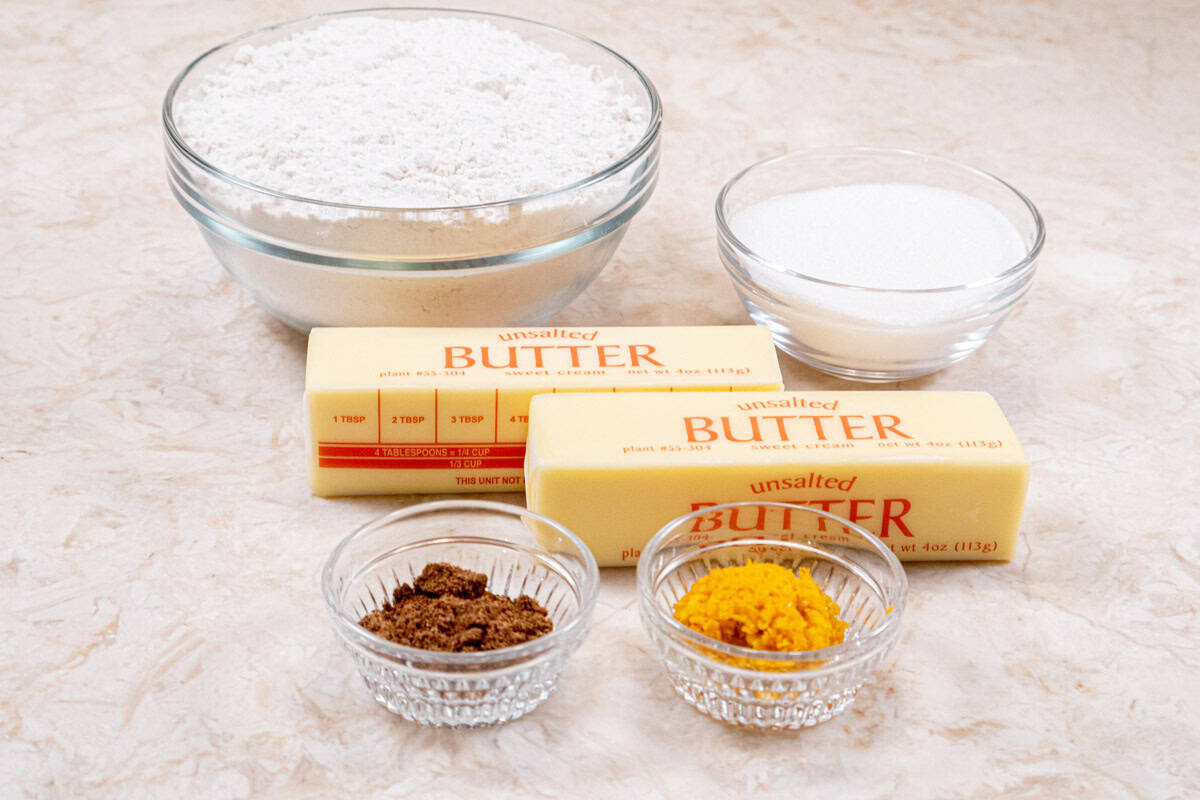
FRONT ROW: 5 Spice Powder, orange zest
MIDDLE ROW: Unsalted butter
BACK ROW: All-purpose flour, granulated sugar

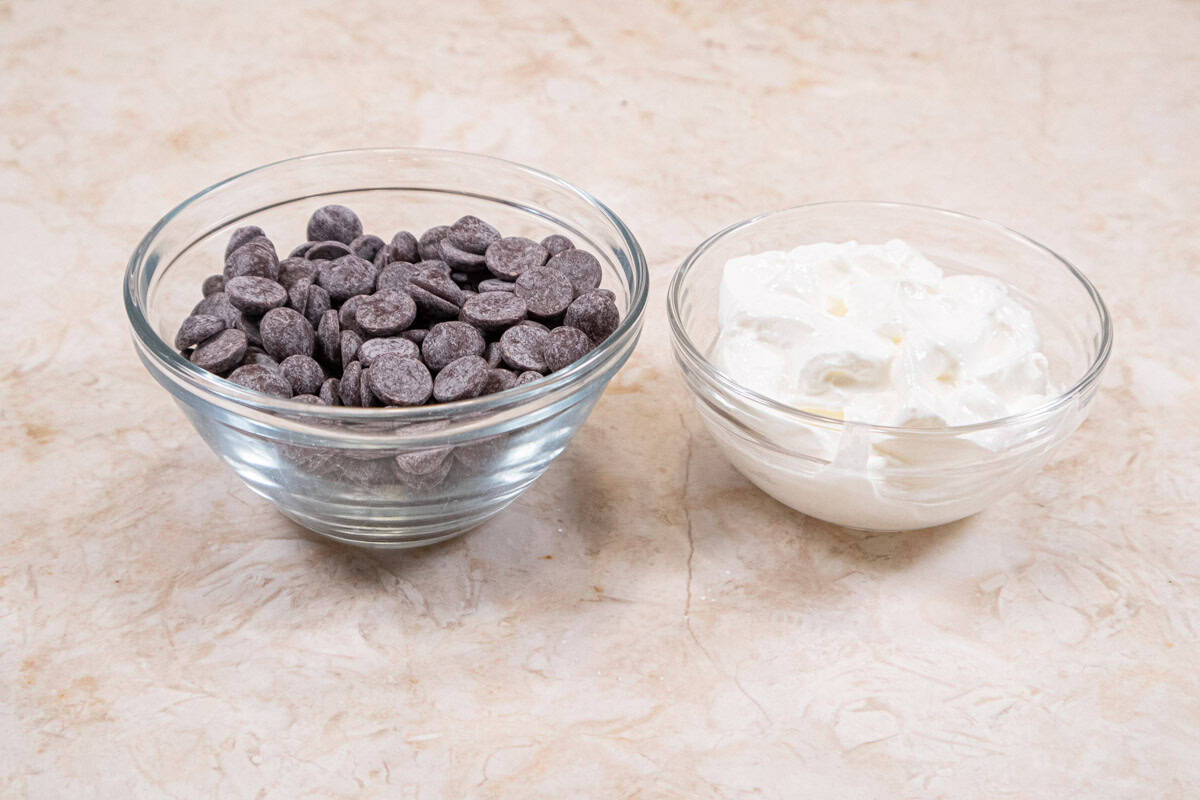
Left to Right: Semisweet chocolate (not chocolate chips), sour cream

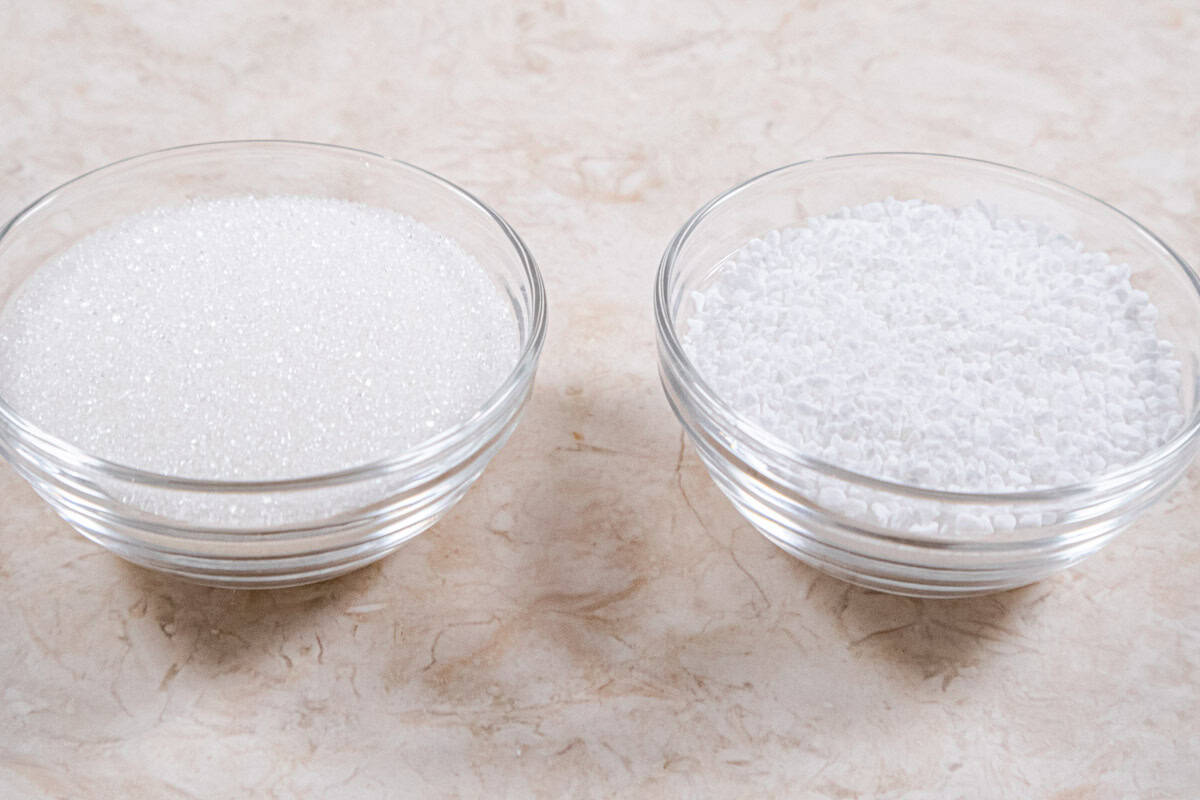
Left to Right: Sanding Sugar and Swedish Pearl Sugar
Be sure to see the recipe card below for the full ingredients and instructions.

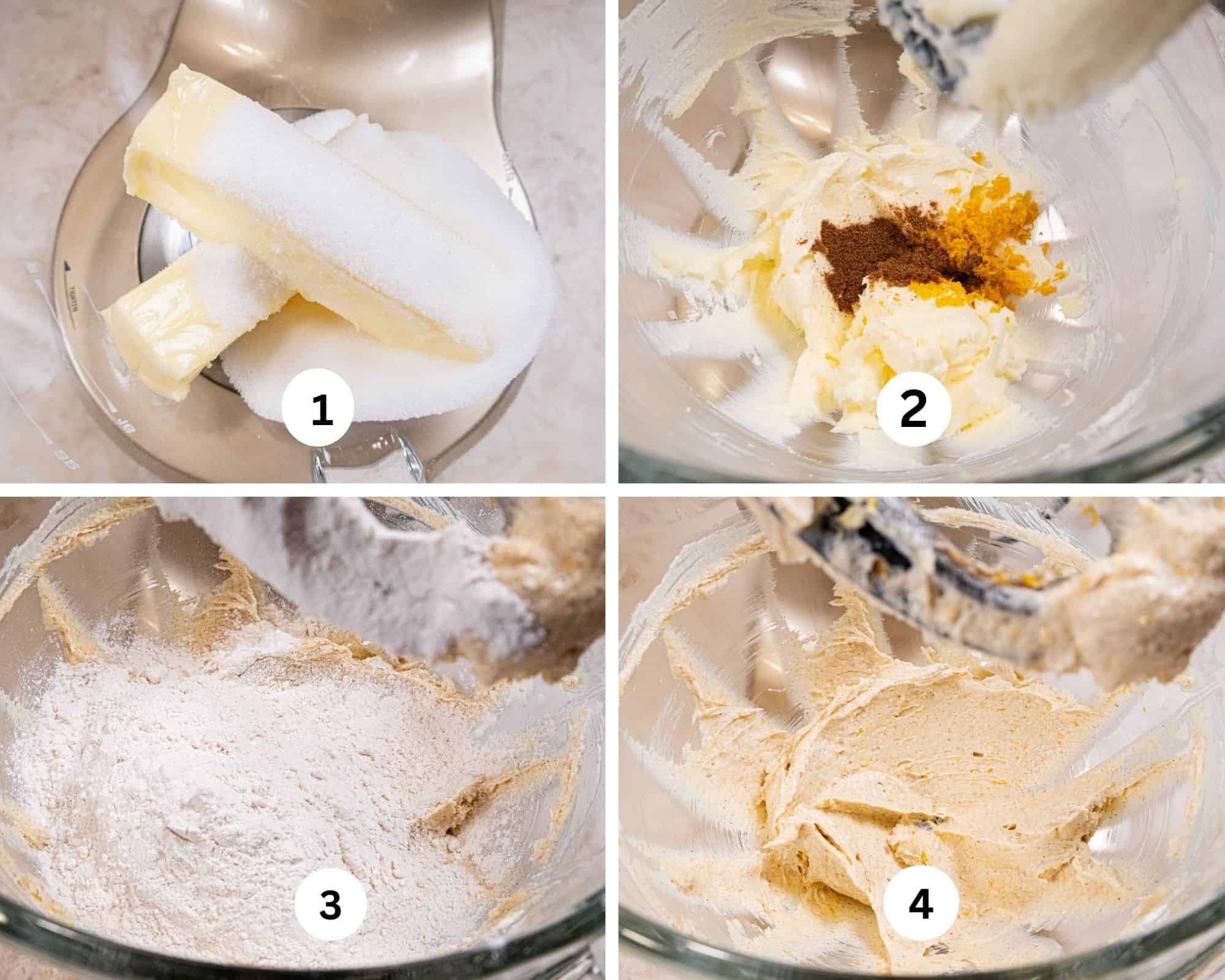
Step 1. Place the softened butter and granulated sugar in the bowl of a mixer. Step 2. Beat until the mixture is light and fluffy, then beat in the 5 spice powder or cinnamon and orange zest. Step 3. Add the flour all at once. Step 4. Beat until it comes together.

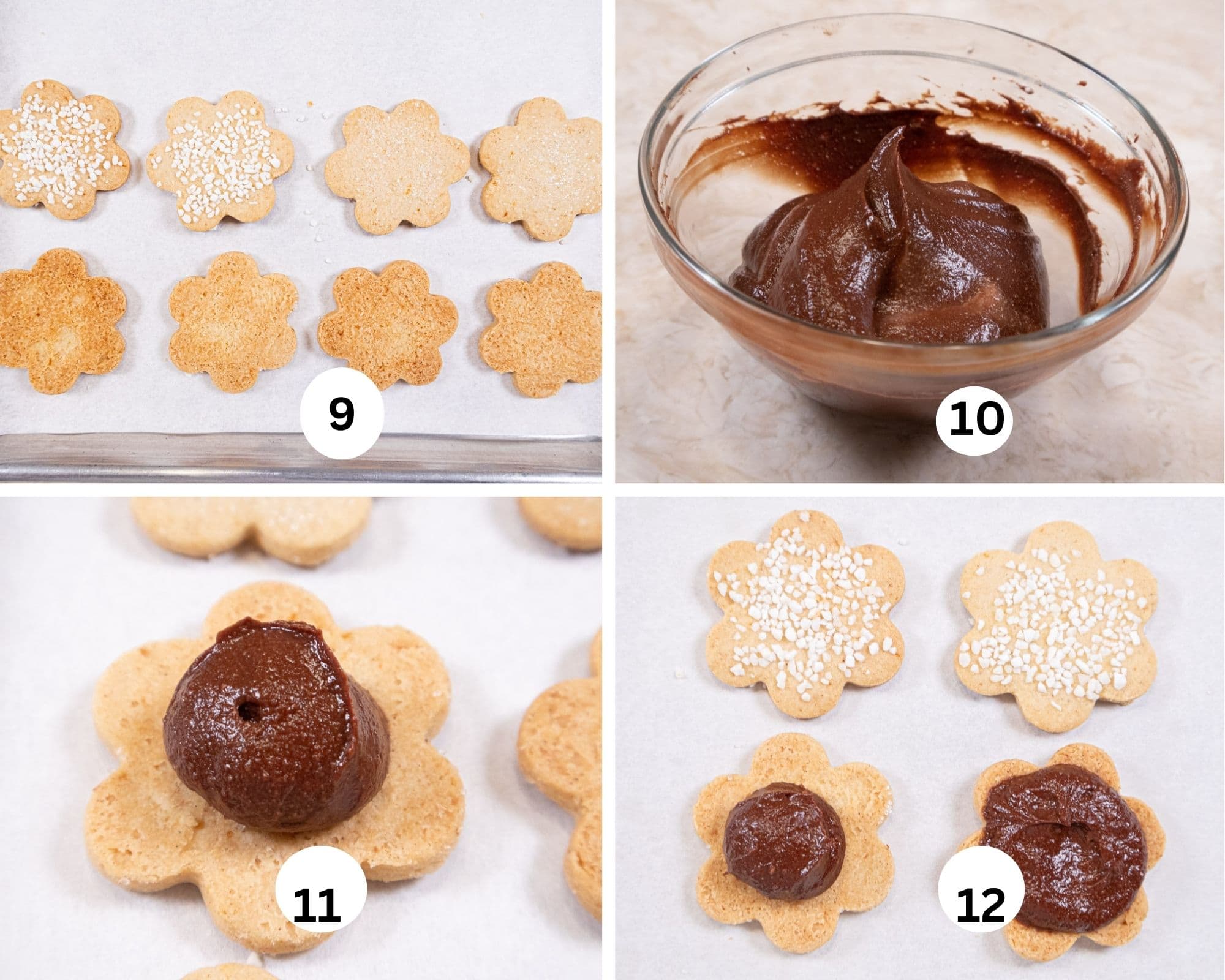
Step 5. Continue mixing until it forms a solid mass. Step 6. Remove it from the mixer and shape into a disc. If it is very soft, refrigerate or freeze briefly to firm up. Step 7. Divide the dough in half. Cover one half. Roll between sheets of waxed paper to the thickness of about ¼". (See the Cut Out Cookies using the Waxed Paper Technique). If the dough has softened, place it on a cookie sheet and refrigerate or freeze briefly to firm it up for the best looking cookies. Cut the cookies out. I used a 2" daisy cutter. Step 8. To easily remove the cookies, chill or freeze until hard. Lift them off with a pancake turner or just pop them out and place them on parchment lined cookie sheets or half sheet pans about 1" apart. Sprinkle half of them with either sanding sugar or Swedish Pearl Sugar. Bake as directed. Cool completely before sandwiching.

Step 9. Line the cookies up so the bottoms are turned upward and the tops are facing bottom down. Step 10. Melt the chocolate at half power in the microwave or over simmering water in a double boiler. Cool to lukewarm and stir in the room temperature sour cream. Step 11. Pipe or spoon the ganache in the middle of the bottom cookie. Spread it flat leaving a bit of room around the edge. Place the top sugared cookie on and press lightly to make sure it adheres.
See the recipe card if using the food processor.
It depends upon the texture you want. Granulated sugar makes a crisp shortbread while powdered sugar makes a more tender one. However, they cannot be exchanged for each other by volume - only by weight. ½ cup granulated sugar weighs 100 grams. ½ cup powdered sugar weighs 65 grams.
Many people believe that European style butter which has a higher fat content makes the best tasting cookie since the flavor of the cookie comes from the butter.
Of course. Vanilla, peppermint, and almond extracts are popular additions. Finely ground nuts, coconut, mini chocolate chips, lemon or orange zest, many things can be added.

A lot of work goes into each of my recipes and my only ask is that if you like the recipe or even the looks of it, please leave me a star rating to help me rank better. It’s important and I appreciate it and I appreciate you.
Modified: · Published: by Helen S Fletcher · This post may contain affiliate links · 13 Comments
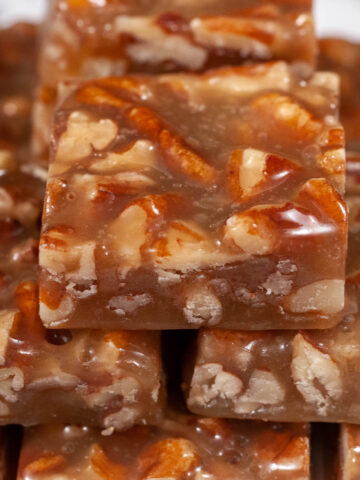
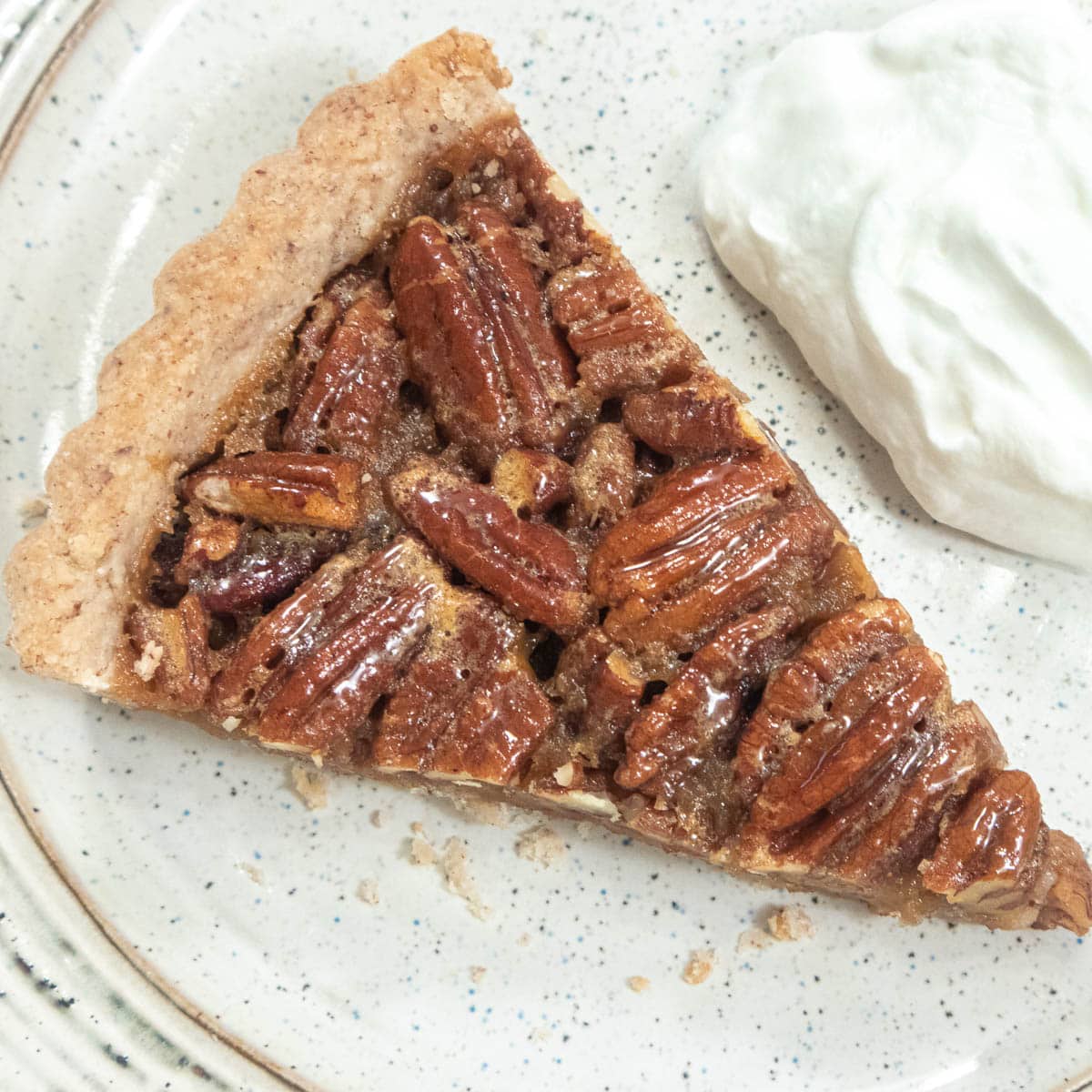
This Butter-Rum Pecan Tart screams fall is just about here. Fresh pecans abound and are perfect for the amazingly easy pastry tart shell. Golden syrup and a bit of dark rum accentuates the flavor of the toasted nuts for an unbeatable combination that is sure to find a place in your repertoire.
With Thanksgiving just around the corner, this could very well be the easy recipe you were looking for.

Fall is a wonderful time of the year. I also especially like it since it brings fresh apples just off the trees and a new crop of pecans. Both are among my favorite foods.
A few more of my favs: Chocolate Truffle Raspberry Curd Tart, Easy Almond Raspberry Tart, Chocolate Cranberry Curd Tart, Cinnamon Whiskey Apple Tart, Strawberry Crumb Tart, and everyone's favorite, the S'Mores Tart. If you enjoy delicious Autumn recipes, check out Fill Your Home With Autumn Baking and Chocolate Cranberry Curd Tart.
This post was originally published on November 8, 2021. It has been updated in the new format with additional information and a recipe card.
Although there are exceptions, I toast all of the nuts I use to deepen their flavor. The toasted pecans are used in both the crust and the filling. I generally toast the nuts when I buy them, cool them completely, and then freeze them for longer storage. That way, they are ready to use when needed.
To toast the nuts, preheat the oven to 350°F. Place the pecans on a rimmed baking sheet in a single layer and toast for about 7 minutes. Stir, then toast for 3 to 5 minutes more until fragrant and lightly colored. Cool completely before using. Freeze for longer storage.
This crust is easily made in the processor. I found a new, easier way to make the bottom of the tart crust, which I show you below in the step by step photos. I then press in the sides to complete it. The crust can be frozen for several months, well wrapped, so it is at hand and ready to be partially baked from the freezer.
The crust needs to be par baked before the pecans and filling are added.
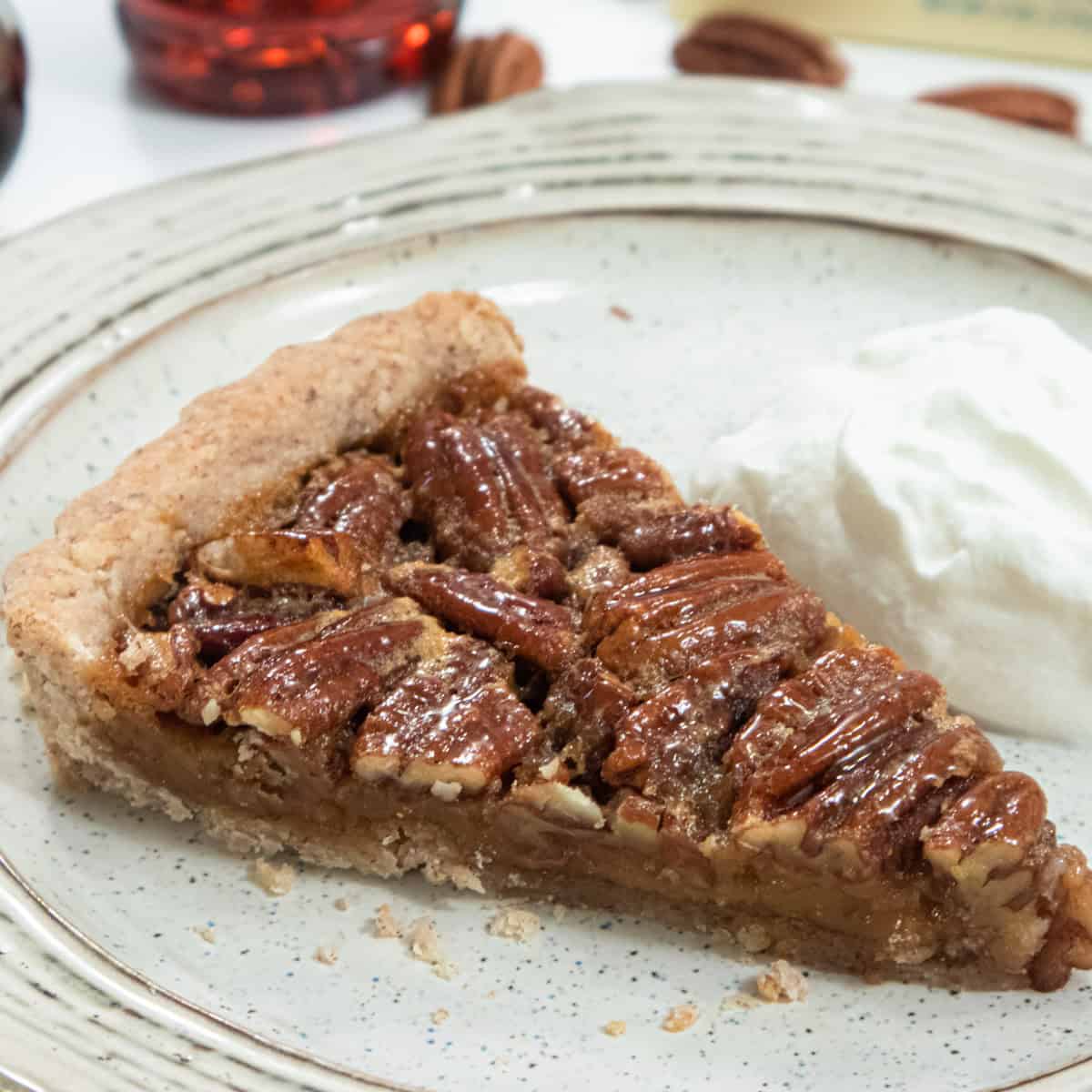
Less gooey than a regular pecan pie, this tart is every bit, if not more, sinfully rich. The use of golden syrup instead of corn syrup adds one more layer of flavor to this already best of all pecan tarts.
This filling couldn’t be easier to make. A whisk and a bowl, and you’re ready to go.

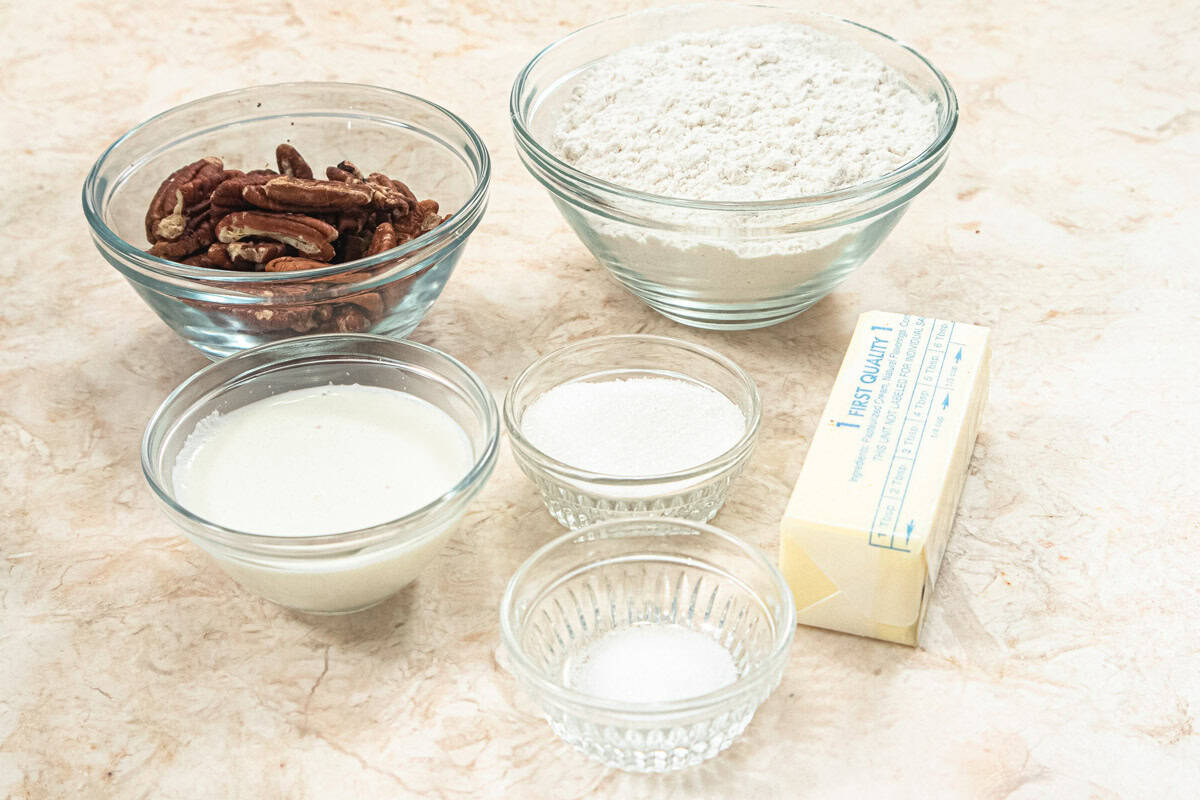
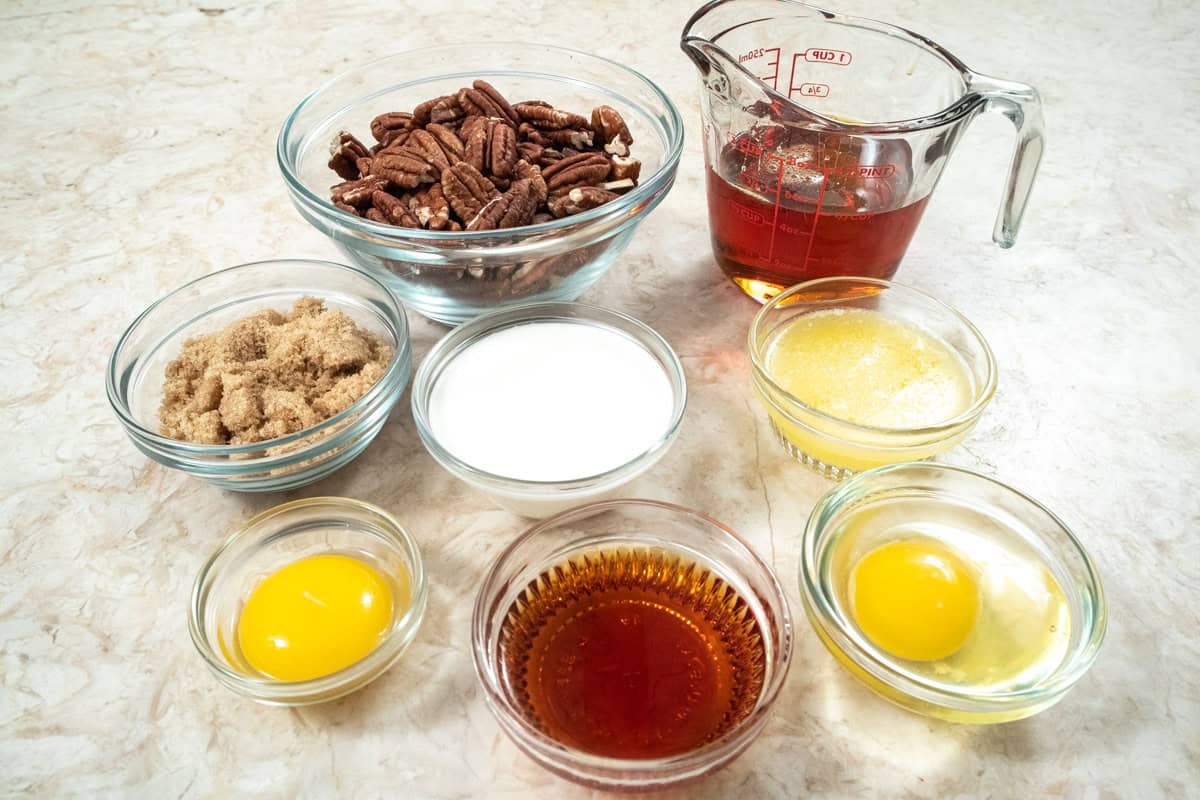
COUNTERCLOCKWISE: Pecans, all-purpose flour, unsalted butter, salt, granulated sugar, and cream in the middle.

FRONT ROW: Egg yolk, dark rum, whole egg
MIDDLE ROW: Brown sugar, heavy cream, melted butter
BACK ROW: Toasted Pecans, Golden Syrup

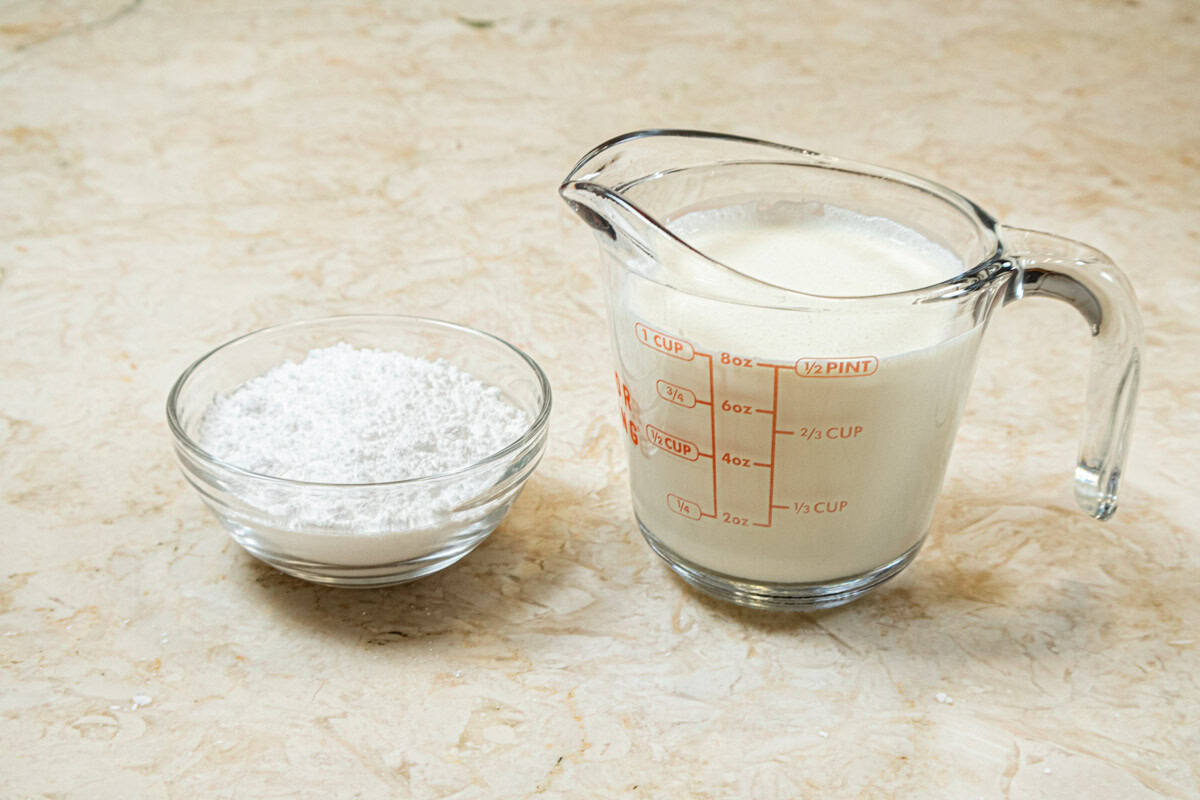
Powdered Sugar, heavy cream
Be sure to see the recipe card below for the full ingredients & instructions.
It is easiest to toast all of the pecans at once, using the amounts called for in the crust and filling.

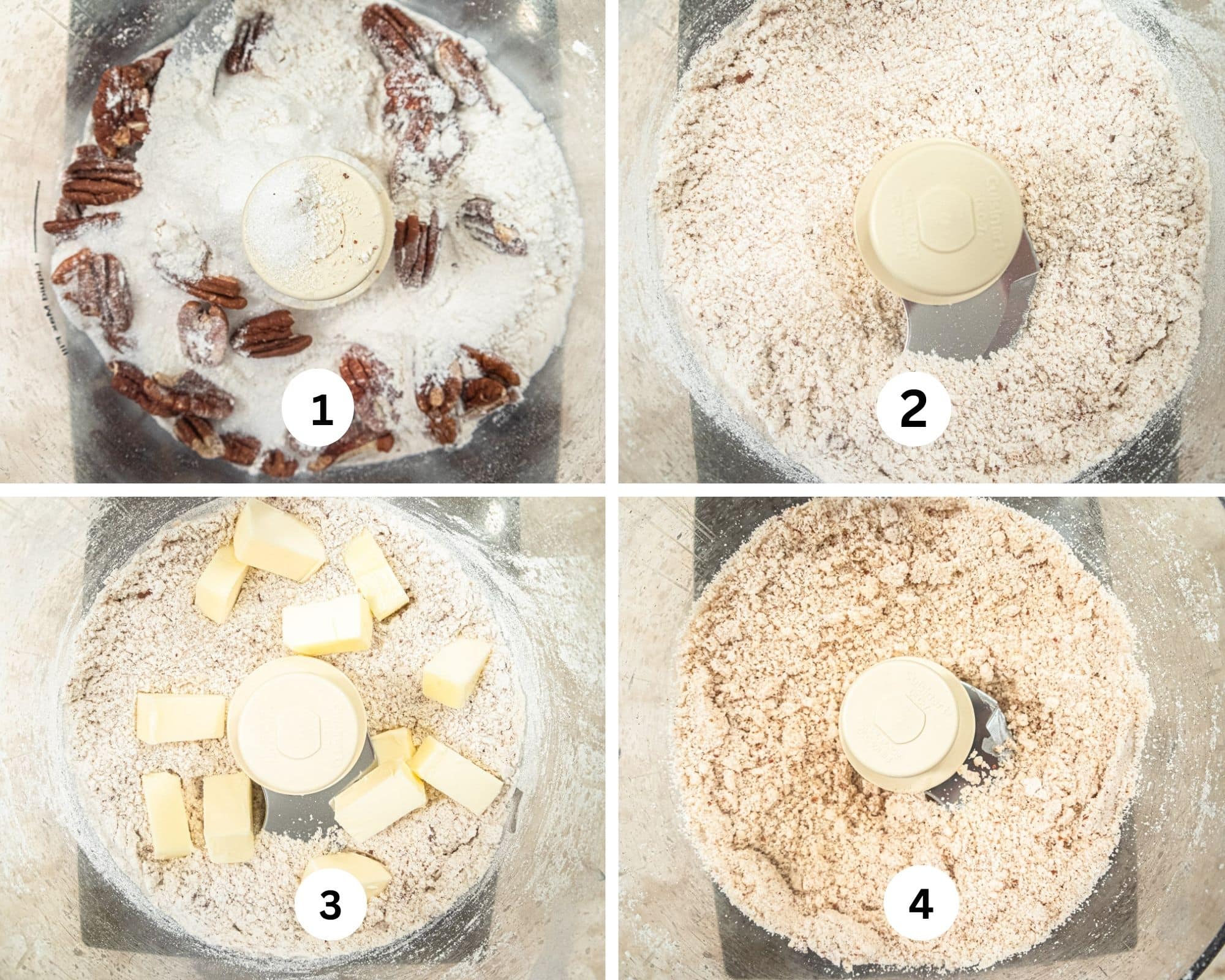
Step 1. Toast the pecans and cool them. Place them in the processor along with the flour, sugar, and salt. Step 2. Pulse to cut them coarsely. Step 3. Cut the butter into pieces and place them over the flour/pecan mixture. Step 4. Process until it looks like sand.

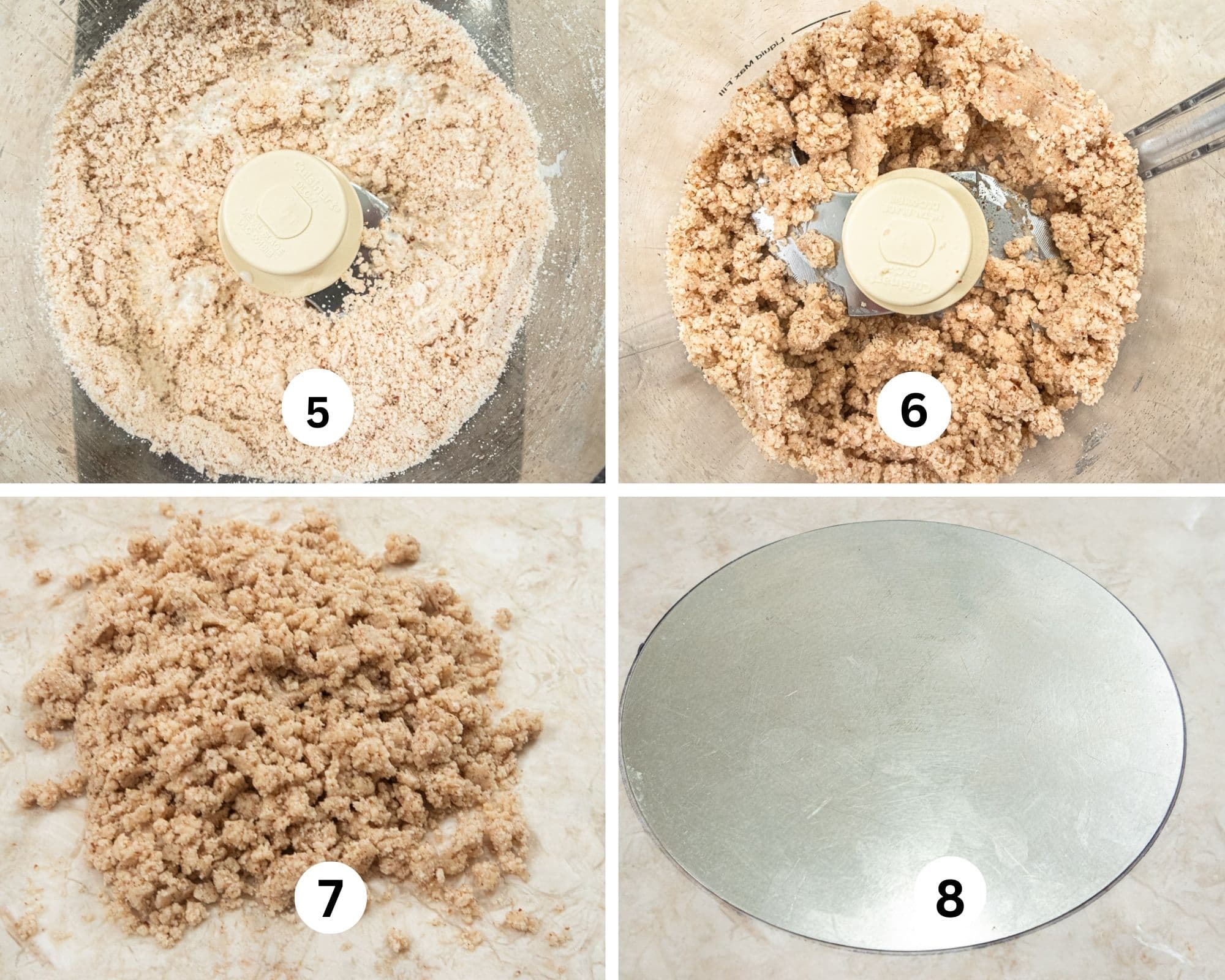
Step 5. Add the cream to the processor. Step 6. Process until large crumbs form. Take a little of the dough and pinch it together. If it is too dry to hold, process in a teaspoon of cream until it forms large, moist crumbs. Step 7. Pour it out onto a work surface and push it together to form a round. Knead it a couple of times into a smooth ball. Step 8. Place the bottom round of the tart pan on a piece of waxed paper.

Step 9. Using the bottom of the tart pan as the guide, draw a circle on a piece of wax paper. Flip the paper over so the ink is on the bottom. Step 10. If the dough is really soft, refrigerate it to firm it. Divide the dough in half (about 160 grams). Cover the remaining dough. Shape the half into a round and then flatten it in the middle of the circle. Place another piece of wax paper on top and roll it evenly to fill in the circle. Step 11. Remove the top piece of waxed paper. Place the bottom of the tin on top of the dough. Step 12. Flip the dough over so the bottom of the tart pan is on the work surface and the wax paper is on top. Remove the wax paper. Place the pan bottom, dough side up, into the tart pan. If the dough has gotten soft at any point, refrigerate or freeze it to firm it up to make it easier to roll or flip.

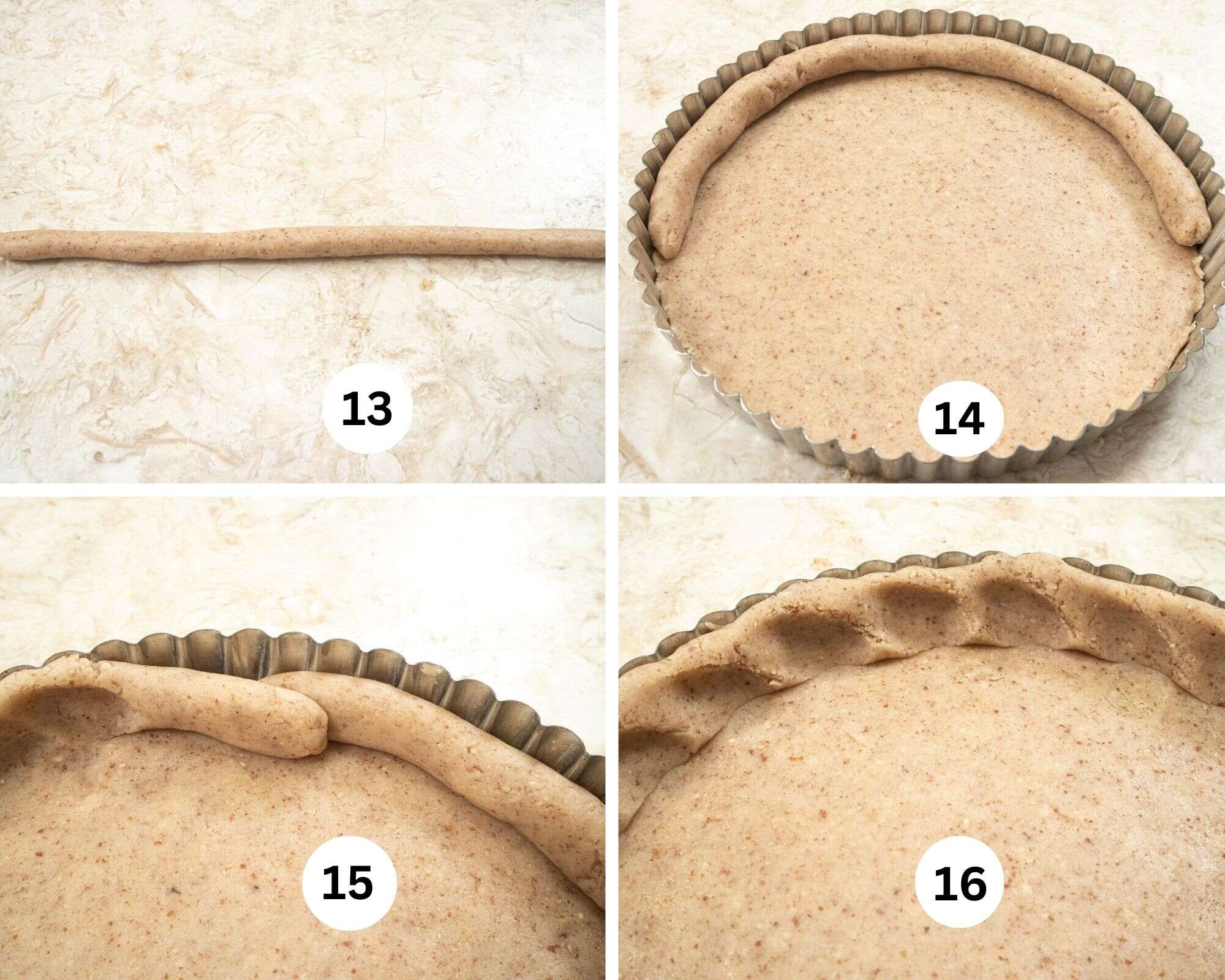
Step 13. Divide the remaining dough in half again (about 80 grams each). Roll one piece into a 14" rope. Step 14. Place it inside the rim halfway around. Step 15. Repeat with the second piece of dough, overlapping the two edges. Step 16. Press the dough firmly against the rim of the pan.

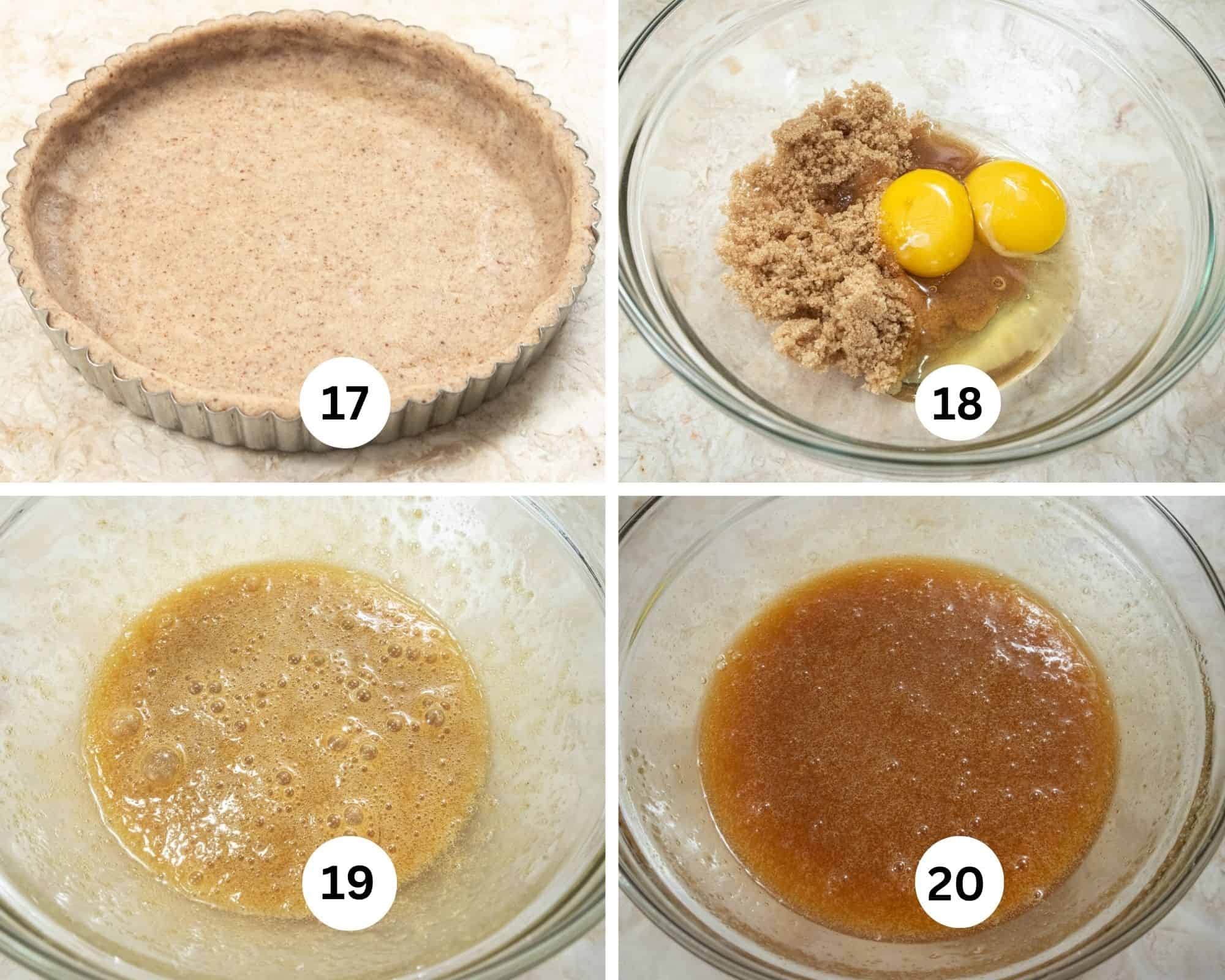
Step 17. Make sure the bottom edge is at a 90° angle is is firmly attached to the side crust. Freeze the crust until hard. Either wrap and store for later or bake as called for and set aside. If baking immediately, place on a parchment lined baking pan and bake as called for. Set aside while preparing the crust. Step 18. Place the brown sugar, egg, and egg yolk in a medium size bowl. Step 19. Whisk them together until completely blended. Step 20. Whisk in the golden syrup.

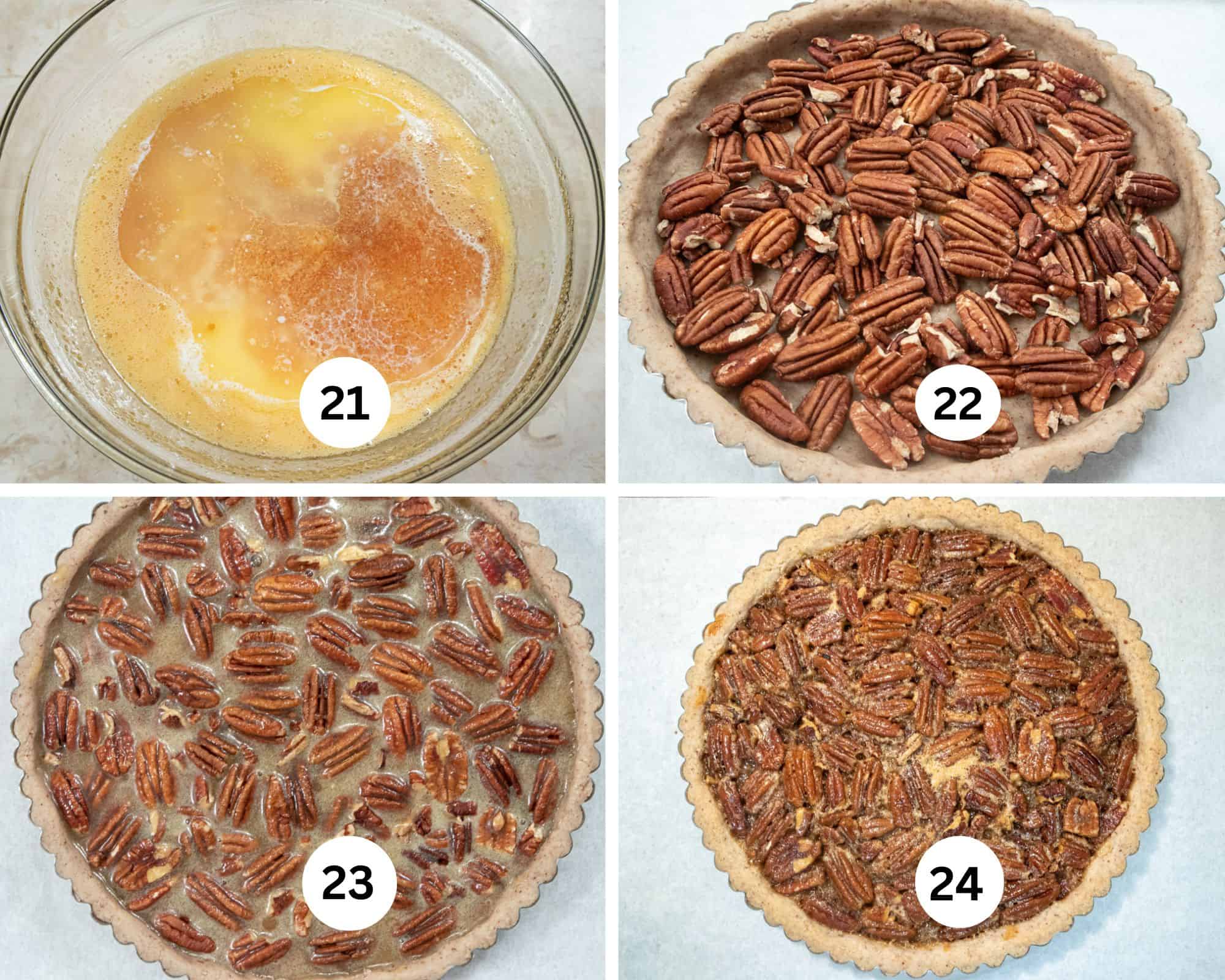
Step 21. Whisk in the cream, rum, butter, and salt completely. Step 22. While still on the baking pan, fill the crust with the toasted pecan halves. Place them in the pecan shell in an even layer. For the prettiest look, turn the halves right side up. Step 23. Whisk the filling one more time, and carefully and gently pour the liquid filling over the pecans. Submerge any pecans not covered with the filling. Step 24. Bake as called for. Cool. The Butter-Rum Pecan Tart can be served immediately, or it can be left in the tin, cooled completely, wrapped wel,l and frozen for a month or so.
Serve with whipped cream as on the recipe card.
Pies usually have a top of some kind. It can have two crusts, one on top and one on the bottom, or a crumb or streusel topping. They are also usually, but not always, deeper than a tart. A tart is distinguished by the lack of a top finish when baked, the sides of the pan are rippled, and it is shorter, in most cases, than a pie. They are often very rich.
It isn't advisable as the crust has to be partially baked. Regular pie crusts shrink during baking, but the tart crust, which is a short crust, doesn't if frozen first.
Using stale pecans, not toasting the nuts first, over or under baking, not par baking the crust, overfilling the crust, using the wrong crust can make a disappointing finished tart.
The crust may be made and frozen in the pan, well wrapped, for a couple of months unbaked. Bake straight from the freezer as called for.
The tart as a whole can be frozen in the pan, well wrapped, for a couple of months also. Thaw the tart at room temperature. Warm it in a 350°F oven for 20 to 25 minutes to refresh it.

A lot of work goes into each of my recipes, and my only ask is that if you like the recipe or even the looks of it, please leave me a star rating to help me rank better. It’s important and I appreciate it.
Modified: · Published: by Helen S Fletcher · This post may contain affiliate links · 21 Comments
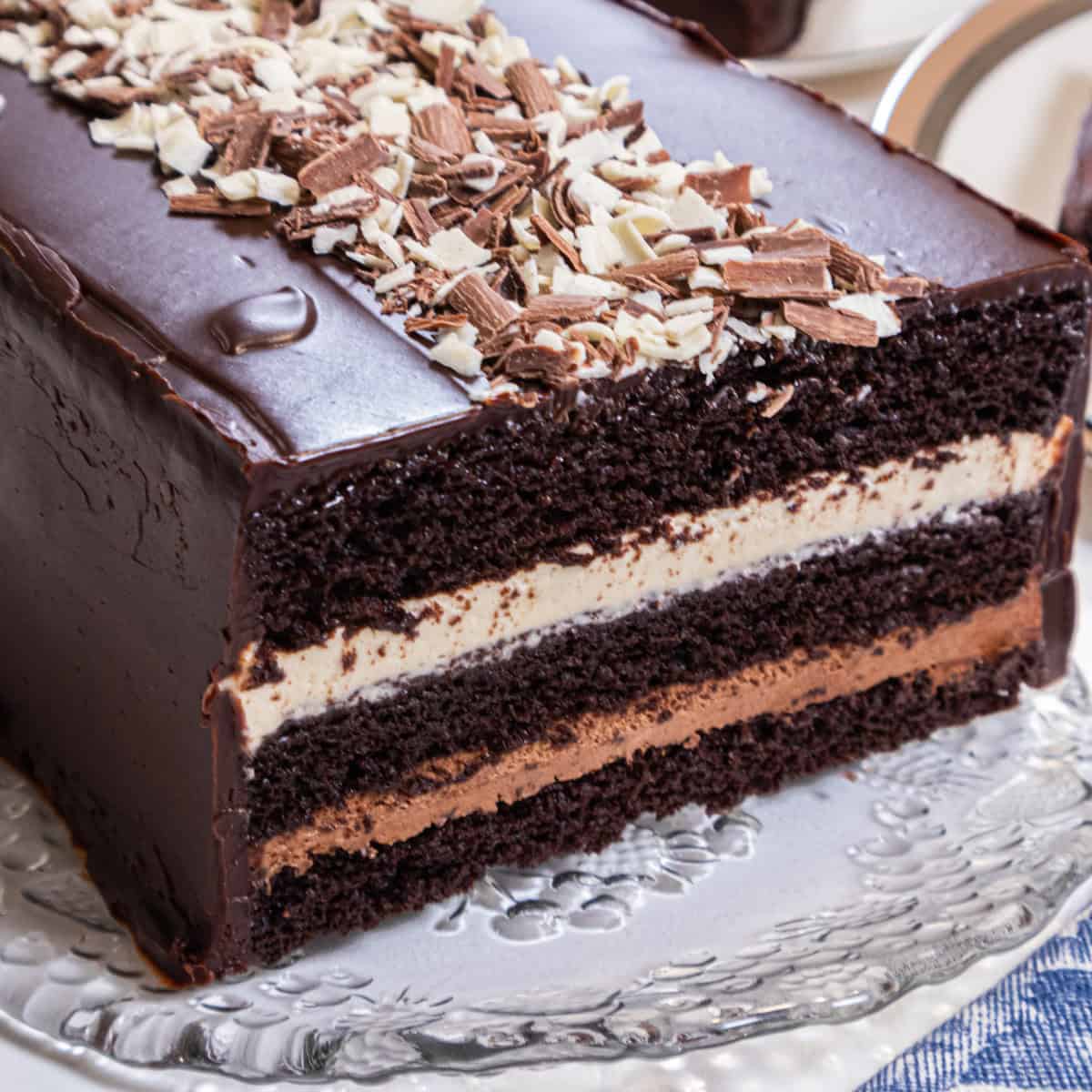
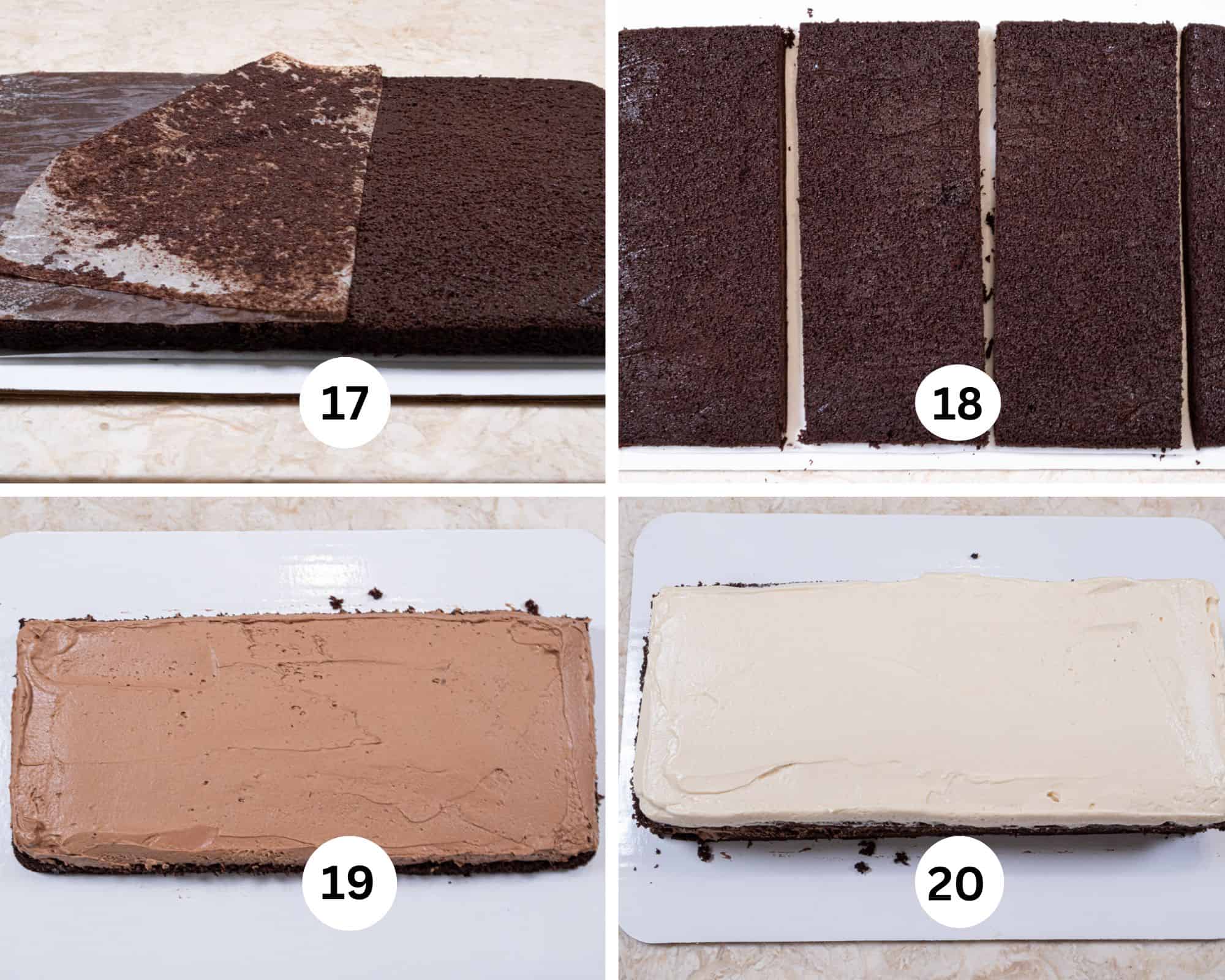
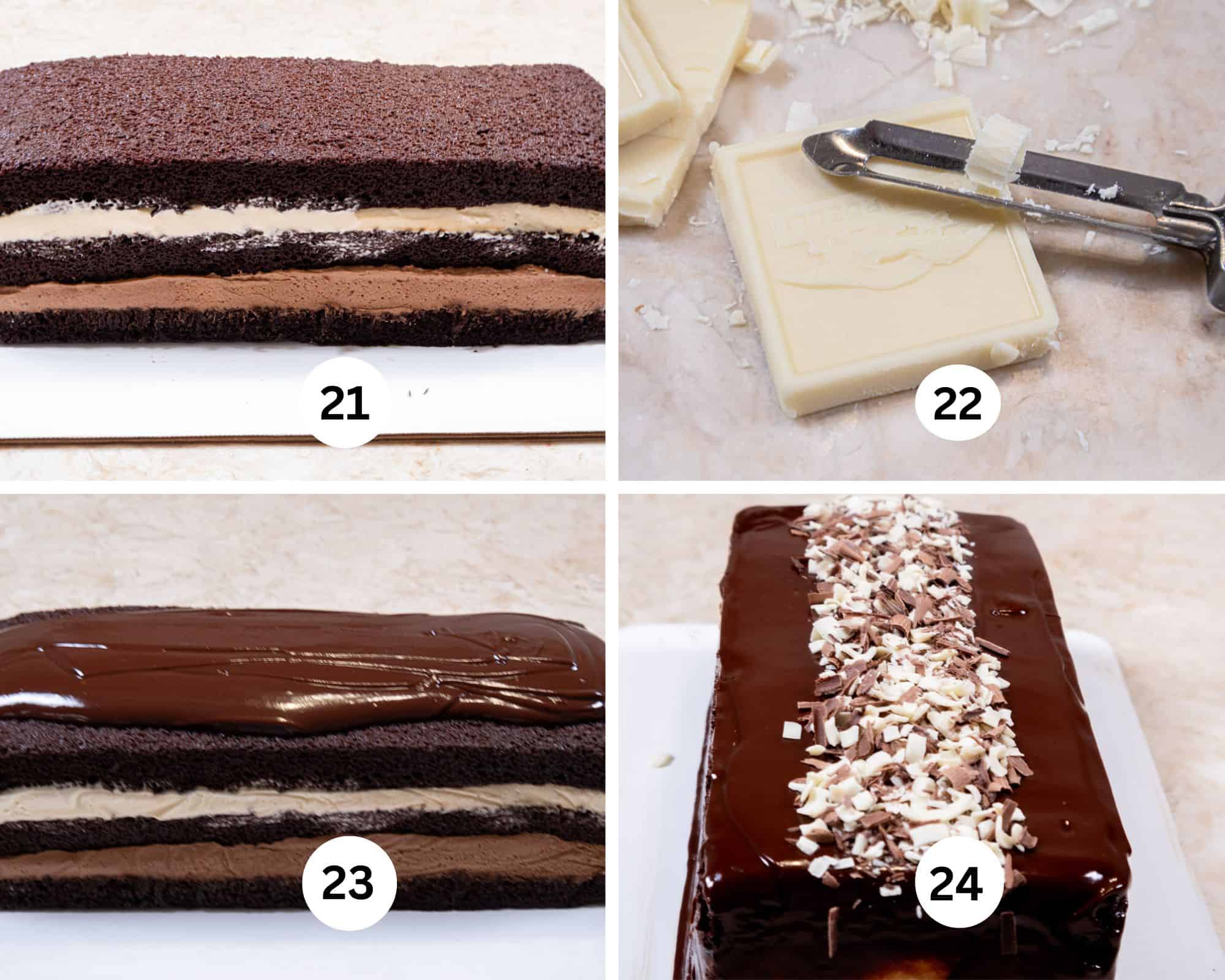
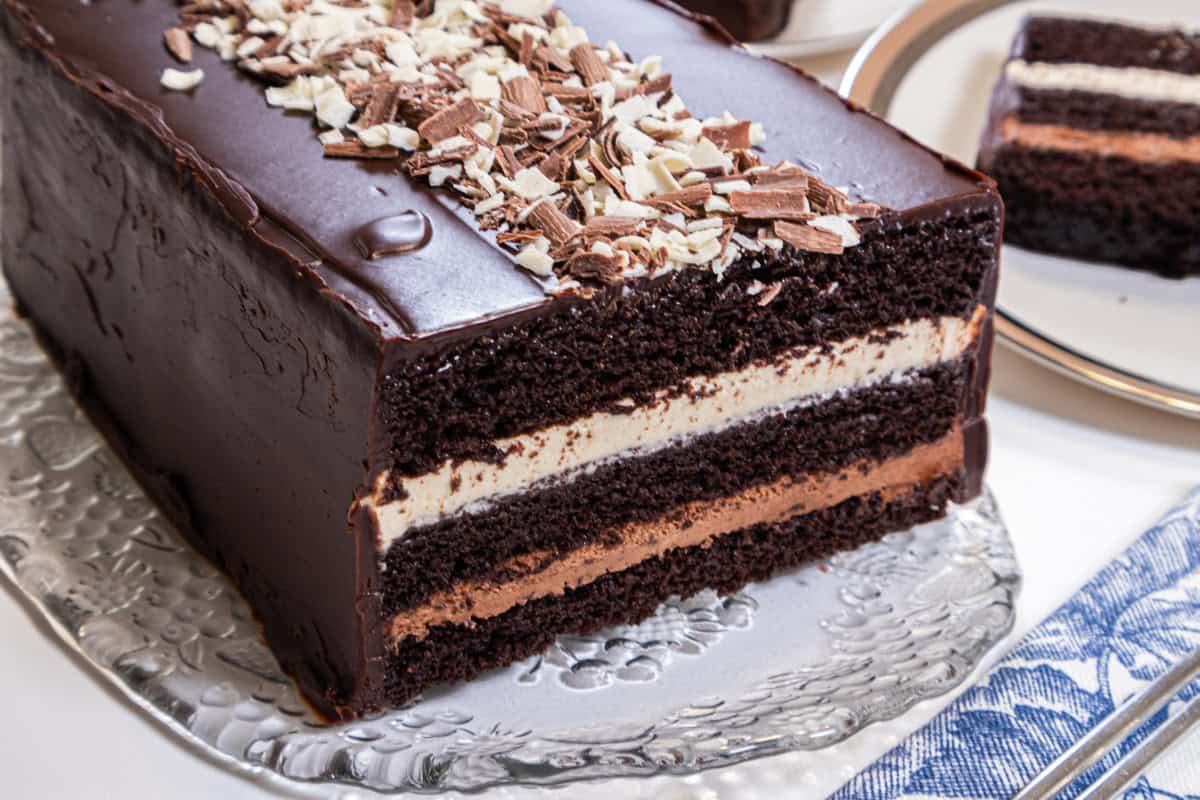
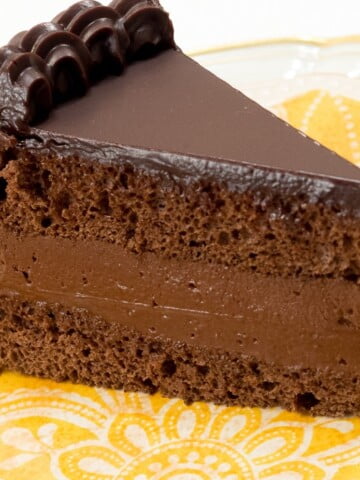
This Exceptional Tuxedo Cake is based on the Costco Tuxedo Cake. Named after the black suit with a white vest, shirt and tie, a tuxedo exudes luxury on sight as does this cake. An easily made decadent chocolate cake it's layered with both a chocolate and Bailey's white chocolate mousse. This cake recipe is the perfect celebration cake for any occasion.

I took some liberty with the white chocolate mousse using my favorite combination of white chocolate Bailey's which you can find in Bailey's Pi Day Pie, Easy Chocolate Guinness Cake with Bailey's Whipped Cream, The Definitive Bailey's Cheesecake and Warm Chocolate Cakes with Bailey's Sauce.
Despite the steps, all of the component parts are simple to make. The chocolate cake layers requires no folding in of ingredients or creaming. Both of the mousses are easy as is the indulgent Dark Satin Ganache which finishes the cake. To make it even more appealing, the entire cake can be made and frozen.
Looking for another showstopping cake recipe? Try this Pecan Upside Down Cake.
When I first opened my bakery I thought, mistakenly, that the best cakes were made with butter and so that is what I pursued. We made everything on site except a small butter shell for petit fours. My bakery mainly serviced hotels, restaurants and caterers......and there in lay the problem.
Despite what is commonly thought, restaurants do not usually serve a whole cake in one night. They need a product that has several days shelf life. Hotels and caterers do but they plate up in advance so the cake has to stay moist and delicious. They are also often stored in the refrigerator until shortly before service.
The sad news is a butter cake has little to no shelf life and it dries out much faster than a cake made with oil. Also, using a neutral oil allows the flavors to come through. Butter, while adding it own wonderful taste, can dilute the main flavor.
If you think about it, butter gets hard if cold and most cakes are stored in the refrigerator. Oil, on the other hand, stays liquid at room temperature or in the fridge. Consequently, oil is often the better choice.
The one exception at the bakery was wedding cakes. The majority were butter cakes unless they chose a chocolate cake (we used the one below) or a carrot cake.
A cake batter can use both oil and butter. Oil to keep it moist and butter for the flavor. All of these cakes have a place in any cake repertoire. It just depends upon when and how it will be served.
Dark chocolate can be melted one of two ways, either in a double boiler over simmering water or at half power in the microwave. For me the half power is the key as it is easier to keep the chocolate from burning.
However, for white chocolate I always melt in a double boiler over barely simmering water. White chocolate is extremely easy to sieze. Siezing refers to chocolate that either by getting too hot or not having enough liquid with it will form a block that will not melt. At this point, a bit of solid shortening (not butter because it has water in it) can be added to help get it back to a state where it will melt.
It's easy to make the curls if you keep a couple of things in mind. The temperature of the chocolate is important. It should be room temperature in a room around 74°F. Also, I have found a lot of success using Ghirardelli chocolate squares in white, milk and dark chocolate. Others may work well also.
Wrap the bottom of the bar in a couple of thickness of paper towels to prevent the chocolate from melting when you are holding it.
The white chocolate is the softest and makes the best curls, followed by the milk and the dark usually makes shards which is fine when all of them are mixed together.
Using a vegetable peeler as seen below, it is easy to just to peel the chocolate from the short side of the bar. The amount of pressure with which you peel will determine the size of the curls.

FRONT ROW: Baking soda, instant coffee, baking powder, vanilla extract, salt
SECOND ROW: Eggs, sour cream
THIRD ROW: Brown sugar, granulated sugar, Dutch cocoa powder
BACK ROW: Water, all-purpose flour, oil

FRONT ROW: Vanilla extract, instant coffee
BACK ROW: Semisweet chocolate, heavy whipping cream

FRONT ROW: White Chocolate
BACKROW: Heavy Cream, Bailey's Liqueur

FRONT ROW: Unsalted butter, corn syrup
BACK ROW: Semisweet chocolate (not chocolate chips), white, milk,dark chocolate curls, heavy cream
Be sure to see the recipe card below for the full ingredients & instructions.
It is important to mix this cake on low. The cake will rise in the center no matter how the pan is prepared if it is mixed on too high a speed.

Step 1. Whisk together the flour, cocoa, baking soda, baking powder and salt. Set aside. Step 2. Add the water and coffee in the mixing bowl and whisk to combine. Whisk in the sugar. It will by rather syrupy. Step 3. Add the dry ingredients to the mixing bowl. Step 4. Mix on low to incorporate - about 2 minutes. It will be thick.

Step 5. Add the oil. Step 6. Beat on low to incorporate the oil. Step 7. Add the sour cream. Step 8. Blend in on low completely.

Step 9. Add the eggs. Step 10. Mix on low for about 30 seconds until it is completely blended. Step 11. Line a half sheet pan with parchment paper and spray the paper. Step 12. Bake as required until the center springs back when lightly touched. It should not pull away from the sides of the pan.

Step 1. Add the coffee to the vanilla in a small bowl. Stir to dissolve the coffee. Step 2. Place the cream and coffee in a small saucepan. Heat just until the mixture comes is steaming hot, stirring from time to time. Do not let it boil. Step 3. Add the chocolate and submerge it under the hot cream. Let it sit for 3 or 4 minutes to melt the chocolate. Step 4. Stir the mixture until all of the chocolate has melted and it's smooth.

Step 5. Using the whisk attachment on your mixer, whip the cream to medium peaks (somewhat passed soft peak). Step 6. Add it to the chocolate base. Step 7. Fold the cream in. It is easiest to use a whisk. Do not stir it in, fold it in so the air is not lost. Step 8. Chill the mousse while the rest of the parts are prepared.

Step 9. Place the Bailey's and white chocolate in the top of a double boiler over simmering (not boiling) water. Step 10. When it begins to melt, stir it until it is all melted and smooth. Do not let the bottom of the top container touch the water and keep the water at a bare simmer. Cool it completely. Step 11. Whip the cream to medium peaks (somewhat passed the soft peak stage). Step 12. Stir about ¼ of the cream into the chocolate to lighten it. Fold the remainder of the cream into the chocolate. Refrigerate.

Step 13. Place the cream, butter and corn syrup in a medium size pan. Step 14. Place over medium heat and heat until the ingredients are melted and the mixture is steaming hot but not boiling. Step 15. Remove from the heat and submerge the chocolate under the hot cream. Step 16. Stir to smooth out, making sure to reach into the corners of the pan. If using immediately, do not use a whisk as it will incorporate air bubbles that are hard to get out.

Step 17. Go around the edges of the pan with a small metal spatula to release the cake. Cover the top of the baked and cooled cake with a large piece of parchment paper paper. Turn the cake out of the pan so the bottom paper is now on top. Remove the paper carefully, keeping it low to the cake. Do not just pull it off or you can tear the cake. Step 18. Turn the cake so the 18" side is in front of you. Cut 3 5" layers from the cake. There will be a small, delicious treat for your efforts up to this point. Enjoy it! Step 19. Place one of the layers of cake on a cake board or a piece of cardboard cut a bit larger on each side. Wrap it in foil and proceed. Spread the cold chocolate mouse over the cake layer. Top it with the second layer of cake. Step 20. Spread the cold white chocolate mousse evenly over that layer. Top with the last layer of cake. Press down gently to make sure ever adheres to each other. Remove any excess mousse outside of the cake layers with a spatula. Wrap the sides and top of the cake in plastic wrap and refrigerate overnight.

Step 21. Top with the last layer of cake. Press down gently to make sure ever adheres to each other. Remove any excess mousse outside of the cake layers with a spatula. Wrap the sides and top of the cake in plastic wrap and refrigerate overnight. Step 22. To make the white, milk and dark chocolate curls, wrap the bottom of a bar of chocolate with a couple of thicknesses of paper towels to prevent melting the chocolate as you hold it. Using a vegetable peeler, peel the chocolate to make curls. You don't need to make curls from the whole bar. Just a quarter of each bar is plenty. Mix the three curls together. Step 23. If the ganache has been made ahead heat it briefly. It should be thick but still able to flow down the sides. Pour most of the ganache on top of the cake. Step 24. With a large offset spatula, push it over the sides and ends of the cake. If the sides aren't perfect, that's fine, they can be finished later. Try to keep the top as smooth as possible. Immediately, using a spoon so the curls aren't broken or melt in your hand, spoon on the curls down the center of the cake. Return excess ganache to the original container. Refrigerate the cake to set up the ganache. If the sides need to be adjusted, use the remaining ganache, without heating it. At this point you want it thicker so you can spread it on the sides and ends with a straight metal spatula. Store the cake in the refrigerator.
White chocolate is softer because it contains a higher proportion of cocoa butter, the fat from the cocoa bean, along with sugar and milk solids, giving it creamy and buttery texture that melts easily on the palate.
Almost any kind of oil can be used but it is usually a neutral flavored oil such as vegetable or canola oil. Olive oil is sometimes used but can impart its flavor if that is the goal. However, oil is mainly used to keep the product moist much longer than other fats.
No. A mousse can be made from a base such as chocolate or a fruit puree to which whipped cream, a meringue or both are used to lighten it. If using a fruit puree gelatin is often used to ensure the mixture sets. Both are chilled into a light and airy richly elegant dessert.

A lot of work goes into each of my recipes and my only ask is that if you like the recipe or even the looks of it, please leave me a star rating to help me rank better. It’s important and I appreciate it and I appreciate you.
Modified: · Published: by Helen S Fletcher · This post may contain affiliate links · 12 Comments
These Apple Caramel Hand Pies feature my Amazing Pastry Dough Recipe that mimics puff pastry without all the fuss. There are no butter blocks to contend with, no butter breaking through and not worries. With apple season just around the corner, what could be better than caramels and apples enclosed in a flaky pastry?

Hand Pies have been around as long as people have been cooking. Anything enclosed in bread or pastry that can be eaten out of hand qualifies. It can be a turnover, English pasty, a calzone, or Russian pierogis. Every culture has a hand pie no matter what they call it.
Another recipe using this pastry is the Amazing Pastry Dough Recipe. If your looking for another easy pastry see my Easier "Danish Pastry Recipe", Pithiviers Made with Blitz Puff Pastry, Sunny Side Up Apricot Pastries, and the Chocolate Raspberry Pop Tarts.
It is important when making the pastry to make sure the butter stays in pea size piece as in a pie crust. The pastry should not come together in the mixer. It should be removed as soon as it clumps together. It is pushed together into a cohesive dough on the work surface and rolled into a rectangle. I fold mine into what is called a book fold as has more layers than the traditional three fold laminated pastry.
It is best to make the pastry at least the day or up to three days ahead. It rolls out easily. When making pastry for a hand pie, do not roll it out too thick, especially as this will rise as does puff pastry but not as dramatically.
This recipe calls for the use of a bought caramel, Werther's Original soft and chewy caramels. But my caramel would make an even better version. Just use about 1 tablespoon per hand pie and place it on the bottom of the hand pie with the apple filling over it.
A salted version can be made by sprinkling coarse sea salt lightly over the caramel.
Or, if you wish, omit the caramel and just use the apple filling. This filling is a great basic apple filling for anything made with apples.
A word about the potato starch. I have recently switched from cornstarch to potato starch for a couple of reasons. The first is anything thickened with potato starch can be frozen and thawed with no harm. Cornstarch will break down if frozen and thawed. Secondly, potato starch can be heated to a higher temperature than cornstarch. If you have ever cooked something with cornstarch in it and it has lost its thickness, it was cooked too long or at too high a heat. The potato starch, like cornstarch, is clear when cooked.
This Apple Caramel Hand Pie can be frozen before baking without the egg wash. It is best to bring it to room temperature, egg wash it and then bake it. Hand Pies are great to have in the freezer when you want a quick dessert or treat.

FRONT ROW: Salt, Baking Powder
MIDDLE ROW: Unsalted Butter
BACK ROW: All-purpose flour, sour cream

CLOCKWISE FROM THE TOP: Apples, water, potato starch, cinnamon, nutmeg, granulated sugar, lemon juice in the middle

FRONT ROW: Amazing pastry dough
BACK ROW: Werther Soft Caramels, cooked apple filling
Be sure to see the recipe card below for the full ingredients &instructions.
If at any point the dough begins to soften, chill it in the refrigerator or freezer before moving on

Step 1. Cut the very cold butter in about 8 pieces per stick. If prepping the remainder of the recipe, refrigerate the butter. Step 2. Place the dry ingredients in the bowl of a mixer. Step 3. Add the cold butter. Step 4. With the mixer set on low, but the butter in leaving large pieces.

Step 5. Add the sour cream to the mixer. Step 6. Add 2 tablespoons of water and beat on low to form a large crumbly dough. Step 7. Pour the dough onto a work area. Step 8. Push it together to form a cohesive block of dough.

Step 9. To make rolling out easier, flatten the dough in about 3 or 4 places with the rolling pin. Step 10. Roll the dough out to about 16" x8". Step 11. Fold the top and bottom to the center, leaving about a ½" gap. Step 12. Fold the top down to make a neat package.

Step 13. Turn the pastry 90° with the open side to the right and repeat the rolling and folding above one more time. Step 14. Roll the dough into a 12 ½"x 18 ½" rectangle. Step 15. Using a 6" circle cut 6 rounds out of the dough. Step 16. Four of the cut rounds. The photos above are representative.

Step 1. Peel the apples and cut into about ½ inch dice. You should have about 4 cups. Combine the apples with the sugar, cinnamon, nutmeg and water. Step 2. Place in a medium saucepan and simmer until the apples are tender. When the apples are almost done, stir the potato starch into the lemon juice and add to the apple mixture. Bring to a boil and cook several minutes until thickened. Cool completely. Step 3. Line 4 caramels along the bottom of the rounds, leaving a ½ inch border. Sprinkle with a little sea salt if using. Step 4. Place ⅙ of the filling (scant ⅓ cup) over the caramels. Wet the border with water.

Step 5. bring the top down over the apples matching the edges. Press together. Step 6. Seal with the tines of a fork. Refrigerate the hand pies until completely cold before cutting the vents to make a cleaner looking pastry. Step 7. Cut a slit in the top of the hand pie. Step 8. Brush with the egg wash. Double pan and bake as directed.
No not at all. They can be half moons, triangles, whole circles with two pieces of dough instead of one.
Although some say they are different, I say they are the same. The pastry might be different but a hand pie is meant to be eaten out of your hand as is a turnover so I don't see any difference.
No. The Cornish hand pie which was often sent to the mine with the workers were substantially filled with meat, vegetables and a sturdy crust. Tiddly in naval slang means 'proper', a common adjective and adverb used
According to the History of Tiddly Oggies, Tiddly in naval slang means 'proper', a common adjective and adverb used by Cornish people, and oggie was the term for a pastie in cornwall, so “tiddly oggie” meant proper pasty. Cornish rugby supporters later adopted the chant “Oggie, oggie, oggie, oi, oi, oi!” when cheering on their team.
This Apple Caramel Hand Pie can be frozen before baking without the egg wash. It is best to bring it to room temperature, egg wash it and then bake it. Hand Pies are great to have in the freezer when you want a quick dessert or treat.
They can be kept at room temperature for several days. Warming them slightly enhances their flavor.

A lot of work goes into each of my recipes and my only ask is that if you like the recipe or even the looks of it, please leave me a star rating to help me rank better. It’s important and I appreciate it.
As
Modified: · Published: by Helen S Fletcher · This post may contain affiliate links · 19 Comments
This version of Multiple Cake Layers from 1 Recipe is a makeover of the original post in 2017. It's a deep dive into baking this type of cake which I hope will get everyone ready for the upcoming season of baking.
The most exciting part of this amazing recipe is that a single recipe can be used to make eight different flavored cake layers to fill and finish as you like. You may never need any other layer cake recipes.

Many, many years ago when I first opened my bakery, the challenge was finding recipes for cake layers that worked and could be scaled up. It seemed like all I did was test.
Then I discovered, as did everyone, "The Cake Bible" by Rose Levy Beranbaum. It was a game changer for anyone interested in baking and cakes. The explanations of what was going on and why in each recipe helped us understand baking better. At that point in time (1988) there was not a lot of information on the science of baking, which made this book all the more valuable.
I found the recipes in her book for cake layers to be the recipes I was looking for. Although I used recipes from many sources, including those I came up with, "The Cake Bible" was always my back up.
This recipe is a slight variation of her White Velvet Cake. I have used it before in my Spirited Marble Cake.
What is a base recipe? It is a basic recipe professional bakers use that can be changed in different ways to make many different bakery items. In my post, The Importance of a Base Recipe in Baking it focuses on a base recipe for cookies but the idea is the same for cakes.
You will see by looking at the recipes there will be additions or slight changes to the original recipe resulting in all of the different flavored layers.
This cake is a high ratio cake. High ratio cakes require the sugar to be equal to or exceed the amount of flour by weight not by volume. It's also the quickest way to make a butter cake. Not every cake can be mixed this way.
Basically, part of the wet ingredients are held out and mixed together. Everything else is added to the mixing bowl. After about a 2 ½ minute mix the wet ingredients are added in thirds, mixed for 30 seconds each and that's it. Into the pans it goes. It just doesn't get any easier, faster or better.
The one point that needs to be stressed in this cake recipe is the temperature of the butter - it needs to be soft. As you will see, the recipe states softened. Most recipes states room temperature butter. That can mean a lot of different things depending on if you're in Alaska or the southwest. I have seen recommendations by several prominent authors that 68°F is the ideal temperature for butter when creaming. However, I find that is still too cold to blend or cream well with sugar. I got a sandy texture but not one where I would call it creamed. Creaming introduces air into the mixture helping the batter to rise.
The temperature of the butter I use for creaming or when calling for "softened butter" is 72°F or 74°F. At this temperature, it will mix together completely. It is important in this recipe as the butter is being combined with a large amount of flour, sugar, and liquid all at once. If you don't have an instant read thermometer (and you should) the best I can tell you is that it will feel soft when you press it in the package but not mushy. In no case should it be liquid. This happens a lot when butter is microwaved to soften it. I usually remove butter the night before if I am baking in the morning. I also keep my house around 73°F in the summer.
The chocolate cake test was really surprising. I made one recipe of the white cake and split the batter in half by weight. I added cocoa to one layer and melted and cooled chocolate to the other layer. The two cake layers couldn't have been more different. The one with the chocolate was much paler and had less of a chocolate taste. It was more like a German Chocolate batter. The cocoa layer was very dark and was intensely chocolate. I am including both for your reference. I thought the one with chocolate would have tasted deeply of chocolate. Both are very good - just different.
I have an entire post on how I prepare my pans in order to get flat cake layers that aren't humpy and don't need to be trimmed. I show you below the basics but see Cake Pan Prep for more in depth information.

FRONT ROW: Salt, baking powder almond extract, unsalted butter
MIDDLE ROW: Egg wites, vanilla exract
BACK ROW: Cake Flour, granulated sugar and milk
Be sure to see the recipe card below for the full ingredients and instructions.

Step 1. The baking pans I use are from Parrish's magic pan line. Some of them are still from my bakery of 35 years ago. They are aluminum and are sturdy. Step 2. Spray the center only with a non-stick baking release. Do not spray or otherwise prepare the sides. This will help keep the paper flat when adding the batter to the pan. Step 3. Line the pan with a parchment paper circle. Step 4. Spray the center only with the baking spray. Again, Do not spray or otherwise prepare the sides.

Step 5. Combine the egg whites, some of the milk and the extracts in a mall bowl. Step 6. Whisk to mix. Step 7. Place the dry ingredients in the bowl of a mixer. Step 8. Mix on low briefly to combie.

Step 9. Add the butter to the dry ingredients. Step 10. Add the remaining milk to the mixing bowl. Step 11. Beat For 1 ½ minutes. Step 12. Add the egg white mixture by thirds, beating for 30 seconds each time. Divide among the 2 pans and bake as directed.

Step 13. Divide the white base layer in half. To one half add the melted and cooled chocolate. Step 14. Place a large spoon of the two batters alternately around the pan. Make a second row on top of the bottom one, placing the white batter on the chocolate one, and the chocolate on the white. Step 15. Swirl the batters together with a toothpick or skewer. Do not over swirl, there should be two different colors of batter visible. Step 16. The marble cake after baking.

Step 17. The white layer baked. Step 18. The yellow cake layer baked. 3 egg yolks are substituted for the egg whites. All the rest is the same. Step 19. Melted and cooled semisweet chocolate is added to the batter then baked. Step 20. Cocoa is replaces part of the cake flour for this chocolate cake which is the deepest and most chocolatey of the two chocolate cakes after baking. There are also 3 citrus versions on the recipe card.
Cake flour has the lowest amount of gluten of the common wheat flours. This makes for a softer layer which is usually more moist than if using other flours.
Yes, Either whole or 2% may be used. Do not use skimmed or less than 2%.
You will most likely get a cake that rises more in the center and has to be trimmed. By not preparing the sides of the pan, the cake clings to the sides and can't slide back down while waiting for the middle of the cake to finish baking. See my post on Cake Pan Prep for in depth information.

From top to bottom: The cut layers are: Marble, yellow, chocolate cake with chocolate (that is slightly under baked), the white cake and the cocoa chocolate cake.
A lot of work goes into each of my recipes and my only ask is that if you like the recipe or even the looks of it, please leave me a star rating to help me rank better. It’s important and I appreciate it.
.SaveSaveSaveSaveSaveSaveSaveSaveSaveSaveSaveSaveSaveSaveSaveSave
Modified: · Published: by Helen S Fletcher · This post may contain affiliate links · 4 Comments
Peach Mousse with Cinnamon Crunch is one last dessert with the fresh peaches of summer. Cold and creamy with a cinnamon crunch topping, it goes with any meal from the fanciest to the most informal. It sits obligingly in the fridge until it’s served.
This is one of the easiest desserts you can make and dare I say, one of the best!

Fruit mousses can be good but unexciting with mainly fruit puree and whipped cream. But to jazz it up I use Amaretto for the liquid and give it a crunchy topping - which by the way is not only easy to make, it's absolutely addictive!
If you love peach desserts, you'll also enjoy these: Peach Crumb Coffee Cake, Caramelized Peach Tart with Brown Sugar Crumble, Dutch Peach Pie, No Churn Peach Swirl Ice Cream
For another elegant dessert idea, try these Tiramisu Parfaits.
There are two ways to peel peaches and one has a definite advantage. They need to be peeled to remove the fuzzy peel which will ruin the texture of the mousse. In both cases the peaches must be ripe for the most flavor.
The first is to use a vegetable peeler and remove the peel. The problem with this is that is also takes the flesh with it. Peaches have thin skins so losing some of the flesh is inevitable.
The second is my preferred way and the one I use. It's actually easier than peeling them and not a bit of the flesh is wasted. Bring a pot of water to a boil. Add the peaches and boil for a minute or two. Test one by running it under cold water and simply slip the skin off. I'll show you below. And once the water boils, the peaches can be peeled faster than with a vegetable peeler. See the photos below. For more in depth information on peaches see my post, All About Peaches.

FRONT ROW: Vanilla Extract, unsalted butter, cinnamon
BACK ROW: Dark brown sugar, granulated sugar

FRONT ROW: Amaretto, granulated sugar, gelatin
BACK ROW: Peeled peached, heavy cream
Be sure to see the recipe card below for the full ingredients & instructions.

Step 1. Combine the brown and granulated sugars along with the cinnamon in a bowl. Step 2. Mix throughly. Step 3. Stir the melted butter and vanilla together. Step 4. Pour over the dry ingredients and mix with a fork to make a paste.

Step 5. Pour the paste onto a parchment lined quarter sheet or 9x13"pan. Step 6. Spread out evenly. Step 7. Bake as directed. I got a bit over enthusiastic and started eating it as soon as it was cool. See if you can do better. Step 8. Break it up into crumbs. If making ahead, store in an airtight container.

Step 1. Bring a pot of water to a boil. Add the peaches. Step 2. Immediately run cold water on the peaches to stop the cooking. Simply remove the skin from the peaches. It will slip off easily. Step 3. Cut the peach on it's equator. Step 4. Separate the halves of the peach and remove the stone.
Step 1. Combine the brown and granulated sugars along with the cinnamon in a bowl. Step 2. Mix throughly. Step 3. Stir the melted butter and vanilla together. Step 4. Pour over the dry ingredients and mix with a fork to make a paste.
Step 5. Pour the paste onto a parchment lined quarter sheet or 9x13"pan. Step 6. Spread out evenly. Step 7. Bake as directed. I got a bit over enthusiastic and started eating it as soon as it was cool. See if you can do better. Step 8. Break it up into crumbs. If making ahead, store in an airtight container.

Step 1. Place the peeled peached in the bowl of a processor. Step 2. Process until smooth. Scrape down as necessary and process until completely smooth. Step 3. The amaretto and gelatin waiting to be Step 4. Combined. Let sit until bloomed.

Step 5. Pour the puree into a medium size bowl. Place the bloomed gelatin in the microwave for about 8 seconds or so until liquid and slightly warm. Stir it into the puree. Refrigerate the puree until it starts to set. This can take a couple of hours depending upon your refrigerator. Step 6. When the puree is partially set, whip the cream to medium peaks. Do not let it get stiff or it won't fold well into the puree. Step 7. Add the cream to the puree. Step 8. Fold it incompletely. Pour it into serving glasses and refrigerate. Top it with the cinnamon crunch just before serving.
Yes. The most known is chocolate mousse which is of the thick and creamy type. Fruit mousses are generally lighter.
Fruit purees such as strawberry, peach, etc. are generally lighter than chocolate. A fruit mousse base is the pureed fruit and whipped cream making a lighter, more airy mousse.
No they are two different desserts. A mousse is not cooked and has a lighter texture often resulting in a more intense flavor than pudding which is heavier, cooked and thickened with cornstarch or another starch.

A lot of work goes into each of my recipes and my only ask is that if you like the recipe or even the looks of it, please leave me a star rating to help me rank better. It’s important and I appreciate it.
Modified: · Published: by Helen S Fletcher · This post may contain affiliate links · 14 Comments
Dacquoise with Raspberry Mousse is an amazing combination of three nutted meringue discs filled with a raspberry mousse that is enhanced with mascarpone. Made into individual desserts (who doesn't like their own dessert?) these stunning offerings are easy to make and easier to eat.

The Raspberry Mascarpone Mousse is a recipe I designed for the restaurant one year for Valentine's Day. While I could buy raspberry puree for the restaurant, I have not found one I like that is offered to the public. Using seedless red raspberry jam which has been smoothed out in a processor makes an intensely raspberry flavor even with the addition of whipping cream and mascarpone.
Be sure to check out some other fruit desserts including: Roasted Peaches with Amaretti Crisp, Strawberry Verrines, Banana Bread Pudding, Apple Pie ala Mode with Salted Caramel, and Peach Mousse with Cinnamon Crunch.
Meringues are basically egg whites and sugar beaten to various consistencies depending upon what they are going to be used for.
From there they can vary in many ways. Extracts, oils, and powders can be used for flavoring. Any nut can be added for flavoring. Italian, French and Swiss meringues are all put together differently with the end result being a stiff mixture that can be piped, dropped or spread into cookies, cake layers or for piping onto pies such as lemon meringue and of course Baked Alaska.
Coming from Europe the most used nuts are hazelnuts, almonds and pistachios. For some reason, walnuts, although abundant in Europe are not use
Dacquoise is a type of meringue that has finely ground nuts folded into it. It is also the name of a dessert. Broyage, Japonaise, and Nutted Meringues are all the same thing. Broyage is the Swiss name for nutted meringue and Japonaise is the French word for Japan – I have no idea how this came about. What I do know is they are all delicious.
There is some controversy over whether egg whites should be room temperature or cold when whipping. Either way works but there are differences.
Room temperature egg whites whip up a bit faster but with bigger air bubbles which can break more easily when folding in ingredients. If the egg whites are cold, the air bubbles are smaller making for a firmer meringue in which the air bubbles stay intact better, everything else being equal. At the bakery and for home cooking, I am in the beat them cold camp.
Conventional wisdom has always been to add the sugar slowly to egg whites beaten to the soft peak stage. However, while it may take a couple of minutes longer, I add the sugar to the egg whites all at once. I find no discernible difference and I don't have to stand around slowly adding it.
The second tip is to use Baker's sugar which is simply more finely ground granulated sugar so it dissolves more easily, completely, and quickly into the whites which is key to how high they whip. Baker's sugar can be easily made at home and kept in an airtight container. See my post on Three Easy Sugar Fixes.
The one caveat is to make any meringue, nutted or not, is to make it on a dry day. Sugar is hydroscopic which means it attracts water and is difficult to dry out if there is high humidity. To help ensure the meringues dry well, cornstarch is sometimes added to the mixture.
Because meringues are basically dried out, not baked, they should be done so in low heat so as not to brown them. In culinary school you are often graded on how white the meringue is while being dried throughout. I wouldn't get too worried about that - a little color is not a problem. You just don't want then really browned.

FRONT ROW: Toasted Hazelnuts, cornstarch, vanilla extract
BACK ROW: Granulated sugar, egg whites

FRONT ROW: Gelatin, red food coloring is not shown and is optional but makes the mousse look more appealing.
MIDDLE ROW: Mascarpone, powdered sugar
BACK ROW: Heavy Cream, seedless red raspberry jam, lemon juice
Be sure to see the recipe card below for the full ingredients & instructions.

Step 1. Toast the hazelnuts in a 350°F oven for 7 to 10 minutes. To remove the skins easily see my post Hazelnut Gianduja. After the nuts have been cooled, place them in the processor bowl with the cornstarch. Step 2. Process until the nuts are finely ground. Step 3. Place the egg whites, vanilla and baker's sugar in the bowl of a mixer. Step 4. Whip until the meringue is very stiff.

Step 5. Add the nut/cornstarch mixture to the meringue. Step 6. Fold the nut mixture into the meringue gently so as not to deflate the meringue. Do not over fold. The meringue should remain firm. Step 7. Using a cookie cutter or pastry circle, draw nine 3 ½" circles, equally spaced, on a piece of parchment the size of the pan. Place a second piece of parchment on top. Fit a pastry bag with a number 3 or 4 open tip.
Holding the tip about ½ inch above the template, pipe the batter in the circles starting in the middle and moving out to the edges. Alternatively, measure a heaping tablespoon of meringue for each circle and spread it within the circle with a small offset spatula. Remove the template, place it on a second half sheet pan and top it with another plain piece of parchment paper. Repeat filling the circles with the meringue. Remove the template before baking. Step 8. Bake for about 1 hour until they are completely dry. Place the parchment on racks to cool completely. They should come off by just lifting them. When completely cooled, place in airtight containers where they can be held for weeks.

Step 9. Dissolve the gelatin in the lemon juice. Set aside. Step 10. Whip the cream until soft peaks form. Remove to another bowl and set aside. Step 11. Have the mascarpone at room temperature. Without cleaning the bowl, add the mascarpone. Whisk until soft. If it is too cold, it may look a bit curdled. That's fine. Step 12. Add the raspberry jam a third at a time.

Step 13. Microwave the gelatin for about 8 to 10 seconds until liquid. Pour into the mascarpone/raspberry mixture and whisk to incorporated. It may look slightly curdled but that will be taken care of in the next step. Step 14. Fold in the cream. It will look rather purplish and not too appetizing at this point. Add red food coloring a few drops at a time until a pleasant color is achieved. Refrigerate until almost set up. It will depend upon how cold your refrigerator is but it took mine about 2 ½ hours. Step 15. Fit a piping bag with an #8 or 9 open star tip. Fill the piping bag about ⅔ full and holding the bag about ½ inch from the disc, pipe the mousse in a circle to within about ¼ inch of the edge. Fill the middle by piping the mousse into it. Pipe 12 circles in this manner. Step 16. Stack 2 of them on top of each other. Top with the 3rd plain meringue disc. Do not press down too hard or the meringue will break. Refrigerate.
Weeping refers to beads of unincorporated sugar rising to the top of the meringues when dried. To avoid this, use Baker's sugar and make sure the sugar is dissolved in the egg whites by taking a bit of the whipped meringue between your fingers. If it is gritty it needs to be whipped more. Baker's sugar can be made at home simply. See my post Three Easy Sugar Fixes to make it.
The three most common are French, Swiss and Italian.
The French meringue is the most common, he lightest and the least stable but also the easiest. It is simply egg whites, sugar, and possibly cream of tartar and a flavoring. This mixture can be beaten to differing stiffnesses and used for cookies, to fold into other ingredients, as a topping for cakes and pies and is the base for marshmallows.

A lot of work goes into each of my recipes and my only ask is that if you like the recipe or even the looks of it, please leave me a star rating to help me rank better. It’s important and I appreciate it.
Modified: · Published: by Helen S Fletcher · This post may contain affiliate links · 21 Comments
Ummmmm cheesecake! This very Easy No Bake Rocky Road Cheesecake will become everyone's favorite! Cheesecakes have an unwarranted reputation of being difficult to make. Do you use a water bath or not? How do you prevent it from cracking? What temperature is best to bake it? And on and on it goes. What if you could make a great cheesecake without any baking involved? Of course you would!
Well look no further because this Rocky Road Cheesecake is as easy as it gets.

While it looks complex it is actually very easy. Peanuts, chocolate and mini- marshmallows are stirred into a chocolate cheese cake made with cream cheese, condensed milk and a bit of whipped cream - all in the processor. And as to the complements you get? Bask in their glory and share the recipe!
Other summer desserts include: Roasted Peaches with Amaretti Crisp, Hello Dolly Cookies, Dutch Peach Pie, Almost No Bake Strawberry Pie, and the unusual dessert of Chilled Peach Soup. And for more great no-bake options, check out No Oven? No Problem!
Several years ago I found a better way to mix cheesecakes.....the processor. It was quite accidental. I was making them for the restaurant and I had something in the bowl of the mixer. The particular cheesecake I was making takes a long time to bake and cool in the oven so I made it in the processor. When the owner of the restaurant tasted the newly made cheesecakes he said, "I don't know what you did, they were always good but these are outstanding".
But why are they better? When mixed in a mixer, air is whipped into the cream cheese mixer even when using the paddle attachment. This makes for a fluffier cheesecake. For the ultimate smooth, creamy cheesecake using a processor which doesn't add air to the mixture is the answer. They are simply better this way whether they are baked or a no bake cheesecake. While some of my older posts still use the mixer (at least till I get to updating them) I make all my cheesecake in the processor now. See if you can't see a difference.
When I had my bakery we used Cheesecake pans for cheesecakes as well as to assemble cakes with soft fillings that could slide before setting up.
A Cheesecake pan has a solid outer ring and a flat bottom that fits in it. On the other hand the springform pans have an outer ring that opens and closes with a spring. The bottom also usually has a lip on it to fit within the ring when it is closed. The problem with that is two fold. Over time or sooner depending upon how it is stored, the spring no longer closes tightly.
While the cheesecake in the cheesecake pan can be easily released by dropping the side and then using a metal spatula to go between the crust and the bottom plate it is easily released and moved to a serving plate or cake board. We did this thousands of times at the bakery.
With the springform pan the lip on the bottom makes it much more difficult to release cleanly as it is more difficult to get the spatula under the crust. The cheesecake pan is also a snap to wash and dry. Not so much the springform pan.

FRONT ROW: Cocoa powder, unsalted butter
BACK ROW: Graham Crackers, powdered sugar

FRONT ROW: Roasted, salted peanuts, vanilla extract
MIDDLE ROW: Mini-marshmallows, semisweet chocolate
BACK ROW: Sweetened Condensed milk, cream cheese and heavy cream

Semisweet chocoalte, dry roasted and salted peanuts. (Not shown homemade or purchased caramel Ice cream Sauce. )
Be sure to see the recipe card below for the full ingredients & instructions.

Step 1. Combine the broken graham crackers, cocoa powder and powdered sugar in the bowl of a food processor. Process to make fine crumbs. Step 2. Transfer the crumbs to a bowl and add the melted butter. Step 3. Use a fork to mix the crumbs. The texture should be that of lightly wet sand. Step 4. Spray a cheesecake or springform pan with a non-stick baking release. Press the crumbs evenly into the bottom of the pan. Set aside.

Step 5. To make the peanuts and chocolate for both the inside of the cheesecake and the gravel top this can be done in one step and divided or twice as desired. Place them in the bowl of the processor (no need to clean it). Step 6. Pulse the processor to make large crumbs. Step 7. Wipe out the processor bowl with a paper towel. Add the heavy cream and process until very stiff around the edge of the bowl. The cream in the middle will remain liquid. Step 8. Place in a bowl, along with the unwhipped cream and mix them together. This should result in a medium stiff cream. Set aside.

Step 9. Without cleaning the bowl, break up the softened cream cheese and add it to the bowl. Step 10. Process until it is creamy. Step 11. Add the condensed milk, melted chocolate and vanilla. Step 12. Process until completely combined, scraping the sides as necessary.

Step 13. Add the reserved whipped cream to the cheesecake mixture. Step 14. Stir in the peanuts and chocolate. Step 15. Stir in the marshmallows. Step 16. Pour the mixture into the prepared pan and top with the gravel. Freeze until hard. This can also be refrigerated overnight for a softer texture.
To release the cheesecake, go around the outside of the pan with a hair dryer on high. Place the cheesecake on a wide can such as a 28 ounce can of tomatoes. Slide down the side. Place a metal spatula between the crust and the base of the pan. Go around the bottom to loosen it. Using two pancake turners, transfer the cheesecake to serving plate or a 10" cake round.
One of the most frustrating things about the food processor is getting the last of the mixture out of the bowl. Here is the easy way to do it.

Step 17. In this photo, I got as much of the cheesecake out of the bowl as I could with the plastic spatula. Do not use a rubber spatula in this step and it can be easily cut by the blade. Step 18. Replace the top on the processor and pulse it 2 or 3 times. The cheesecake batter will be slung off the blade, essentially cleaning it. Step 19. Remove the blade. Step 20. Using a rubber spatula for this step, remove the remaining batter from the bowl.
Somewhere in the 5th century BC, the Greeks on the island of Samos created the first known cheesecake. It wasn't the dessert it is today. The original cheesecakes were made with fresh cheese that was pounded smooth with flour and honey then baked and reportedly served to the athletes during the first Olympic Games in 776 BC.
According to multiple food history sites, the modern New York-style cheesecake, with its signature creamy texture, is largely credited to Arnold Reuben, a well-known restaurateur, who is said to have experimented with a classic cheesecake recipe by adding cream cheese turning it into one of the most popular desserts today.
Despite it being called a cake it is actually classified as a custard or pie, as it uses eggs and cream cheese to form a custard-like consistency. Some even argue that it’s closer to a tart because of its crust.

A lot of work goes into each of my recipes and my only ask is that if you like the recipe or even the looks of it, please leave me a star rating to help me rank better. It’s important and I appreciate it.
Modified: · Published: by Helen S Fletcher · This post may contain affiliate links · 6 Comments
Peanut Butter & Jam Muffins are a year 'round favorite. You don't have to be a kid to love peanut butter and jelly. No matter what your age, this satisfies that craving. It is important to use jam in these muffins as jelly has a tendency in the heat of the oven to run out. The thicker jams stay put.

Any flavor of jam can be used. This is an easy recipe that can be whipped up in no time with simple ingredients that are probably in your pantry.
Muffins and Quick Breads are among the fastest and easiest treats to put together. Here are a few more for you to consider: Date Nut Bread, Cranberry Muffins, Blueberry Crumb Muffins, Cinnamon Filled Buttermilk Scones, Heavenly French Toast with Blueberry Compote, and Best Banana Streusel Muffin.

FRONT ROW: Baking powder, vanilla, salt, baking soda
MIDDLE ROW: Strawberry jam, peanut butter, egg
BACK ROW: All-purpose Flour, oil, buttermilk, brown sugar
Be sure to see the recipe card below for the exact ingredients & instructions.

Step 1. Combine the oil, brown sugar, egg, and vanilla in the bowl of a mixer. Step 2. Beat until completely mixed. Step 3. Add the peanut butter. Step 4. Mix on medium to blend.

Step 5. Add the first of 3 additions of flour. Step 6. Beat the flour in on medium. Step 7. Add the first of 2 additions of buttermilk. Step 8. Mix in to blend together.

Step 9. After adding the flour and buttermilk in order, add the last addition of flour. Step 10. Beat it in until the batter is completely mixed. Step 11. Spoon ⅓ of the batter into each of 6 jumbo muffin tins. If using regular size tins, use about 3 tablespoons of batter in each of 11 or cups. Step 12. Dollop 1 tablespoon of jam in the center of each cup.

Step 13. Top the jam with another ⅓ or 3 tablespoons of batter. Step. Since this is a rather sticky batter, wet a small the spoon, shake it off and push the batter to the side of the muffin wells, sealing it to the side to prevent the jam from coming out. Evening it out across the top. Step 15. Bake the muffins as called for. Step 16. Let them cool in the pans for about 15 minutes and the release them carefully and let them cool completely on a cooling rack.
While George Washington Carver is often thought of as the inventor peanut butter, it was actually invented by the Aztec far before Carver's time. However, Carver was a prolific inventor and came up with over 100 ways to use peanut butter.
Several factors helped this sandwich to soar in popularity. Peanut butter is inexpensive, nutritious and easily available. Add sliced bread and jelly and it was especially welcome during the depression and during wartime when food was rationed. It was easy to make a sandwich.
The better question might be what can't you make with peanut butter? Sandwiches of course, cakes, cookies, cupcakes, ice cream, and sauces. It can be used in sweet and savory cooking and baking. One of the popular treats is peanut butter cookies. See my Peanut Butter Sandwich Cookies where peanuts are used two ways.

A lot of work goes into each of my recipes and my only ask is that if you like the recipe or even the looks of it, please leave me a star rating to help me rank better. It’s important.
Modified: · Published: by Helen S Fletcher · This post may contain affiliate links · 19 Comments
This Yellow Buttermilk Cake is a complete remake of my original one and is one of the easiest cakes to make. The layers are a full 1 ½ inches tall reaching almost to the top of the cake pan for a spectacular presentation. As a high ratio cake, it is basically two steps and into the oven it goes. This is as close to fool-proof as a cake can get.

This Yellow Buttermilk Cake is very tender, light and stays moist for days. It is easily scaled up and accepts any number of filings. The batter is thick, velvety and luxurious. If you've ever been intimidated by making cake, this is the one to make.
If you enjoy classic homemade cakes, you'll also love this Pecan Upside Down Cake.
High ratio cakes require the sugar to be equal to or exceed the amount of flour by weight not by volume. It's also the quickest way to make a butter cake. Not every cake can be mixed this way.
Basically, part of the wet ingredients are held out and mixed together. The dry ingredients are added to the mixing bowl along with part of the liquid and all of the very soft butter. After about a 2 ½ minute mix the wet ingredients are added in thirds, mixed for30 seconds each and that's it. Into the pans it goes. It just doesn't get any easier or any better.
Another great example of high ratio cakes on my site are From One Recipe Comes Multiple Layers.
At the bakery, we didn't have time to trim humpy cakes flat so I came up with a method to insure flat layers. It is based on the way an angel food cake is baked. Angel food cake pans are not prepared in any way. The batter is just added to the pan, smoothed out and baked. By sticking to the sides of the pan, the cake cannot slide down the side as it does in a greased pan.
Cake Pan Prep guides you to the perfect, flat cake layers every time. It's all in how the cake pan is prepared.
Although chocolate filling and frosting are often used with the Yellow Buttermilk Cake which is said to be the favorite birthday cake, there are many ways to finish this cake. Here are a few for to get you started: Spirited Chocolate Buttercream, Strawberry Buttercream, any flavor of Swiss or Italian Buttercream, French Buttercream. There is more information in All Manner of Buttercreams.

FRONT ROW: Baking soda, vanilla extract, baking powder, salt
MIDDLE ROW: Unsalted Butter, egg yolks
FRONT ROW: Granulated sugar, cake flour and buttermilk
Be sure to see the recipe card below for the exact ingredients and instructions.

Step 1. Combine the egg yolks, ⅓ cup buttermilk, and the vanilla. Step 2. Whisk to combine. Step 3. Place all the dry ingredients in the bowl of a mixer. Step 4. Add the very soft butter and the remainder of the buttermilk.

Step 5. Mix for 30 seconds on low to bring the ingredients together. Scrape down. Step 6. Raise the speed to medium and mix for 2 minutes. Step 7. Add ⅓ of the liquid to the batter and beat for 30 seconds. Repeat twice more. Step 8. The batter when it is finished.
These instructions for 9" pans.
The layers can be frozen for later use. Freeze unwrapped until hard, wrap well in foil and freeze for several months.
The recipe can be easily scaled up to any size required. See Pan Size Conversions and The Secret of the 9 Inch Cake Pan.
Egg yolks, because they are fat, add additional moisture to the butter along with buttermilk which is a natural moisturizer.
High ratio cakes of any flavor are super easy to make, generally taking only 2 steps.
Absolutely not. Yellow cake is a base cake as is white, chocolate, sponge cakes, etc. Any cake can be filled and finished as desired.

If you love this Yellow Buttermilk Cake, It would be hugely helpful and so appreciated it if you would take a moment to leave a rating below. Thank you.
Modified: · Published: by Helen S Fletcher · This post may contain affiliate links · 9 Comments
This amazing No Bake Macadamia and Coconut Tart came about as the result of the chocolate truffle craze in the late 1980's. They were everywhere and we couldn't get enough of them. My bakery fell right in step with everyone else. So much so that I was asked to create a line of chocolate truffles for a client. This white chocolate macadamia truffle was one of them. For the bakery, I simply turned it into a tart.
Easy is not the word for this recipe. The only caveat is to not overheat the white chocolate but more on that later.

A simple graham cracker crust is filled with a white chocolate truffle mixture that includes toasted macadamia nuts, toasted coconut, a bit of cream of coconut and a whisper of dark rum. It's the perfect dessert with which to cool off in these hot summer days.
If you enjoy unique and delicious tarts, you'll also love this Chocolate Cranberry Curd Tart and my Strawberry Crumb Tart.
White chocolate is not actually chocolate. It is a blend of cocoa butter, sugar, milk solids, lecithin and vanilla or vanillin. It is important to read the label and if it doesn’t contain cocoa butter it is confectionary coating or summer coating which isn't the same product. I cannot speak to how it melts or if it would work in this recipe as I don't use it.
The biggest caveat is melting it. White chocolate requires lower heat to melt it as it seizes much easier than dark or milk chocolate. Water should never be used to thin out any chocolate, white, dark or milk. It dulls the chocolate when cooled and diminishes the taste. Cream and butter are all acceptable as long as the ratio of chocolate to liquid is followed. This will keep the chocolate glossy. To keep chocolate from seizing when liquid is added to it, 1 ½ tablespoons liquid per ounce of chocolate is the ratio. It is best to add the liquid with the chocolate when melting it.
When liquefying chocolate by itself, it is important to keep it from getting too hot and to keep any moisture from reaching it as the chocolate can seize which simply means clump up with no apparent way of getting it smooth. If this happens, you can add vegetable shortening or cocoa butter a little at a time to get it back to a liquid consistency and keep the heat low or remove it from the source of heat.
There are several ways of melting it. The two most common are over a double boiler or in the microwave. I favor the double boiler as I can control the amount of heat more easily. Place the white chocolate and whatever other ingredients are called for in a bowl that will fit in a pan of barely simmering water without the bottom touching the water. As soon as the chocolate begins to melt, stir it to help it along. Low heat is necessary. If the chocolate gets too hot, it will seize and become unusable.
If the microwave is used, it should be in short bursts at half power, stirring each time. This method can result in scorched or burned chocolate more easily if not watched carefully.
All graham crackers are not equal and as such may require more or less butter to bind them together. I give a range and always start with a given amount adding more if the crumbs won't stick together.
Whenever I have a leftover ingredient, I try to find some ways to use it. Here are a couple of suggestions and some amazing things I found out about cream of coconut . These are based on Coco Reàl Cream of Coconut that I used in this recipe. I love it because it doesn't separate. It is a translucent semi-thick liquid that is very easy to work with. There is no separation or having to mix it together. Just open and pour.

This photograph shows the bottle of Coco Reàl Cream of Coconut in the back, as well as ½ cup of the cream of coconut in a 2 cup container on the left and then after it has been whipped on the right. It over doubled and has the texture of marshmallow.

Step 1. This shows the coconut cream and the chocolate. Step 2. From looking around the internet most people suggest the easiest, fastest way to melt chocolate is with 10 seconds bursts at full power and stir vigorously. A much, much easier way, to to put 6 ounces (170 grams)of chocolate in a microwave bowl, heat at half power for two and a half minutes until a portion is shiny and melted. Be careful when removing the dish as it will be very hot. Simply stir the chocolate and it will be smooth and beautiful. Less chocolate takes less time, more a bit more. Step 3. Add 4 other 6 ounces of semisweet chocolate (not chocolate chips) to 1 cup of whipped cream of coconut. Stir well. Step 4. Let it sit at room temperature where it will firm up. The 4 ounces of chocolate makes a mousse, The 6 ounces makes fantastic fudge - add nuts or anything else you want at the beginning before it sets up. The fudge is marvelously creamy. Neither one tastes on coconut.

FRONT ROW: Unsalted butter
BACK ROW: Graham Crackers, powdered sugar

FRONT ROW: White chocolate, heavy cream, dark rum, vanilla
BACK ROW: Toasted Coconut, cream of coconut and toasted madacamia nuts
Be sure to see the recipe card below for the full ingredients & instructions.

Step 1. Place the broken up graham crackers and powdered sugar in the bowl of a processor. Step 2. Process until uniform fine crumbs form. Step 3. Add 8 tablespoons of melted butter. Step 4. Pulse until crumbs form. Pick up a few between your fingers. If they don't stick together, add additional melted butter 1 tablespoon at a time until they do.

Step 5. Arrange ⅔ of the crumbs against the side of the tart pan. Using a small measuring cup, press the crumbs firmly against the side. Step 6. Flatten the top edge with the palm of your hand. Step 7. Pour the rest of the crumbs into the bottom of the pan. Step 8. Press them firmly into the bottom and against the edges to complete the shell.


Step 1. After toasting the macadamia nuts until a deep medium brown, place the coconut on the same tray. Spread it out evenly making sure the ends are tucked next to the rest of the coconut so they don't burn. Toast in a 350°F oven until medium brown. Stir and rearrange as necessary to make sure the coconut is evenly colored. Step. 2. Break the chocolate into small pieces. Place it along with the cream and cream of coconut in a medium size glass bowl or the top of a double boiler. If using the bowl, place it over a saucepan where it will fit snugly. Place a couple of inches of water in the bottom pan and bring it to a bare simmer. Heat, stirring constantly after it first starts melting until it is smooth. Make sure the water is very low and not producing a lot of steam. Step 4. Remove the bowl from the pan and add the vanilla and dark rum, stirring it in completely.

Step 5. Stir in the toasted macadamia nuts and ⅓ cup of coconut. Step 6. Pour it into the prepared graham cracker crust, Step 7. Add the remaining coconut around the inside edge of the tart. Step 8. Use the rest of the coconut to finish the top of the tart. Refrigerate to firm up.
While they are native to the rainforests of Queensland Australia, Hawaii was the first place to plant commercial macadamia nut orchards. They are also grown in South Africa, and parts of Latin America, Asia, and Africa.
A Scottish-Australian chemist, John Macadam, conducted extensive research on the nut in the 1850s, and it was named after him.
It is a type of fruit which is classified as a one seed drupe. Peaches, mangos, olives, and cherries are also drupes.

A lot of work goes into each of my recipes and my only ask is that if you like the recipe or even the looks of it, please leave me a star rating to help me rank better. It’s important.
Modified: · Published: by Helen S Fletcher · This post may contain affiliate links · 12 Comments
You don't want to miss these Nutella Ice Cream Squares with their unbelievably silky smooth nutella ice cream between two crispy, crunchy chocolate rice krispie squares. Remember the Peanut Butter Ice Cream Pie? So what to do with the leftover rice krispies? Look no further than this recipe because the nutella ice cream is sandwiched between two squares of chocolate rice krispies. It doesn't get easier or better!
This is a super easy, super refreshing dessert that is perfect for these hot summer months. It literally uses three ingredients for the ice cream and four for the chocolate rice krispies. And if you're looking for fast this is it! The hardest part is waiting for these to freeze.
I can recommend these easy desserts also: Hello Dolly Cookies, (No Bake) Bailey's Pi Day Pie, Chocolate Truffle Raspberry Curd Tart, Ultimate Hot Fudge Marshmallow Sundae, Homemade Ice Cream Sandwiches, and my Hawaiian Sundae
It's frustrating to have a partial can leftover. Here are a few ideas of how to use it.
Stir it into coffee or hot cocoa for a special treat. It also works with cold coffee.
Drizzle it over fresh fruit instead of using sugar.
instead of all milk for French toast use half sweetened condensed milk with a heavy hand of nutmeg.
Make coconut macaroons. The base recipe is ¼ cup all-purpose flour, 5 ounces of sweetened coconut flakes, ⅓ can of condensed milk and ½ teaspoon vanilla. Mix the flour and coconut. Combine the condensed milk and vanilla then combine the two. Use a medium size cookie scoop and place on parchment paper. Bake at 350°F for about 12 to 15 minutes.

FRONT ROW: Unsalted butter, golden syrup (or honey or corn syrup may be used)
BACK ROW: Rice Krispies, semisweet chocolate

FRONT ROW: Condensed milk
BACK ROW: Nutella, heavy cream
Be sure to see the recipe card below for the full ingredients & instructions.

Step 1. Combine the chocolate, butter and golden syrup, honey or cornsyrup. Step 2. Melt the butter and chocolate over low heat, stirring occasionlly until smooth. This can also be done in a microwave. Cool. Step 3. Pour over the rice krispies. Step 4. Stir to coat the krispies evenly.

Step 5. Line a 8x8" pan with parchment paper. I lined it in one direction only. I suggest you line it in both directions for easier removal. Lightly spray the paper with a non-stick baking release.. Press half of the chocolate rice krispies (about 175 grams) evenly into the bottom of the pan. This is easiest done with the back of a large spoon. Freeze hard. Step 6. Remove the base from the pan and flatten out the paper. Step 7. Use a metal spatula to go between the chocolate base and the parchment paper. Place it in the freezer. This is the top of the square. Reline the pan with parchment paper. Press the other half of the chocolate krispies into the bottom of the pan. Freeze it while preparing the filling. Step 8. Place the nutella in a large bowl. Microwave it brieflly to soften it. Do not turn it to liquid.

Step 9. Pour the condensed milk over the nutella. Step 10. Mix them together completely. The mixture will be stiff, but make sure it is blended. Step 11. Whip the cream until fairly stiff. Step 12. Add about ⅓ of the whipped cream to the nutella and stir it in to loosen it.

Step 13. Add the remainder of the whipped cream and fold everything together so no cream is evident. Step 14. Remove the pan with the bottom layer of chocolate krispies from the freezer and pour in the nutella ice cream. Step 15. Take the frozen layer of the krispies from the freeze and center it, upside down so the flat side is on top, in the pan over the ice cream. Because the pan is tapered, it will not fit quite edge to edge. Freeze overnight. Step 16. If you haven't lined all four sides of the pan with parchment paper, heat the uncovered sides briefly with a hair dryer. Lift the squares from the pan using the overhanging parchment paper. Step 16. Trim the uncovered sides of ice cream. Cut into 9 squares. Return to the freezer.
Roasted hazelnuts, cocoa, sugar, palm oil, skim milk powder, lecithin and vanillin.
Roasted hazelnuts and cocoa provide the chocolatey nutty taste.
Hazelnut is the name used outside of America. In America, hazelnuts are called filberts and 99% are grown in the Willamette Valley region of Oregon. Turkey, Italy and America are the main growers of hazelnuts no matter what they are called.
The ice cream is closer to a soft serve after a few minutes at room temperature. It is important to keep the squares frozen until just before serving. Well wrapped, they will last a couple of months in the freezer.

A lot of work goes into each of my recipes and my only ask is that if you like the recipe or even the looks of it, please leave me a star rating to help me rank better. It’s important.
Modified: · Published: by Helen S Fletcher · This post may contain affiliate links · 6 Comments
With peaches in full swing, I couldn't resist making this Peach Crumb Coffee Cake. A simple to make sour cream coffee cake, topped with an uncooked peach filling and finished with loads of crumbs, this is great any time of the day.

The thick layer of peach filling requires no cooking because it is set with Instant Clear jel, although I have given alternatives if you don't have this. But I can't say enough good things about it. It will thicken without heat, just by mixing it with sugar and fruit. It is so much easier than fussing with a cooked filling which changes the taste of the fruit.
The brown sugar crumbs are easy to make in a matter of minutes and are the perfect topping for the peaches.
If you haven't tried one or two of these coffee cakes they're worth your time: Blueberry Crumb Coffee Cake, Easily Made Raspberry Ripple Coffee Cake, Cuccidati Coffee Cake or the Irish Apple Cake.
As long as they are fresh and ripe it doesn't make a difference. However, I do suggest the yellow and not the white peaches so they show up.
There are two basic types of peaches - cling stone peaches and free stone peaches. They are exactly what they sound like. With the cling stone peaches the peach pit or stone is firmly attached to the flesh of the peach and is harder to remove. With the free stone peach the pit is easy to remove. For indepth information on peaches, see my post, All About Peaches.
Technically, you need to remove the fuzzy skin but there is an easy way to do it. Peeling the peaches takes some of the flesh with it. I like to use every bit of the flesh so I use a second method which keeps the fruit intact, is easier and faster. Simply bring a pot of water to a boil, add the peaches and boil for a minute or so until the skin loosens. Run under cold water and the skins just slip off. The one caveat is the peaches have to be ripe.

FRONT ROW: Salt, cinnamon
MIDDLE ROW: Unsalted butter
BACK ROW: Cake flour, dark brown sugar

FRONT ROW: Instant clearjel, white balsamic vinegar, almond extract
BACK ROW: Peaches, granulated sugar

FRONT ROW: Table salt, baking powder, baking soda, vanilla extract
MIDDLE ROW: Unsalted butter, eggs
BACK ROW: Sour cream, all-purpose flour, granulated sugar
Be sure to see the recipe card below for the full ingredients & instructions.
Spray a 9x3" cheesecake pan with a removable bottom or a springform pan with a non-stick baking release. Set aside.
The butter should be very soft, about 74°F and the eggs and sour cream should be room temperature for this method to work well.

Step 1. Place the dry ingredients for the brown sugar crumbs in the bowl of a processor. Step 2. Pulse to form crumbs and pour them into a bowl. Refrigerate until needed. Step 3. Remove the skin of the peaches either by peeling them, or better, blanching them in boiling water. After a minute or two, run one under cold water to see if the skin slips off easily. If so, remove all of them and run under cold water. Remove the skins and pits or stones. Cut the peaches into ½" dice. Step 4. Place the peaches in a bowl. Combine the instant clearjel and sugar. Add it to the bowl of peaches. See the notes in the recipe card for thickening substitutions.

Step 5. Stir well. They will gel almost immediately. Set aside. Step 6. Place the butter, sugar, eggs and vanilla in the bowl of a mixer. Step 7. Beat on medium high until the mixture comes together smoothly. It will most likely curdle. That's fine - it will be corrected in the next step. Step 8. Alternated adding the flour and sour cream starting and ending with the flour. Add the first of 3 additions of flour to the curdled batter. Beat until smooth.

Step 9. Mix in half of the sour cream. Repeat adding another third of the flour, the remainder of the sour cream and the last of the flour. The batter will be very thick. Step 10. Pour the batter into the prepared pan and smooth it out. Step 11. Add the peach filling on top of the batter to within ½" of the edge of the pan. Step. 12. Top with all of the crumbs, breaking them up with your hand if they are a bit stuck together. Bake as directed.
Coffee cakes are usually one layer cakes without or without a filling, often topped with crumbs or streusel. They are eaten at breakfast, brunch and for snacking. They are not usually served for dessert. While they can be leavened with yeast, they most often use baking powder or baking soda in America.
Coffee cakes are attributed to Germany where they were called "Kaffee kuchen". However the Danish took it to a new level with designated coffee breaks becoming common. These immigrants brought their recipes with them and the coffee cakes became even more diverse and beloved.
No, they are usually simple cakes leavened with baking powder or baking soda that are easily put together. The yeasted version can take longer due to the dough having to rise a couple of times, but neither is particularly difficult.

A lot of work goes into each of my recipes and my only ask is that if you like the recipe or even the looks of it, please leave me a star rating to help me rank better. It’s important and I thank you.
Modified: · Published: by Helen S Fletcher · This post may contain affiliate links · 4 Comments
This Strawberry Balsamic Granita Recipe is a zippier version of the basic Italian ice and so easy, I can assure you anyone can make it. Granitas can be made with any fruit, fresh or frozen, or combined with other fruits. It's perfect for a snack, dessert or anytime of the day. Think of it as a more intense snow cone in a bowl!
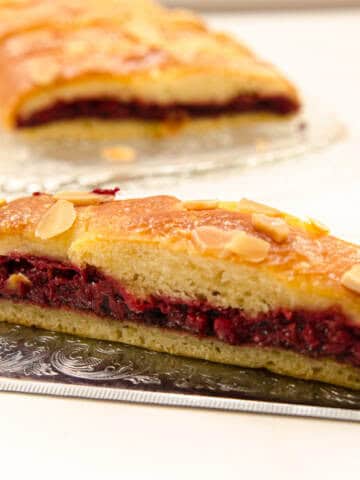
Have you heard the expression, "It's as easy as falling off a log?" Well, this is that!

The beauty of this refreshing ice is that it only needs a processor or blender, a pan and a fork. It can be sweetened with almost anything including honey, sweeteners, sugar, or my favorite, a simple syrup which guarantees a smooth result.
Using a glass pan to freeze the granita is important if using the balsamic vinegar, since it might react with an aluminum pan.
Some other no bake desserts especially welcome during the summer months include: No Bake Pina Colada Cheesecake, (Almost) No bake Strawberry Pie, Amazing Banoffee Pie, Chocolate Truffle Raspberry Curd Tart and Cafe au Lait Tart
Granita is an Italian ice. At it's most basic, it is just fruit and sweetener combined and frozen. Every so often, it is scraped with a fork to fluff it up so it melts in your mouth and that's it! It doesn't get much easier. In addition to fresh or frozen fruit, coffee or juices work well also.
When using fresh fruit, make sure it is ripe, so the maximum flavor is had. For coffee granita, just make coffee as you drink it, sweeten it and into the freezer it goes. What could be easier than orange juice? The easiest way to make lemon granita is to use a frozen lemonade concentrate. Thaw it and add water and a sweetener to taste. This is one of the most versatile recipes, limited only by your imagination.
For an adult version, liqueurs can be poured over the ice. Think strawberry and orange liqueur, peach and amaretto, coffee and Kahlua. You get the idea.
Well, the Italian way is to eat it for breakfast! With brioche!! I can't say that doesn't sound good, although I think as an American, I would opt for an anytime snack or dessert. In the olden days of multiple courses of dinner, it would be served as a palate cleanser between courses. There is no wrong time today.
Both of these enhance strawberries and I have used this combination several times on my blog as it is a favorite. See my Strawberry Balsamic Jam and the Oreo Tacos with Strawberry Salsa.
The use of white balsamic vinegar as opposed to the normal dark is to keep the strawberries a vibrant red. The main difference between the white and dark balsamic vinegars is the grapes used and the amount of aging.
Italians have been making balsamic vinegar for a thousand years. Balsamic vinegar is sweeter than the more robust vinegars. Some dark balsamic vinegars are aged up to 100 years in different barrels for a complexity of taste.
However, these balsamics are very expensive, just like a fine wine and are used as a finishing vinegar and not as an ingredient. All dark balsamics are thicker and sweeter than the white balsamic, which can be aged in barrels or stainless steel tanks for a shorter amount of time. The white is usually used when you don't want to discolor the food with which it is being used, as would dark balsamic vinegar.
Granita can be made with any puréed fruit or combination of fruit or fruit juice, lemonade, coffee, tea, watermelon. If using a fruit juice or any liquid, there are no special tools needed. If making with fruit, a blender or processor is used to purée the fruit.
Simple syrup is my sweetener of choice. It can be made and held for a week in the fridge so you can have granita all summer long. Add about 20% of the syrup to the fruit or unsweetened liquid. That's about ¾ cup to 4 cups of fruit or liquid. The simple syrup can be infused with other flavors as in this recipe, or part of the liquid can be a liqueur. Add it to the water and sugar when making the simple syrup to burn off the alcohol, leaving only the flavor of the liqueur.
After mixing everything, just put it in a dish and freeze it. A thickness of ½ inch in the pan is ideal, but it can be deeper. It will just take longer to freeze. When it freezes, follow the technique below to fluff it up into those crunchy ice crystals that are unique to granita. Re-fluff just before serving.

FRONT ROW: Black pepper, granulated sugar, white balsamic vinegar
BACK ROW: Strawberries, water
Be sure to see the recipe card below for the full ingredients & instructions.
It is important to use a glass dish if using the balsamic vinegar, and an aluminum pan may interact with the vinegar causing a metallic taste.

Step 1. To make the simple syrup, place the water and sugar in a small saucepan. Step 2. Bring to a rolling boil. Boil for 1 minute. Step 3. Remove from the heat and add the black pepper. Step 4. Stir in the white balsamic vinegar.

Step 5. Place the strawberries and simple syrup in the bowl of a processor or blender. Step 6. Purée the mixture, scraping down as necessary. Step 7. Pour into a 9" glass or ceramic dish. Step 8. Freeze until about ¾ frozen. Fluff it up using a fork, drag it through the granita and then chop it up with the fork. Freeze until hard. If the granita gets frozen hard before fluffing it, let it sit at room temperature for a few minutes to soften it slightly. Place it back in the freezer. Fluff it just before serving.
By liquifying the sugar in water, it ensures the smoothest finish for the granita. However, honey or sweetener can be used by themselves. In that case, no water is necessary. Sweeten to taste.
Sorbet is whipped and smooth, granita is What is the difference between a granita and a sorbet? Granita is not whipped but frozen and then fluffed up with a fork to allow ice crystals to form making a granular, crunchy texture.
Since it's basically fruit or fruit liquid or other liquid, and a bit of sweetener, it is one of the healthiest desserts or snacks to be had.

A lot of work goes into each of my recipes and my only ask is that if you like the recipe or even the looks of it, please leave me a star rating to help me rank better. It’s important.
Modified: · Published: by Helen S Fletcher · This post may contain affiliate links · 10 Comments
These Samoa Cookie Bars are the essence of minimum work for maximum flavor. A melt in your mouth shortbread crust topped with homemade caramel (you can do it, it's foolproof) chock full of toasted coconut with the bottoms dipped in chocolate. Just like the Girl Scout cookie version but in a much simpler form.

This bar version is so much easier to make than the cookies. I just don't have the patience it takes to fiddle with cutting out those small cookies, patiently arranging the caramel coconut filling on them and then dipping them. I saw one person said it took her 4 hours. No thanks! These can be whipped up in no time and you have way more Samoa Bars than little cookies. One bar is at least 2 cookies. How could you not love that?
I love brownies and bar cookies because they are generally so easy to make and you get a sizeable amount for the time invested. Here are a few others you should look into: Cocoa Brownies, Pecan Bars, Mocha Kahlua Brownies (these are still the most sought after brownie I made - we also cut them smaller for petit fours), Mexican Brownies, and from down under, Spice Bars. Also check out this collection of recipes 7 Quick Wins for Mother's Day.

The coconut on the left is the one most used in baking. The shreds are longer and it's moist and sweetened. The coconut on the right is desiccated coconut.
For desiccated coconut the meat is shredded and then dehydrated to remove most of its moisture. It is usually unsweetened. Unsweetened desiccated coconut is most important to the Samoa Bars. Additionally, it is important to toast it to give it the same flavor as the Girl Scout cookies. Otherwise, it is just a coconut cookie.
Be careful when toasting coconut as it can burn easily. I find desiccated coconut easier to toast than the sweetened. You will see in the photos below how beautiful it is. I didn't need to stir it at all, I just turned the tray around about ¾ of the way through and it browned evenly. The key here is to make sure it is in single layer and any stray shreds are scooted into the edges or they will burn on their own.
I am a firm believer that this homemade caramel is better than anything you can buy. So I encourage you to take a flyer and give it a try.
It is true you need candy thermometer but they are inexpensive and the results are very worth the investment. My recipe, Caramel - A building Block of Pastry shows you how to make caramel for any need you will have from a caramel sauce to hard caramels from the same recipe.
Having said that, you can substitute 8 ounces of Werther's soft caramels if need be. I don't suggest any other caramel because they don't have the same buttery taste. Werther's is the closest to mine that I've found.

FRONT ROW: Unsalted Butter
MIDDLE ROW: Vanilla extract, granulated sugar, corn syrup
BACK ROW: Water, desiccated coconut, heavy cream

FRONT ROW: Unsalted butter
BACK ROW: All-purpose flour, powdered sugar

Left to Right: Semisweet chocolate, crisco
Be sure to see the recipe card below for the full ingredients & instructions.

Heat the cream until hot. Set aside. Step 1. Place the water, corn syrup and sugar in a saucepan about 3 times larger than the ingredients. Step 2. When the syrup comes to a rolling boil, place a lid on the pan to wash down the side so no sugar remains stuck on it. Alternatively, dip a clean pastry brush in cold water and wash down the side of the pan. Step 3. Continue boiling hard. Step 4. The syrup becomes a deep golden brown. This sets the taste for the caramel.

Step 5. Off heat, stir in the butter until it melts. Step 6. Add the cream and vanilla. If the cream lumps up, don't worry about it, the next step will fix that. Step 7. Return the mixture to the heat and boil to a temperature of 230°F. Step 8. Remove from the heat and cool.

Step 1. Line a 9x9 inch pan with parchment paper allowing the sides to extend to make a sling. Set aside. Step 2. Place the desiccated coconut on a tray in a single layer. Make sure there are no stray shreds on either side. Step 3. Place it in 350°F oven for about 8 minutes turning ¾ of the way through. I did not have to stir mine but if you notice yours is baking unevenly, stir it. Cool the coconut. Reserve ½ cup and set aside. Step 4. Place the flour and powdered sugar in the bowl of a processor. Process with a few pulses to mix.

Step 5. Add the cold, cut up butter to the processor. Step 6. Process until large chunks form. Step 7. Place chunks of the dough evenly around the bottom of the baking pan. Step 8. Press the dough together to make the base. Make sure no seams show. It should be one solid sheet of dough.

Step 9. Bake the base as called for until a light golden brown. Cool the base. Step 10. Place the cooled caramel in a medium size bowl. If it has set up, microwave it briefly to loosen it up. If using the caramels, unwrap them and microwave to soften them to a near liquid state. Step 11. Add 1 ½ cups coconut and stir to mix completely. Step 12. Distribute the coconut over the base.

Step 13. Spread the caramel-coconut mixer evenly over the base with a small offset spatula. Remove the bars from the pan. Remove the parchment paper and set the Samoas on a cake board or a cutting board as long as it doesn't harbor strong smells. Step 14. Immediately, sprinkle the reserved coconut evenly over the caramel mixture. Press it in lightly so it adheres. Step 15. Melt 6 ounces of chocolate with 1 to 2 teaspoons of crisco to loosen it. Place a small amount in a piping bag fitted with a small plain writing tip and pipe diagonal lines across the bars. Cut 7 across one side and 3 down for a total of 21 bars. Step 16. Place the rest of the chocolate in a bowl just big enough to hold the bar, bottom side down. Dip the bottom of one bar at a time into the chocolate and place on waxed paper or parchment paper to firm up. These can be refrigerated briefly to set the chocolate.
Samoa (or Caramel deLites) Girl Scout Cookies were introduced in 1975.
The name "Samoa" is believed to be inspired by the island nation of Samoa which is half way between Hawaii and New Zealand. The cookies are names after Samoa because It is a major coconut exporter.
The cookies are made by different manufacturers in different areas It depends on how the bakers are licensed.

A lot of work goes into each of my recipes and my only ask is that if you like these Samoa Bars or any other recipe or even the looks of it, please leave me a star rating to help me rank better. It’s important.
Modified: · Published: by Helen S Fletcher · This post may contain affiliate links · 24 Comments
This amazing Caramelized Peach Tart combines a creamy pastry cream, caramelized peaches, and a brown sugar crumble made with almond paste in an easy pastry crust. The brown sugar crumble is worth everything all by itself. Don't be put off because this recipe contains several component parts. All of them can be made ahead and the tart assembled on the day of serving.

But don't wait until peach season is gone - this is truly worth making. From the press in cookie crust, to the creamy pastry cream, the intensely flavored peach filling, and finally a bake alone crispy crumble topping that is good on ice cream, fresh fruit, and myriad other things, including snacking I am told, this is a summer winner for sure.
Other fruit offerings include: Blueberry Crumb Muffins, Two Step Banana Bread, No Churn Peach Swirl Ice Cream, Mini Pineapple Upside Down Cakes, and Plum Crisp
[feast_advanced_jump_to]Years ago when I wrote European Tarts, I included this as the topping for the Apricot Crumble Tart. Because this is baked on a sheet pan, it can be cooled and kept as a final flourish to anything requiring a bit of crunch and extra flavor.
The almond paste and brown sugar work well together. When I went to make this I didn't have any almond paste. What I did have was a lot of almond flour. In a matter of minutes I made a batch of almond paste which I used here. When you go to the post there are two versions. I used the one with the simple syrup.
I will say the brown sugar crumble came out of the food processor in crumbs but baked up in a solid sheet. So I used a fork to pull the mass of baked "crumble" into crumbs while hot. When they cool, they are crisp and if not small enough, just break them up between your hands.
As mentioned above this dessert requires a number of parts but all of them can be done ahead. Here's how that looks.
This can be made weeks, even months ahead and frozen unbaked in its tin. It can be baked from the freezer when needed. Go to the Easy Almond Raspberry Tart for how to photos .

Just like the shell above, the pastry cream can be frozen for a month or two. Just thaw it in the refrigerator up to 5 days before using. The whipped cream should be added after it has thawed but can be done several days ahead.. Please see Pastry Cream Filling for how to photos of this pastry staple.

This almond paste can be made months ahead and stored in the freezer or it can be stored in the refrigerator for a couple of weeks. You can also buy almond paste if desired. For how to photos go to How to Make Almond Paste.
There are two methods on the post. I use the one with the simple syrup.


COUNTER CLOCKWISE: Unsalted butter, all-purpose flour, cake flour, baking powder, granulated sugar. Egg in the middle

FRONT ROW: Gelatin
MIDDLE ROW: All-purpose flour, vanilla, water
BACK ROW: Egg yolks, granulated sugar, milk

FRONT ROW: Simple Syrup, almond extract
BACK ROW: Almond Flour, powdered sugar

FRONT ROW: Salt, unsalted butter
BACK ROW: All-purpose flour, almond paste, dark brown sugar
Be sure to see the recipe card below for the full ingredients & instructions.
This can be made a week or so ahead. Store in a covered container at room temperature.

Step 1. Place all the ingredients in a food processor. Step 2. Process until crumbs form. Step 3. Pour out onto a parchment line half sheet pan and spread out evenly. Step 4. If they bake up in a sheet, use a fork to pull the dough away to make crumbs while it is still hot. Cool. If the crumbs are too big, smash them between your hands.

Step 5. Peel the peaches. For the easiest way see my post, All About Peaches. Cut them in about ½" pieces. They shoudn't be too thin or they will reduce in size as they cook. Set aside. Step 6. Place the all the ingredients except the peaches in a skillet large enough to hold the peaches. Step 7. Bring to a boil and boil for several minutes to reduce the mixture. Step 8. Add the peaches and continue boiling until the syrup is reduced and the peaches have softened. This can be done a day ahead and refrigerated.

Step 9. Spread the pastry cream evenly in the pastry shell. Step 10. Add the peach filling. Step 11. Top with the brown sugar crumbles. Step 12. If you wish to finish the tart with powdered sugar, cut strips of paper about ¾" wide. Arrange them on top of the tart. Sprinkle heavily with powdered sugar. Carefully remove the paper strips.
The stones or pits of a freestone peach release very easily from the flesh. A cling or clingstone peach is one where the stone or pit is difficult to remove as it clings to the flesh of the peach.
A pie has a crust, a filling and some kind of top be it a pie crust, crumb or streusel. It is deeper than a tart. A tart has a crust and a filling but not necessarily a top. It is made in a pan with rippled edges and is shorter than a pie.
Almond or vanilla extract or a bit of both as well as amaretto, peach schnapps, bourbon or orange liqueur all go well with peaches.

A lot of work goes into each of my recipes and my only ask is that if you like the recipe or even the looks of it, please leave me a star rating to help me rank better. It’s important.
Modified: · Published: by Helen S Fletcher · This post may contain affiliate links · 4 Comments
I wanted to highlight some of the best Sweet and Savory recipes on this site for the summer months. Many are no bake recipe, others feature the abundant fruits and vegetables coming from gardens or markets. I trust you will find a few to perk up your summer meals.


Modified: · Published: by Helen S Fletcher · This post may contain affiliate links · 9 Comments
This Peanut Butter Ice Cream Pie would be perfect anytime but during the summer months it's the perfect end to a BBQ. It's a do ahead, no bake recipe that is easy as can be with a chocolate rice crispy crust that stays pliable even in the freezer.
A super smooth and easy homemade no churn peanut butter ice cream fills the chocolate crust in this extravaganza.

A crunchy crust is juxtaposed with the smoothest ice cream you'll ever make. And it's all so quick and easy.
Looking for another fun frozen dessert? Try these Homemade Ice Cream Sandwiches, my Hawaiian Sundae and my Truly Amazing S'mores Ice Cream Cake.
I've added a couple of ingredients to the chocolate crust to make it a better eating experience. By adding a bit of honey to the crust and reducing the chocolate just a little, it's more like rice krispie treats and who doesn't like those? The crust retains its crunchy texture even if completely thawed. Crushed up honey roasted peanuts adds another flavor ingredient.
When pressing it into a well sprayed pie plate, it's easiest to use nitrite or vinyl gloves. Latex gloves are not recommended as some people are allergic to them and handling the food with them can trigger a reaction. Lacking gloves, use a plastic bag as a glove. The crust is very sticky so you can use a little non-stick spray on them which helps.
This is so easy, it's like falling off a log. Truly! The key ingredients are whipped cream and condensed milk. After that, the sky's the limit. In this case we used peanut butter and vanilla extract but that's it. And a smoother, creamier ice cream you won't find. It can get a tad hard in the freezer so it's best to take it out about 10 to 15 minutes to let it soften a bit.
I have several more on my blog including: No Churn Caramel Brickle Ice Cream, No Churn Peach Swirl Ice Cream, No Churn Nutella Ice Cream, and Double Chocolate No Churn Ice Cream. Other cold and frosty treats are the L'Opera Ice Cream Cake and the very exciting Strawberry Balsamic Granita which is the easiest dessert ever.

FRONT ROW: Unsalted butter, honey roasted peanuts, honey
BACK ROW: Rice Krispies, semi-sweet chocolate

FRONT ROW: Vanilla extract, creamy peanut butter
BACK ROW: Condensed milk, heavy cream

FRONT ROW: Honey roasted peanuts, powdered sugar, semisweet chocolate
BACK ROW: Heavy Cream
Be sure to see the recipe card below for the full ingredients & instructions.

Step 1. Place the peanuts in a processor and process fairly finely. Reserve 2 tablespoons. Step 2. Add them to the bowl of rice krispies. Step 3. Combine the chocolate, butter and honey in a small saucepan. Step 4. Place over low heat to melt the chocolate and butter, stirring frequently. This can also be done in a microwave at half power to prevent the chocolate from burning.

Step 5. Pour the chocolate over the rice krispie mixture. Step 6. Stir the mixture together until everything is evenly coated. Step 7. Spray the pie pan well with a non-stick baking spray. The mixture is very sticky. It is best to use nitrite or vinyl gloves to press the crust in or simply use a plastic bag as a glove. Spraying them lightly with a non-stick baking release will help keep the crust from sticking to the gloves. Use a table knife to press the sides securely around the rim of the pan. Step 8 Place in the freezer while preparing the ice cream.

Step 9. Stir together the condensed milk and the peanut butter until smooth. Step 10. Fit the mixer with the whisk attachment. Whip the cream to fairly stiff peaks. Don't get it too stiff or it will be difficult to mix in the thick peanut butter mixture. Step 11. Add half of peanut butter mixture and beat it in on low. Step 12. Add the remaining peanut butter mixture in and beat in on low. If it is still lumpy, raise the speed and beat until smooth.

Step 13. Pour the ice cream into the crust and freeze. Step 14. Melt the chocolate at half power in the microwave and drizzle it over the top of the frozen pie. Step 15. Whip the cream stiffly. Step 16. Fit a pastry bag with a #4 open star and pipe the cream to around the edge of the pie. Pipe a second ruffle inside of that one. Sprinkle the reserved ground peanuts on top of the cream. Store in the freezer.
NOTE: To release the pie, leave it at room temperature for about 15 minutes. Go between the pie and the pie plate with a small metal spatula. You probably can't go all the way to the bottom of the pie plate but just loose the top edge. At this point the entire pie should be able to be removed and placed on a cake board by simply placing a cake server under the bottom crust where it can be lifted out. This will make cutting it much easier. Cut into small slices as this is extremely rich.
Depending upon what the other ingredients are, if the cream is not whipped quite so stiff, that helps when it freezes. However ingredients such as chocolate and peanut butter will make it harder. The other option is to add a couple of tablespoons of alcohol such as vodka, rum or a liqueur to the recipe. The alcohol will prevent it from freezing hard.
Both evaporated and condensed milk start with cow's milk and are made by removing about sixty percent of the water to form a concentrated, shelf-safe form of milk. Evaporate milk is unsweetened but condensed milk has about 55% sugar added which acts as a natural preservative. All condensed milk is sweetened.
On the contrary they are one of the easiest desserts to make. A simple graham cracker crust can be filled with a purchased ice cream and voila - ice cream pie!

A lot of work goes into each of my recipes and my only ask is that if you like the recipe or even the looks of it, please leave me a star rating to help me rank better. It’s important.
Modified: · Published: by Helen S Fletcher · This post may contain affiliate links · 2 Comments
Cream Biscuits with only four ingredients are the simplest ever to make. Gone is the trepidation about cutting the butter in and worrying about handling the dough too much, activating the gluten making a tough biscuit as with buttermilk biscuits. One change in the ingredients makes this almost fool proof. High, light, tender and so easy to make, it's a great biscuit recipe for beginners.

And forgetting about having to make them at the moment. To make these even more tempting, they can be made, cut out, frozen and stored in an airtight freezer bag to be baked from the freezer for fresh biscuits anytime. Imagine the surprise of eating warm biscuits anytime with any meal or just because.
I am also giving you two different baking temperatures and times depending upon if you like your biscuits with a softer top and bottom or a crisper one.
Biscuits and scones are very close cousins and each are enhanced with jams. Try these with the Strawberry Balsamic Jam that is truly unusual. Several scones come to mind including the luscious Cinnamon Filled Buttermilk Scones, Breakfast Scones featuring hot sausage and cheddar cheese right in the Scone and the sugar topped Scone with Cranberry Strawberry Jam. For more great recipes, check out A Last Minute Easter Roundup.
This is the really magical thing about these scones. Heavy whipping cream replaces the butter. How? Think of how butter is made - by churning heavy cream until it makes butter. It's easy to do in a mixer. Just keep beating past the whipped cream stage and it will separate into the whey (the liquid) and the butter.
It's the fat content that is important and the heavy cream has that in spades! Heavy cream has a higher fat content than regular whipping cream so that's the one you want. Heavy cream has a butterfat content of no less than 36% to 40% which is the best if it can be found. This cream whips and holds as a decoration or to finish a cake with no stabilization. It can also be frozen on a cake and thawed with no change. Regular whipping cream is 30% to 35% and doesn't hold as well so requires some kind of stabilization.
These cream biscuits have only 4 ingredients and have a softer texture inside making them ideal to serve with any meal. And don't forget the dessert - adding a bit of sugar to lightly sweeten them and they are the best for a great strawberry, peach or mixed fruit shortcake.
Speaking of adding things, add a cup or so of any cheese of your choice. If you're going to use these for sandwiches, add a teaspoon or so of black pepper to give them a bit of a kick.
This is a key ingredient and I don't suggest substituting all-purpose flour for it. Of all the wheat flours, cake flour has the lowest amount of protein or gluten. As such, it's really, really hard to overwork the dough and it ensures a tender, fluffy biscuit even when made in a mixer.

CLOCKWISE: Cake flour, heavy cream, baking powder, salt
Be sure to see the recipe card below for the full list of ingredients & instructions.

Step 1. Place the cake flour, salt and baking powder in the bowl of a mixer. Step 2. Mix for a few seconds to blend then slowly pour the heavy cream into the mixer while it is running. Step 3. Beat just until it comes together. Step 4. Remove from the mixer and, on a lightly floured surface, shape into a smooth ball by kneading a few times.

Step 5. Press the dough out with the palm of your hand. No need to roll out. Step 6. It should be ¾" thick. Step 7. Using a 3" round cutter or a biscuit cutter the desired size, cut the biscuits. When cutting, do not twist the cutter. Cut straight down then remove the cutter for straight biscuits. If you twist the cutter, the biscuits can come out lopsided. Place them on a parchment paper lined baking sheet pan. Re-roll the scraps as necessary Step 8. Just before putting them in the preheated oven brush them with a bit of additional cream. Bake as called for until just golden brown. Do not over bake. These can also be cut out, frozen hard, then stored in a freezer bag. Add a few minutes additional baking time.
The butter and liquid should both be cold. The second secret is the dough should be almost almost wet and sticky.
According to history, it originated with the Romans in the 9th century. However, the Viennese have been using it lavishly for 300 years are are credited its current popularity.
There is a fascinating article on how the beginning of our biscuits came from Europe in King Arthur's, Rise the History of America's Biscuits
Cake flour is important to the soft, fluffy outcome of these biscuits. It has the lowest protein or gluten count of the white wheat flours.
Heavy cream with 36 to 40 percent butterfat is used here.
Beat just until the dough comes together. It does not form a ball.
To re-roll push the dough together or knead it lightly.
While the biscuits are best warm out of the oven, they can be kept for several days well covered at room temperature. They also freeze really well. I prefer to freeze them before baking and adding a few minutes to the baking time, but they can also be frozen baked. Thaw and refresh in a 350° oven for about 10 minutes. In any case, serve them warm.

Love this Cream Biscuits? It would be hugely helpful and so appreciated it if you would take a moment to leave a star rating. Thank you.
Modified: · Published: by Helen S Fletcher · This post may contain affiliate links · 7 Comments
Strawberry Surprise Cupcakes encompass strawberries in two ways with the surprise tucked inside. Lucious pureed fresh strawberries in the batter as well as intense freeze-dried strawberries making a creamy strawberry buttercream frosting ensure all the strawberry flavor is delivered.

Two thoughts going forward. I didn't add red food coloring to the cupcake batter and I should have. Unfortunately, pureed fresh fruit in baked cakes, cupcakes, etc. comes out with a grayish color. It tastes great but falls a bit short in the looks department.
The second thought is that I should have made them in the regular size pans not the jumbo. Why? Because then you could get a bite of everything, cake, filling and buttercream at once.
Several recipes on my blog also feature the Strawberry Buttercream including: Banana Split Cupcakes, Strawberry Cake - A Little Slice of Heaven, Strawberry Brownies
Another great cupcake recipe to try is my Amazing Boston Cream Cupcakes.

FRONT ROW: Baking soda, baking powder, salt
MIDDLE ROW: Red food coloring, eggs & yolk, granulated sugar
BACK ROW: All-purpose flour, fresh strawberries, vegetable oil

Heavy cream, semisweet chocolate

FRONT ROW: Milk, almond extract
MIDDLE ROW: Unsalted butter,
BACK ROW: Powdered sugar, red food coloring and freeze dried strawberries
Be sure to see the recipe card below for the full ingredients & instructions.

Step 1. Place the strawberries in the bowl of a processor. Step 2. Puree until smooth. Step 3. Measure 1 cup and set aside. Step 4. Whisk together the oil sugar and almond extract in a medium size bowl.

Step 5. Whisk in the whole egg and the yolk to the bowl. Step 6. Add the strawberry puree. Step 7. Whisk all together to mix well. Step 8. Combine the dry ingredients - flour, baking powder, baking soda and salt. Add to the liquid.

Step 9. Whisk together the ingredients. Step 10. Add the food coloring if using. Step 11. Fill the cupcake liners ¾ full (about ⅓ cup). Step 12. Bake as called for. A toothpick in the center will let you know if it is baked long enough as it should come out clean.

Step 13. Heat the cream until very, very hot but do not let it boil. Step 13. Add the chocolate. Step 14. Submerge the chocolate under the cream and let it sit for 3 or 4 minutes. Step 15. Start whisking the ganache pulling the cream into the center of the bowl. Step 16. Whisk until all of the cream and chocolate are one. Cool until thick. If it gets too thick, microwave for a few seconds.

Step 17. After the cupcakes have cooled completely, cut a hole in the top of the unfrosted cupcakes. Using a small knife pointed down and towards the center, go around the center of the cupcake to remove some of the cupcake to make room for the ganache. Be sure to save that piece to replace it. Step 18. Using a piping bag fitted with a plain tip, fill the hole with the ganache pretty much up to the top. Step 19. I forgot to do this but you should cut away the pointed end of the piece you removed. You only need a thin piece of cake to go seal the top. Step 20. After the tops have been replaced, pipe on the strawberry buttercream below.

Step 21. A package of the freeze dried strawberries. Be sure to take the desicant out of the package before processing. Step 22. Place the strawberries and powdered sugar in the bowl of a processor. Process until they are a powder. Step 23. Combine the powder, butter and extract in a mixing bowl fit with the paddle attachment. Mix on low to blend. Step 24. Raise the speed to medium or medium high and until very light. Add food coloring at the end. Use an ateco #6 open star tip in a pastry bag to pipe the buttercream on top of the cupcakes.
Sure but it's how they are added that is important. Most fruit if pureed will turn the batter an off color, usually grayish which is why food coloring is often recommended. If whole fruit is used, it is best to freeze it (cut it up prior to if necessary) and add it to the batter frozen. That way very little juice escapes to color the batter.
No. They do not have the intensity of taste nor the properW consistency.
The main differences are how they are dried and what they taste like. Dehydrated strawberries (dried) use a process that dries them in ovens over along period of time removing some, but not all of the moisture. This method produces a leather like fruit with some taste of strawberries but not like fresh.
Freeze dried strawberries freeze the fruit first and then by placing them in a vacuum chamber the frozen water is turned into a vapor without becoming liquid. The result is crisp, crunchy texture that is airy, light and which tastes even more like fresh strawberries due to the concentration. They are perfect for baking as they don't add liquid to the recipe. The shelf life of these is almost indefinite. Freeze dried food was originally made for astronauts in space.

Love these Strawberry Surprise Cupcakes? It would be hugely helpful and so appreciated it if you would take a moment to leave a star rating. Thank you.
Modified: · Published: by Helen S Fletcher · This post may contain affiliate links · 25 Comments
Easy English Muffin Bread is possibly the easiest, fastest bread you can make. But the best part is its chewy texture and it tastes just like an English muffin. Slice and toast and you have a breakfast, brunch or an anytime treat.

The original recipe comes from Fleischmann's Yeast. I found it in the early 1980's. I recently found it again but they have reduced the flour to make more of a batter than a dough. In any case it's a quick yeast dough and a great way to start if you're a novice.
Kathy shared, This is an excellent bread! I’m enjoying a slice now."
One of the best ways to eat the toasted bread is with my Strawberry Balsamic Jam, the Peach Amaretto Jam or the Cranberry Strawberry Jam (use frozen cranberries). All of these require no canning and are very easy to make.
Here are a few other breakfast/brunch recipes you are sure to enjoy: Homemade Breakfast Stromboli, Bacon and Cheddar Cheese Popovers, Apple Fritters, Best of All Strawberry Muffins, Date Nut Bread, and Breakfast Scones.
And if you love cheesy bread, try this Brazilian Cheese Bread Recipe. If you like bread with a little extra flavor, try Red Pepper & Olive Bread.
Nope! According to research they were actually invented by Samuel Bath Thomas around 1880. Thomas was a British immigrant who made them on the griddle as we do today. He may have been influenced by British breakfast breads as well as the English crumpet, a close cousin to the English muffin. One of the more interesting aspects of the name is that in England they are referred to as simply "muffin.
Slice the bread and toast it lightly. It's great just buttered or with jam or honey. Even better, make a breakfast sandwich with bacon or sausage, eggs and cheese. Or use it for the traditional eggs benedict using Canadian bacon, poached eggs and an easy Hollandaise sauce. Simply melt the butter, until it just comes to a boil, put the rest of the ingredients in a food processor, pulse to mix then pour the hot butter down the feed tube slowly while running the processor. Do not use the milky residue at the bottom of the pan. That's it.

FRONT ROW: Salt, baking soda, granulated sugar
MIDDLE ROW: Instant yeast, water
BACK ROW: Cornmeal (to dust the pan), all-purpose flour, milk
Be sure to see the recipe card below for the full ingredients & instructions.

Step 1. Heat the milk to about 110°F. Place the milk and water in the bowl of a mixer. Sprinkle the yeast over the milk. Step 2. Stir the mixture and let it sit while preparing the remainder of the ingredients. Step 3. Combine the flour, sugar, salt and baking soda and pour over the milk mixture in the mixer. Step 4. Beat the mixture for 2 minutes on medium, scraping down as necessary.

Step 5. Spray the 8x 4 ¼ inch pan with a non-stick baking release and sprinkle heavily with cornmeal. Step 6. Scrape the batter into the pan and level it. It will be very sticky. The easiest way to level it is to wet your hands, shake them off and press the dough as evenly as possible in the pan. Step 7. Spray a piece of film with non-stick spray and place it over the pan. I don't normally like plastic wrap covering rising dough because I think it can constrict it. However, this dough is sticky and would stick to a tea towel.

Step 9. Remove the plastic wrap and place in a 400°F oven. Bake as called for. Step 10. Remove it from the oven after baking. Place the pan on a cooling rack. Step 11. Turn the bread out immediately and cool on the rack. Step 12. Slice the bread when cooled.
These are the same "nooks and crannies" as in English muffins. They hold butter, jam, honey etc.
The baking soda is what makes the "nooks and crannies" in the bread. Without it, the texture would be closed like most breads.
Milk makes a softer bread with longer shelf life.

Love this English Muffin Bread? It would be hugely helpful and so appreciated it if you would take a moment to leave a star rating. Thank you.
Modified: · Published: by Helen S Fletcher · This post may contain affiliate links · 4 Comments
This Millionaire's Shortbread Tart is a modern take on a classic bar cookie made of shortbread and caramel covered with chocolate. For this bar I've added crunch to the caramel layer and a bit of heat and salt to the chocolate.

The origin of this bar has said to come from Australia, Scotland and Great Britian. So take your choice Wherever it came from it is luxurious and rich, hence the name Millionaire's Shortbread which has been accredited to Scotland because of its indulgent layers. Other names such as caramel square, caramel slice or caramel shortbread have been attributed to other countries.
Here are some other bar cookies you're sure to enjoy: Mexican Chocolate Brownies, Easy Brookie Recipe, Mocha Kahlua Brownies (The frosting is worth the whole recipe), Hazelnut Crunch Bars, and the always popular Pecan Bars. These were a favorite at the bakery. We would cut them in half for petit four trays.
Basically each component part can stand on its own but when combined they make an unbelievably opulent cookie. The butter-rich shortbread base melts in your mouth while the homemade caramel is the definition of decadence and the smooth chocolate ganache glides across your tongue. Why have them individually when you can put them together in one outstanding bar.
Short refers to the large amount of some kind of fat (think butter or shortening) in these recipes making them very tender. The fat surrounds the gluten strands preventing them from becoming long and stretchy and/or absorbing water which makes the dough chewy such as in bread. A short dough is tender, breaks easily and is crumbly with limited gluten development giving them a melt-in-your-mouth texture. Shortbread cookies and crusts such as Pâte Sucrée and Pâte Sablée are perfect examples of short crusts.
The classics shortbread cookie consists of only 3 ingredients - sugar, butter and flour in a 1,2 3 formula. 1 part sugar, two parts butter and 3 parts flour. That it!
There are building blocks or base recipes that are used over and over in baking and pastry. Caramel is one of them. It goes from a sauce to a hard candy in a matter of minutes and is invaluable. Caramel can make a sauce, soft or hard candy, coat a cake or top a tart. For a complete tutorial please see my post Caramel - A Building Block of Pastry.
As long as a few simple rules are followed, it is so easy to make and any store bought caramel pales next to it. The biggest problem is caramel turning grainy after making. In my recipe I have reduced that possibility by substituting corn syrup for part of the sugar. Corn syrup is an invert sugar which helps control the sugar returning to a granular state after cooling or if stirring at the wrong time.
The only thing you need for success is a few simple ingredients and a candy thermometer to make sure the temperature is what is needed for whatever recipe is being used.

FRONT ROW: Unsalted Butter
BACK ROW: All-purpose flour, granulated sugar

FRONT ROW: Unsalted butter, vanilla extract
MIDDLE ROW: For this bar I've added a bit crunch to the caramel layer and a bit of heat and salt to the chocolate. Light Corn Syrup, Rice Krispies
BACK ROW: Water, granulated sugar, heavy cream

FRONT ROW: Cayenne peper, unsalted butter and honey
BACK ROW: Semisweet chocolate, heavy cream
Be sure to see the recipe card below for the full ingredients & instructions.

Step 1. Microwave the cream to hot. Set aside. Combine the water, granulated sugar and corn syrup in a medium size saucepan. Step 2. When the mixture comes to a boil, cover the pan with a tight fitting lid for 3 to 4 minutes to make sure there are no sugar crystals clinging to the side of the pan. Alternatively, (this is my favorite way), Wash the sides of the pan down with a brush dipped in cold water. Step 3. Bring to a rolling boil. Step 4. Boil hard until the syrup changes a bronze color.

Step 5. Remove pan from the head and add the butter to hot syrup. Stir until it melts. Stir in the hot cream and vanilla. Step 7. Return the caramel to the heat, clip on a thermometer if possible, bring to a rolling boil and take to 228°F. Remove from the heat and let it cool while preparing the rest of the recipe.

Step 9. Cut the cold butter into small pieces and add it to the flour in the bowl of a processor. Step 10. Process until it it indistinguishable. Step 11. Add the sugar to the bowl and process until it comes together. It won't form a ball. Step 12. Pour it out on a work surface and push it together.

Step 13. Distribute the dough evenly in the pan. Step 14. Press it into a smooth, even crust. Step 15. Dock the crust with a fork to keep it from rising too much or bubbling up. Step 16. Bake it to a medium brown.

Step 17. Add the rice krispies to the caramel. Step 18. Spread it over the cooled shortbread crust in an even layer. Step 19. Place the heavy cream, unsalted butter, honey and cayenne pepper in a small saucepan. Step 20. Heat it over medium heat to very hot but not boiling.

Step 21. Off heat, add the dark chocolate to the hot mixture. Stir to mix completely. Be careful if using a whisk as it is easy to incorporate air bubbles. Step 23. Spread the ganache over the caramel layer with a small offset spatula. Let set up at room temperature or chill it in the fridge briefly, Use a small straight metal spatula to release the two uncovered side. Remove the bars from the pan and cut as desired. I cut 6 across and 3 down for a total of 18 bars. Step 24. Sprinkle lightly with flaky sea salt. I used Maldon but any good brand will do.
It can. In fact we used a shortbread crust for our cheesecakes at the bakery because it held up better than a graham cracker crust when held in the refrigertor.
Caramel has an undeserved reputation of being hard to make. There are two ways to make it - the wet method which combines sugar and liquid. The mixture is cooked at a rolling bowl until it is deeply colored. Off heat, butter, cream and vanilla are added. It is brought to a boil again and a thermometer is used to obtain the desired temperature. The dry method simply puts sugar directly in a heavy, wide shallow pan such as cast iron and heating it until it melts and colors which is the tricky part. Then the cream and butter are added. The wet method is more dependable for most people as it is easier to control.
Ganache is a rich mixture of cream and chocolate. The chocolate can be dark, milk or white. It can be used in various thickness such as for a sauce, which is pourable, a thicker version using less cream and more chocolate for filling and frosting cakes as well as the thickest version used for truffles. It is endlessly variable with liqueurs often added for flavor, honey substituted for sweeteners, hot pepper, etc.

Love these Millionaires Shortbreads? It would be hugely helpful and so appreciated it if you would take a moment to leave a star rating. Thank you.
Modified: · Published: by Helen S Fletcher · This post may contain affiliate links · 2 Comments
This Summer Vegetable Tart takes advantage of the abundance of fresh local veggies coming to market. They can be sautéed and when combined with cheese in an easy to make crust, it's perfect for brunch, lunch or dinner. A splash of white balsamic vinegar red pepper flakes add a bit of zip to the crust.

It can be endlessly altered by adding whatever you like fresh herbs, olives, different vegetables or cheese, whatever you like. I have given measurements but nothing is set in stone. Just remember that when you saute the vegetables, they will reduce considerably. So whether you pick them from your garden or buy them at the store, you're sure to add this to your summer rotation.
Other summer dishes you may enjoy include: Strawberry Salad with Basil Vinaigrette, Goat Cheese Pesto Tart, Southwestern Vegetable Couscous Salad, or the Southwestern Seafood Tart.
[feast_advanced_jump_to]Salads are a great choice. Try a simple cucumber salad with a sour cream and dill dressing, or a cucumber, feta and tomato salad. A Mediterranean type salad with olives, feta, pepperoncini, a simple crisp lettuce salad or my favorite Greek Tomato Salad.

FRONT ROW: Salt, oregano, basil
MIDDLE ROW: Unsalted butter, thyme, cayenne pepper
BACK ROW: All-purpose flour, parmesan cheese, water

FRONT ROW: Canola oil, white balsamic vinegar, red pepper flakes
MIDDLE ROW: Red onion, artichoke heart quarters, provolone cheese
BACK ROW: Yellow pepper, red pepper, yellow squash, zucchini
Be sure to see the recipe card below for the full ingredients & instructions.

Step 1. Place the all-purpose flour, parmesan cheese and herbs in the food processor. Step 2. Process until combined. Step 3. Cut the cold butter up into pieces and add to the processor. Step 4. Process until the butter is indistinguishable.

Step 5. Add the water as called for and process until a ball forms. Step 6. Remove fro the processor and divide into two equal pieces (about 145 grams each). Divide one of the balls into half again (about 70 grams each). Step 7. Remove a little of each piece of dough to make a walnut size piece of dough. Wrap in plastic wrap and set aside. This will be used to patch the crust if it separates. Step 8. Using one of the smaller pieces of dough, roll it to a 15 inch rope.

Step 9. Place the rope against one side of the rim. Step 10. Roll the second smaller piece of dough into a 15" rope and place it on the opposite side with the ends of the dough overlapping. Step 11. Pinch the ends securely together, Step 12. Press the ropes firmly into the rim.

Step 13. Press the remaining large piece of dough into a round to fit the bottom of the pan. I didn't need any flour, but lightly flour the board if you do. Step 14. Place it into the pan. Step 15. Lightly moisten the bottom of the crust that has been pressed into the rim of the pan. Press the bottom crust up to edge and firmly into the crust on the rim. Seal the edges well. Step 16. Press the crust slightly over the rim of the tart pan.

Step 17. Spray a large piece of foil with a non-stick baking release. Make sure the foil extends over the edge of the pan. Setep 18. Fill the foil to the very top of the pan with dry beans or pie weights. Bake as called for. Step 19. The crust may crack along the joint. Step 20. If the crust separates as soon as it comes from the oven, pinch off a small piece of the reserved walnut size piece of dough and roll it into a thin mini-rope Place it over the separation.

Step 21. Smooth out the patch to seal the separation. Be careful the pan and crust are hot. This is best done with a small pointed offset spatula or small metal spatula. Step 22. Cut the peppers into strips, then cross 3 or 4 times, but the zucchini and yellow squash into rounds, then quarter them, cut the onions into half moons. Step 23. Place in a large skillet and been sauté until somewhat softened or grill or roast. Add the remaining ingredients. Cool. Step 24. Place 5 or 6 pieces of provolone on the bottom of the crust.

Step 25. Place the prepared filling into the crust. Step 26. Cover it with 5 or 6 slices of cheese. Step 27. Place the tart on a half sheet pan covered with parchment paper. Step 28. Bake as called for. Cool slightly, remove from the pan and the metal bottom, slice and serve.
The main difference is the size of the shape. Pie pans are deeper and generally have smooth as well as slightly slanted sides. The crusts are generally of the American type which are thicker and pies most often have a pastry or crumb top. Tarts on the other hand are shorter, the sides are straight and generally rippled. Tart pans also are made in two pieces, the rim and the bottom making them very easy to release and serve. They usually don't have a topping and the crusts are butter crusts and thinner. Either one can be sweet or savory.
Blind baking refers to baking an empty pastry crust. After the crust is placed in the pan, a large piece of foil is sprayed with a non-stick baking release. The foil is placed, sprayed side down on the crust and filled with weights such as beans or pie weights. It is important to fill the foil to the top of the tart.
A crust is blind baked either partially or completely because it either won't be baked additionally for a long enough time to completely bake it or because the filling won't be baked at all. This applies to either a pie or tart crust.

Love this Summer Vegetable Tart? It would be hugely helpful and so appreciated it if you would take a moment to leave a star rating. Thank you.
Modified: · Published: by Helen S Fletcher · This post may contain affiliate links · 3 Comments
You're going to love the ease of making this Caramel Hot Fudge Brownie Sundae. A couple of bowls, a whisk, and some measuring cups are all you need for this all in one treat. Instead of making brownies, this recipe is based on Hershey’s Hot Fudge Pudding Cake. There is no need to make a brownie and a hot fudge sauce. This is an all in one recipe with very little prep time.

I have made chocolate pudding cakes before and they always lacked the punch my Lemon Raspberry Pudding cake has. But this recipe is more of a warm brownie sundae with hot fudge sauce on the bottom and it is outstanding. By adding a few caramels it takes it over the top.
Other ice cream confections make the Easy Hawaiian Sundae, Magic Shell for Ice Cream, Meringue Shells to hold your ice cream, and the zippy Hot, Hot Fudge Sauce.
If you are looking for other indulgent individual desserts, try this Peach Mousse with Cinnamon Crunch, Homemade Ice Cream Sandwiches, and my Hawaiian Sundae.
[feast_advanced_jump_to]Pudding cakes are like magic. A batter is put in the bottom of a pie plate or bowl and then a topping is added and the whole thing is covered in really hot water. For the caramel version, 4 Werther’s Soft Caramels are placed on top of each cup before really hot water is poured over everything.
Then the magic happens. After baking for a few minutes the fudgy brownie comes to the top and the hot fudge and caramel sauce are on the bottom. It should be served warm with a big scoop of vanilla ice cream. The ice cream will melt just enough to make a second sauce.
While I made these ice cream sundaes in individual containers it can also be made in a 9” pie pan. I give you both options.

FRONT ROW: Marachino cherries, salt, baking soda, natural cocoa powder, vanilla, unsalted butter.
MIDDLE ROW: Granulated sugar, brown sugar, all-purpose flour, milk
BACK ROW: Vanilla ice cream, Werther's caramels, water.
Werther's Carmels are as close as I can get to my homemade and best ever Caramel. Brach's just isn't the same.
Natural cocoa such as Hershey's or Ghiradelli 100% Cocoa is what you need for this recipe. Do not use Dutch cocoa.
Baking Soda is the leavening agent when using natural cocoa.
If the caramels are difficult to unwrap, place them in the freezer for a few minutes and the papers will come off very easily.
Be sure to see the recipe card below for the full ingredients & instructions.
Unwrap all of the caramels first. Set aside.

Step 1. In a medium size bowl, combine ¾ cup granulated sugar, all-purpose flour, baking soda, salt and ¼ cup natural cocoa. Step 2. Whisk them together and set aside. This is bowl #1. Step 3. In a second bowl, combine the brown sugar, the remaining ¾ cup granulated sugar and remaining ¼ cup natural cocoa Whisk together, making sure to get all the lumps of cocoa incorporated, and set aside. This is bowl 2.

Step 5. Put the unsalted butter and milk in a 1 cup measuring cup or small bowl. Microwave just to melt the butter. Step 6. Stir in the vanilla and let cool to lukewarm. Step 7. When cooled, pour it over the bowl #1 with the flour in it. Whisk until smooth. Step 8. Place ⅓ cup of batter in each of 7 cups. I used a regular measuring cup for this.

Step 9. Add 2 tablespoons +1 teaspoon of the mixture in bowl #2 over the batter in each cup. If there is any leftover, just add it to the cups. Step 10. Place 4 caramels in each cup. Step 11. Pour 2 tablespoons + 1 teaspoon boiling water into each cup. Step 12. Bake as called for. The brownie should be set around the edges but the middle should still be wiggly. Cool slightly before serving. Top with scoops of ice cream and a cherry. Store leftovers in the fridge.
Bertha Palmer of the The Palmer House Hotel in Chicago is credited with inventing the brownie in 1893. She wanted a portable, chocolate cake-like dessert for boxed lunches at the World's Columbian Exposition. It is not known who invented the brownie sundae.
While it can vary, the basics are a chocolate brownie, vanilla ice cream, chocolate or hot fudge sauce with a cherry on top. Variations include chopped nuts on top, caramel sauce along with chocolate or instead of the chocolate.
Because it is all made together, the brownie and the fudge sauce. No need to make them separately.

Love these Caramel Hot Fudge Brownie Sundaes? It would be hugely helpful and so appreciated it if you would take a moment to leave a star rating. Thank you.
Modified: · Published: by Helen S Fletcher · This post may contain affiliate links · 4 Comments
This is the Strawberry Buttercream you have always wanted and searched for. Fresh strawberries or strawberry jams are no comparison to this intensely flavored buttercream. This truly is a party in your mouth. A full pound of fresh strawberries are reduced to 1.2 ounces when freeze dried. Added to a simple buttercream the result is just short of amazing for a recipe that takes only 30 minutes. I am not shy in saying this is the best strawberry buttercream you will ever make.

The recipe calls for freeze-dried strawberries - the kind the astronauts took with them. A 1.2 ounce package equals a full pound of strawberries without the juice making them ideal to introduce into a strawberry frosting.
A couple of other recipes frosting recipes using freeze dried strawberries include my Strawberry Cake - A Little Slice of Heaven of Heaven, Banana Split Cupcakes and the elegant Chocolate Strawberry Ruffle Cake.

These are the most intensely flavored strawberries you can eat. All of the moisture has been taken out of them leaving only the shape, color and pure strawberry taste. Originally developed for astronauts all manner of food was freeze dried. One of my favorites was the ice cream. Today there are all kinds of freeze dried fruits. Trader Joe's has the best price I can find a large variety of flavors. The only one I don't like is the red raspberry. When those are ground, the seeds seem to stay very noticeable.
A single 1.2 ounce package makes about ½ cup when processed to strawberry powder in the processor which makes for a real strawberry flavor. The strong strawberry flavor keeps the sweetness of the buttercream in check.
Any flavor of freeze dried fruit can be substituted.....blueberry, raspberry, mango - you get the idea.

BACK ROW: Powdered sugar, red food coloring, freeze dried strawberries
MIDDLE ROW: Unsalted butter
FRONT ROW: Milk, almond extract
Be sure to see the recipe card below for the full ingredient list and instructions.

Step 1. Make sure to get freeze dried strawberries and not dried strawberries. Remove the little package of desiccant that may be in the package to keep the strawberries dry.

Step 2. Place half of the strawberries and half of the powdered sugar in the bowl of a processor.

Step 3. Process the powdered sugar and strawberries to a fine powder. Remove and repeat with the second half.

Step 4. Place all of the ingredients in the bowl of a mixer fitted with the paddle attachment. Whip on low to bring together

Step 5. Beat the ingredients on medium until they are light and fluffy. Scrape often. Add the red food coloring at the end to the desired red or pink color.
Because they introduce the most strawberry flavor to the buttercream. Because they have no juice, just pure flavor, the flavor of the buttercream is more intense.
This is an American buttercream which means it is based on powdered sugar and butter as its main ingredients. American buttercream is especially good if the cupcake or cake has to hold up in a warm environment.
No. The final product will be grainy. Powdered sugar is just that, powdered. It is made to dissolve completely with no trace of graininess.

If you tried this Strawberry Buttercream recipe or any other recipe on my website, please leave a 🌟 star rating in the recipe card and let me know how it goes in the 📝 comments below. I love hearing from you!
Modified: · Published: by Helen S Fletcher · This post may contain affiliate links · Leave a Comment
My Best Banana Cake Recipe forgoes the heavier banana cakes laden with substantial buttercreams in favor of a light cake filled with caramelized pineapple and topped with fresh strawberries and whipped cream. It's the perfect summer dessert. I have included a Make Ahead Schedule for your convenience.

This cake is unusual in that it uses both butter and oil, each one serving its own purpose. Although lighter in texture it is loaded with banana flavor.
A few other great lighter cakes include: A Quick and Easy Summer Tea Cake, Strawberry Cake - A Little Slice of Heaven, Lemonade Cake with Blueberry Sauce, Mini Pineapple Upside Down Cakes, and one of the quickest, easiest cakes ever the Orange Almond Teacake. You might also want to take a look at my Two Step Banana Bread. It is truly the easiest and the best.
Looking for a delicious fruity cupcake recipe? Try this Strawberry Surprise Cupcake Recipe.
This post is a complete redo of the Fruit Basket Banana Cake originally posted on May 11, 2015. It features a completely updated recipe, new photography and ton of new information to ensure your success.
[feast_advanced_jump_to]While most cakes use one or the other there are definite benefits to using both. The butter is used for flavor while the oil is used to keep the cake moist.
When I had my bakery, I thought I had to use butter cakes since we were upscale. The problem was they dry out faster than those made with oil, such as chiffon cakes. However, combining the two makes a perfectly balanced cake - flavor and longevity.
This recipe starts with fresh pineapple. I was astounded by the high price of fresh pineapple chunks at my grocery store and quickly switched to a whole fresh pineapple which was about a third of the price. I'm going to show you how easy it is to clean and cut the pineapple in just a few minutes.
It is important use underripe but not totally green pineapple because they don't exude as much juice as ripe pineapple when caramelized. Larger chunks are also recommended so they don't break down when caramelizing.
One of my favorite ingredients, Golden Syrup, is used to ensure the syrup doesn't granulate and become grainy as it can if just sugar is used. There are several brands of Golden Syrup but Lyle's Golden Syrup is the one I prefer and is easily found on Amazon or in International Food Stores.

Have you ever marveled at the glossy fresh fruit toppings in stores and wondered how they did it? It's Instant Clearjel! Using Instant Clearjel is an easy way to thicken fresh fruit without cooking it which I believe changes its taste. I'm not a fan of using strawberry jello as it uses artificial flavors which tastes - well, artificial. While I usually go to Amazon for a lot of products, I find their offerings for this product confusing and use Nuts.com to purchase this. Whatever you decide to use make sure it is INSTANT.
There are two types of Clearjel so it is important to use the correct one. Clearjel has to be cooked to gel and breaks down if frozen and thawed, Instant clear gel does not. It can be frozen and thawed with the item kept in tact. I have used it in several recipes including: Almost No Bake Strawberry Pie which has detailed information on the two types of gel, and the naturally gluten free Lemon Strawberry Cake.
I made a rookie mistake and should have known better. I often freeze the layers of a cake before assembling to make it easier or when made ahead. However, they should be thawed to where only the edges remain a bit firm. Consequently, after the cake was assembled the top layer of whipped cream poked out because the cake settled when thawed. So the lesson here is don't do this.
Also, if making this the day before, the strawberries can bleed into the whipped cream. So finish the cake with whipped cream. Then make the strawberries as called for, putting them in a bowl and covering with plastic wrap. Add to the middle of the cake shortly before serving if you don't want them to bleed.


Ingredients are: Golden Syrup , unsalted butter, brown sugar, and fresh pineapple.

Ingredients for the Banana Cake include: Cake Flour, granulated sugar, ripe bananas, oil, buttermilk, eggs, unsalted butter, baking powder, salt and baking powder.

The ingredients are: Caramelized pineapple, fresh strawberries, heavy cream, granulated sugar, powdered sugar, water, red food coloring (optional) and clearjel.
Be sure to see the recipe card below for the full ingredients and instructions.

Step 1. Cut the top and bottom off the pineapple. Step 2. Stand the cleaned pineapple up. Step 3. Slice the pineapple away from the core one side at a time leaving only the hard core standing. Step 4. Cut the pineapple spears into large chunks. Set aside. This step can be done the day before if desired.
This should be made at least a day before using so it can set up in the fridge.

Step 1. Add the butter, brown sugar and golden syrup to a skillet large enough to hold all the pineapple in one layer. Step 2. Bring the mixture to a rolling boil. Step 3. Add the pineapple chunks. Step 4. Cook over medium heat until most the liquid of the syrup and juice from the pineapple are reduced to a thick syrup that stays apart briefly when separated with a spoon. Cool, place in a container and refrigerate until cold or up to a week ahead of time.
The layers can be made ahead, wrapped and frozen for several months.

Step 1. Whisk together the dry ingredients - cake flour, baking powder, baking soda and salt. Set aside. Step 2. Break up the bananas and place in the food processor along with the buttermilk and oil. Step 3. Process until liquid. Step 4. Place the softened butter and sugar in the bowl of a mixer.

STep 5. Cream the butter and sugar together until light and fluffy Scrape the bowl as necessary. Step 6. Add the first egg. Step 7. Beat to combine. Add the second egg and beat to mix well. It may curdle at this point but it will be corrected in the next step. See my post, How to Avoid Curdled Batters for more information. Step 8. Add the first of 3 additions of the flour mixture.

Step 9. Mix the flour in. Step 10. Add the first of two additions of the banana puree. Step 11. Blend completely. Add the second addition of flour and mix completely. Step 12. Add the last addition of banana puree on medium.

Step 13. Add the last addition of the flour mixture. Step 14. Mix on medium, scraping as necessary to make a smooth batter. Step 15. Divide between the two pans. Bake as called for. Cool. Step 16. To release the cake from the pan, place a small, flexible metal spatula between the cake and the edge of the pan. Go around the edge of the pan keeping the spatula pressed against the side of the pan and not the cake. For more information on releasing the cake please see my post, How to Bake a Flat Cake Layer or Cake Pan Prep.

Step 17. Combine the sugar and the clear jel in a large bowl. Step 18. Add the ¼ cup water. Step 19. Stir everything together. Step 20. Add the strawberries, stirring to coat them. Set aside.

Step 21. Combine the powdered sugar and heavy cream in mixing bowl. Step 22. Whip to stiff peaks. Step 23. Place about ¾ of the caramelized pineapple on top of the bottom layer. Step 24. Spread it to within 1" of the edges of the cake.

Step 25. Place the top layer on the cake. Step 26. Cover the top and sides with about ⅔ of the whipped cream. Step 27. Make a channel at the bottom of the cake by carefully removing the cream at the bottom of the cake leaving about ⅛" exposed. This will make it much easier to move the cake without damaging the finish. Use 2 pancake turners to lift the cake and place it the serving plate. Step 28. Fit a pastry bag with a #5 open star tip. Fill the bag with the remaining cream. Pipe a wreath around the edge of the cake. Fill the center with the strawberries. Refrigerate for at least 4 hours or overnight.
1 large bananas will make ½ cup. The key is large. If in doubt buy 2.
Really ripe bananas will puree smoothly and have more flavor than under ripened bananas. If the bananas are really firm, they don't puree as smoothly or impart the same level of flavor.
The skin of the banana will be heavily speckled with brown or will be turning brown. It should not be black just really brown. At that point it's at its maximum flavor.

Love this My Best Banana Cake Recipe? It would be hugely helpful and so appreciated it if you would take a moment to leave a star rating. Thank you.